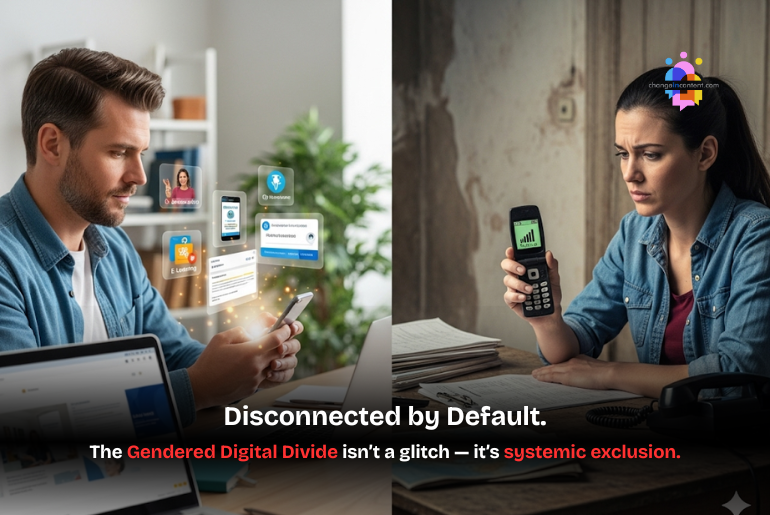
The gendered digital divide isn’t about Instagram crashing or a dead battery. Instead, it is about millions of women never getting online in the first place. While men scroll, trade, study, and earn, many women are left with basic handsets, no data, and no digital skills. This isn’t just a tech story. It’s an equality story.
Introduction to the gendered digital divide
We panic when our phone dies or when there is a network outage, right? It’s hard to imagine going even a few hours without our smartphones. When Instagram crashes, people lose their minds. Digital technology, including the internet and mobile phones, has become an integral part of our daily lives and has spread everywhere. It connects us to information, makes life a lot easier, and is even cost-efficient in many ways.
Think about it. When you see something in a store, chances are you check online to compare prices before making a purchase. Banking has also gone digital, and you could even finish KYC checks from your couch.
Yet, not everyone has equal access to digital technology. Multiple studies and surveys indicate that women are still lagging behind men in internet usage and smartphone ownership, particularly in low- and middle-income countries. Women here are 8% less likely to own a mobile phone. Around 405 million women still don’t have one at all.
What the Mobile Gender Gap Report 2025 says on digital inequality
The GSMA Mobile Gender Gap Report 2025 is based on over 17,000 face-to-face surveys conducted across 15 low- and middle-income countries. The findings show that progress in closing the gender gap in mobile internet use has stalled. The gender gap in mobile ownership stayed at 8% in 2024, while the gap in smartphone ownership remained at 14%.
Yes, more women are online than before, but the rate of new adoption has slowed. Women are now 14–15% less likely than men to use mobile internet, leaving 235 million women not digitally connected compared to men. Currently, 74% of men in the low- and middle-income countries use mobile internet compared to only 63% of women.
Out of the 885 million women who still don’t use mobile internet, nearly 60% live in South Asia and Sub-Saharan Africa. These regions also have the widest gender gaps in mobile internet adoption, at 32% and 29%, respectively.
The gender gap in smartphone ownership
The kind of phone a person owns decides how much they can do online. A basic phone limits users to calls and texts, keeping internet use low. Feature phones provide limited access, albeit with restrictions. Smartphones, on the other hand, offer access to a wide range of services, including social media, digital payments, and learning platforms.
Many women still don’t own smartphones, and among those who do, a significant share don’t use mobile internet. In fact, 13% of women smartphone owners in India remain offline, and two-thirds of them are unaware that they can access the internet on their devices. Among Indian men who own smartphones, only 9% stay offline, and most of them are at least aware of mobile internet.
Across most middle-income countries, 61% of women and 71% of men now own a smartphone. That’s nearly 1.5 billion women with smartphones, but 945 million still don’t have one.
In India, 115 million women bought smartphones in 2023, but this number dropped to 45 million in 2024. For men, the number of new buyers decreased from 95 million in 2023 to 65 million in 2024. Even with this drop, men still bought more smartphones than women in 2024.
Gender gap in digital access creates a gap in meaningful digital use
The divide between men and women is not only about who owns a phone but also how they use it. Studies show that women often have less advanced devices, which limits their ability to explore the full range of digital services. Many people rely on basic phones for calls and SMS, while men are more likely to use smartphones for tasks such as banking, learning, entertainment, and work-related activities.
For example, a woman with a basic handset may only use her phone to stay in touch with family, while a man with a smartphone can attend online classes, pay bills, or apply for jobs. Women also tend to use digital services less often and for fewer reasons, which limits their access to opportunities.
There is still limited research on how this gap affects children under 18. However, approximately 46% of boys use the internet on their phones for useful online activities, such as learning, skill-building, or accessing information, while only 27% of girls do.
Why digital gender equality matters
The benefits of digital gender equality are no longer about just owning a phone or going online. Studies show that when women own mobile phones and use the internet, they gain more control over their health and financial decisions. They also stay better connected with their communities, which helps them share important information, such as information on sexual and reproductive health.
The economic price of the gendered digital divide
Digital access also plays a significant role in combating poverty and enhancing women’s economic empowerment. Online platforms create flexible ways to network, learn, and earn. Digital literacy has become a crucial skill for job opportunities and career advancement. Today, over 90% of jobs worldwide need some level of digital ability. While a few roles require advanced skills, most jobs and daily tasks only require basic digital know-how to participate in a digital economy.
Without better access and digital use, young girls and women will continue to face barriers to education, job opportunities, and financial stability.
Gendered digital divide, and why it matters: Conclusion
The GSMA report concludes that achieving gender equality in mobile internet adoption across low- and middle-income countries could add $1.3 trillion to global GDP between 2023 and 2030. Perhaps the most important outcome of it all is that when women gain access to digital technology, they gain more than a device. They gain access to healthcare information, online learning resources, and financial tools, and become more empowered.
However, progress is stalling. Millions of women remain unconnected, and even those who own smartphones often lack awareness or digital skills to use them fully. That is why there is an urgent need to ensure affordable access, digital literacy, and equal opportunity, so women can fully participate in the digital economy and benefit from its opportunities.
Changeincontent perspective
At Changeincontent, we see technology as a mirror. It reflects society’s progress and its prejudices. The Gendered Digital Divide is not just about connectivity gaps; it is about power, autonomy, and who gets to belong in tomorrow’s economy. Closing the gap means more than handing out devices. It means rewriting who the internet is built for.
Also Read: The growing threat of online abuse against women.
Disclaimer: The views expressed in this article are based on the writer’s insights, supported by data and resources available both online and offline, as applicable. Changeincontent.com is committed to promoting inclusivity across all forms of content. We broadly define inclusivity as media, policies, law, and history. It encompasses all elements that influence the lives of women and marginalised individuals. Our goal is to promote understanding and advocate for comprehensive inclusivity.