
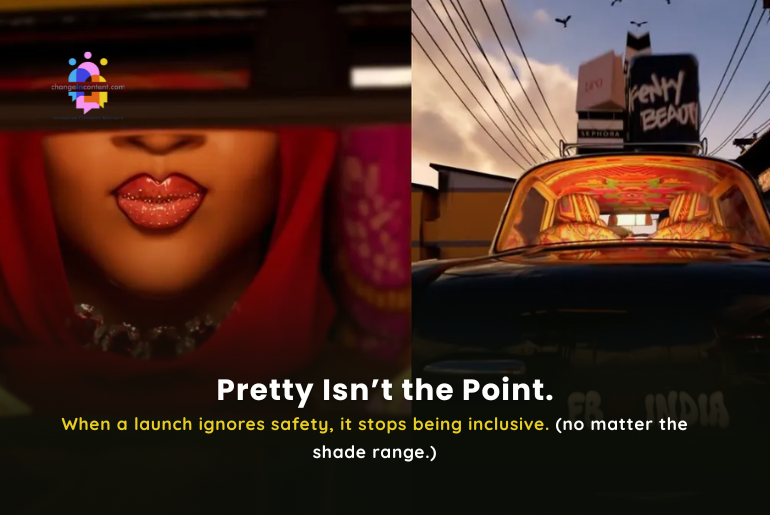
The Fenty Beauty India Campaign wanted whimsy; the internet saw a warning sign. In a country where women plan cab rides like risk assessments, the taxi-mirror moment didn’t read as flirtation; it read as fear. This piece explores why a 10-second visual struck a raw nerve and what “inclusive” truly means in India.
When global pop icon Rihanna launched Fenty Beauty (stylised as FEИTY BEAUTY) in 2017, the brand immediately gained worldwide recognition for its diverse shade range, inclusive approach, and commitment to customisation. While Rihanna’s celebrity status drew initial attention, the products themselves, known for quality and diversity, made Fenty a superhit in the global beauty market.
Fenty Beauty India Campaign: The backstory
It is no surprise that Fenty Beauty continues to grow globally and expand its offerings to new markets, including India. The brand’s India launch comes through partnerships with leading retailers such as Tira and Sephora. Fenty products will be available exclusively at Sephora India, which Reliance Retail acquired in 2023, and at Tira Beauty, the company’s own beauty retail chain, launched the same year.
Teasers rolled out online, promising a launch worth remembering. However, what should have been a grand launch showed poor representation of women and came across as tone-deaf to the serious safety issues they face in India.
The advertisement that sparked debate
The campaign presented itself in a vibrant, cartoon-like style. It opened with Rihanna stepping into a classic black-and-yellow taxi, a visual nod to Mumbai’s iconic street scene. Her luggage bore the Fenty Beauty name, symbolising the brand’s arrival in India. Up to this point, the concept was going ok.
Then we see Rihanna in the back seat, wearing her signature Fenty glossy lipstick, with the taxi driver watching her through the rear-view mirror as she blows a kiss. The campaign might have intended to create a playful moment, but actually, the scene trivialised a serious issue by presenting the male gaze as harmless.
In reality, many women experience discomfort, fear, or even harassment when drivers stare at them through the rear-view mirror. Linking such a moment to glamour and fun ultimately overlooks the real safety concerns that women face daily in public transport across India.
Out-of-touch cultural representation
The ad’s issues go beyond how it represents women. The background music has an Arabian-inspired tune, which feels out of place for a campaign about entering the Indian market. The colours and visuals also follow an “Arabian Nights” style. In a country as culturally diverse as India, details and authentic representation matter.
Data speaks: Why women don’t feel safe after 8 p.m.
For many women in India, the gaze of a taxi or rideshare driver through the mirror is not a playful moment. It is always a feeling of discomfort and fear. Women do not wear makeup to entertain male drivers, nor do they express affection toward strangers behind the wheel. To suggest otherwise reflects a careless disregard for everyday safety concerns.
According to a report by Ola Mobility Institute, only 9% of women feel India’s public transport is “very safe.” The survey covered 11 cities, including Delhi, Mumbai, Hyderabad, Bengaluru, and Chennai, highlighting widespread safety concerns across urban centres.
Another survey conducted by Youth Ki Awaaz and the Observer Research Foundation revealed that 90% of women feel unsafe travelling after 8 p.m. Most respondents preferred commuting between 9 a.m. and 5 p.m., with 71% saying they felt safest during daylight hours. Less than 1% reported feeling secure travelling between midnight and 7 a.m., and nearly half identified this time window as the most unsafe.
Do not trivialise women’s safety issues
The risks are not hypothetical. Cases of harassment involving cab drivers appear frequently in the news. There are countless stories on Reddit about how Rapido drivers continue to call and message women after dropping them off. Even more serious, on June 19, 2025, Mumbai police arrested an Uber driver and two others for the sexual harassment of a 28-year-old woman airline pilot during her ride.
Do you also know there are literal articles online titled Safety Tips for Female Solo Travellers When Travelling Alone in Indian Cabs? A woman definitely does not blow a kiss to the cab driver. Instead, she follows a checklist of precautions: verifying the driver’s identity and vehicle details, sharing ride information with a trusted contact, and ensuring the child lock is disabled so the door can be opened from the inside. Many also share their live location with family or a local guardian, ready to call for help if needed.
Given this sad reality, portraying a taxi driver observing a woman through the mirror, no matter how stylised or playful the intent, feels tone deaf.
Fenty Beauty India Campaign: The final thoughts
While Fenty Beauty has consistently presented its products as inclusive and diverse, the India launch advertisement shows how poorly things can go when women are misrepresented. Representation is not just about showcasing diversity in skin tones. It is also about respecting the lived experiences of women and ensuring their realities are not trivialised for the sake of aesthetics or playfulness.
Changeincontent perspective
At Changeincontent, we’re not anti-playful; we’re anti-careless. India is not a monolith, but there is a shared vocabulary of risk that many women understand too well. If beauty wants to sell “confidence,” it must also respect context. The Fenty Beauty India Campaign is a reminder: representation is not only about shade ranges; it’s about lived realities.
Also Read: Why Anomaly’s sustainable and inclusive approach is the future of the beauty industry.
Disclaimer: The views expressed in this article are based on the writer’s insights, supported by data and resources available both online and offline, as applicable. Changeincontent.com is committed to promoting inclusivity across all forms of content. We broadly define inclusivity as media, policies, law, and history. It encompasses all elements that influence the lives of women and marginalised individuals. Our goal is to promote understanding and advocate for comprehensive inclusivity.
