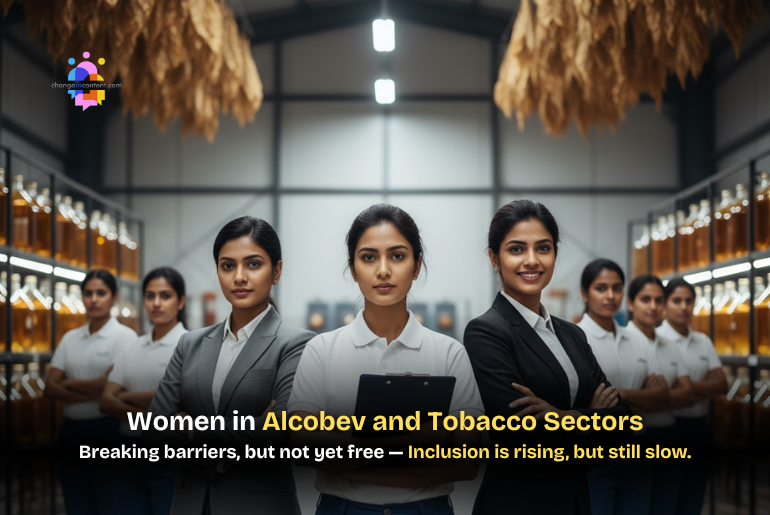
The rise of women in alcobev and tobacco sectors is more than a hiring statistic; it signals a cultural shift in industries long defined by stigma and exclusion. As companies like ITC, United Breweries, and United Spirits open doors wider than before, the narrative is changing. But beneath the progress lies a sobering reality: inclusion remains slower here than in FMCG and other consumer-driven industries.
The alcoholic beverage (alcobev) and tobacco industry has traditionally been a boy’s club. The gender gap has existed not only in India but across the world. For years, society judged women for drinking or smoking, often labelling it as inappropriate or even sinful. Naturally, the idea of women building careers in this space, especially in senior roles, faced strong resistance. However, the latest reports indicate that major alcohol and tobacco companies, such as ITC, United Breweries, and United Spirits, are hiring more women across various roles, building inclusive teams, and setting long-term goals for equal leadership representation.
Rising representation of women in alcobev and tobacco sector
India’s alcobev and tobacco companies now hire more women than in previous years. A younger workforce has helped reduce social stigma, prioritising inclusive workplaces and professional growth over old perceptions.
“While the stigma around alcobev and tobacco is still there in some circles, on the whole, it is fading,” said Deepika Ramani, Partner, Consumer, at ABC Consultants. “The younger generation, in particular, is looking for inclusive culture, growth opportunities and whether the organisation aligns with their values. They care much more about these facets than the product.“
At ITC Ltd, women comprised 17% of permanent employees in FY25, compared with 10% in FY20. Nearly 30% of fixed-term contractual roles are also held by women.
United Breweries reported a rise from 4.6% in FY20 to 25% in FY25. United Spirits, part of Diageo Plc, increased its female workforce from 19% to 28% during the same period.
Women in core roles: Sales, operations, and leadership
Women are now taking roles that were once out of reach. They work in sales, commercial operations, and other business areas that were long considered male spaces. We also had previously reported that women now constitute over 50% of the workforce at the Kerala State Beverages Corporation (BEVCO).
The scenario has changed over the past few years, evident in the sharp rise in applications during campus drives and lateral hiring. Companies that once struggled to attract women now see consistent interest across roles, including technical, commercial, and leadership positions.
“We’re seeing more women step into senior roles not just in marketing, HR, corporate affairs and digital, but also in core commercial functions like sales, a space that has traditionally been male-dominated and central to business,” said Ramani. “This is largely driven by global diversity, equity and inclusion mandates that are now being seriously implemented in India.“
United Spirits aims to increase women’s representation in its executive workforce to 33% by 2030 and achieve 50% representation in leadership positions.
Consumer link: More women buying, more women leading
The hiring drive also shows changing consumer behaviour. More women are now purchasing alcohol and tobacco products, creating a demand for insights that only diverse teams can provide. Companies recognise that effective branding, product design, and customer engagement require perspectives from those who understand this growing segment.
Industry experts note that organisations want women involved at every stage, from conceptualising flavours and packaging to designing marketing campaigns and sales strategies. Their input adds authenticity to products and campaigns designed for a broader consumer base. This approach is visible not just in corporate offices but also in factories and operational units across smaller towns.
“These industries have recognised that women are a significant and growing consumer base for their products. To effectively market to this demographic, they need women in the room,” said Saundarya Rajesh, Founder-President at Avtar Group.
But workforce inclusion is still slow compared to FMCG!
The alcobev and tobacco sector is gradually moving toward workforce diversity levels seen in fast-moving consumer goods (FMCG) companies, where women hold significant positions across roles. FMCG companies maintain a higher representation of women because their products, ranging from daily essentials to personal care, have long been seen as socially acceptable and widely marketed to women consumers. However, the alcobev and tobacco sectors were limited by the outdated perceptions about women’s association with these industries.
Hindustan Unilever reports that women make up 42% of its workforce, while Nestlé India records 50% representation on its board and 24% in permanent managerial roles. Britannia stands out with 44% of women in its factory workforce and 15% in managerial roles, with plans to increase these numbers to 50% and 20% by FY27.
In comparison, progress in alcobev and tobacco companies has been slower. Godfrey Phillips increased women’s representation from 5% to 6% over the past five years, while Radico Khaitan moved from 1.6% to only 2% during the same period. Around 11% of its workforce consists of women in non-permanent roles, showing that alcobev industry is still in the early stages of diversity levels seen in FMCG.
Rising number of women in alcobev and tobacco sectors: The final thoughts
The alcobev and tobacco sector has made progress, but it still lags behind FMCG in building a diverse workforce. Sustained progress will require companies to integrate diversity into long-term business strategy, with inclusive recruitment, career pathways, and no moral policing within the leadership teams. The goal is not to mirror FMCG but to adopt diversity as a fundamental business practice. Moreover, it is about ensuring that women contribute to innovation, decision-making, and growth at every level.
Changeincontent perspective
At Changeincontent, we see the journey of women in alcobev and tobacco sectors as a case study in how societal norms can delay inclusion. Progress is real, but systemic bias still lingers. It lingers in hiring numbers, leadership representation, and cultural perceptions. True equity will mean moving beyond tokenism and creating workplaces where women lead, innovate, and redefine industries that once excluded them.
Also Read: The rise of the female workforce in India: A milestone or just a statistical win?
Disclaimer: The views expressed in this article are based on the writer’s insights, supported by data and resources available both online and offline, as applicable. Changeincontent.com is committed to promoting inclusivity across all forms of content. We broadly define inclusivity as media, policies, law, and history. It encompasses all elements that influence the lives of women and marginalised individuals. Our goal is to promote understanding and advocate for comprehensive inclusivity.