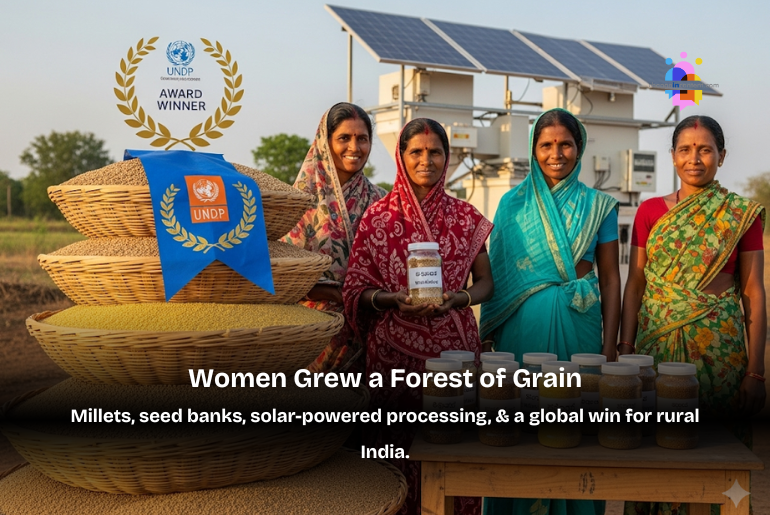
The recognition for Bibi Fatima SHG is a lot more than just a feel-good headline. It is proof that women-led collectives can simultaneously scale sustainable agriculture, protect biodiversity, and build rural economies. This award shines a light on how smallholder women farmers, equipped with seed banks, millets, and access to clean energy, can achieve what policy papers often only promise.
Bibi Fatima SHG: From local collective to global recognition
The Bibi Fatima Women’s Self-Help Group (SHG) from Teertha village in Karnataka’s Dharwad district has won the United Nations Development Programme (UNDP) Equator Initiative Award 2025. Often referred to as the “Nobel Prize for Biodiversity Conservation,” this award recognises community-led, sustainable projects that restore ecosystems while supporting local livelihoods. The awards were announced on International Day of the World’s Indigenous Peoples, celebrating projects rooted in local knowledge that restore ecosystems and support long-term sustainable development.
Selected from over 700 nominations across 103 countries, Bibi Fatima SHG earned a place among ten global winners representing Argentina, Brazil, Indonesia, and Kenya. Apart from a cash prize of USD 10,000, the UNDP Equator Initiative Award places this Indian women-led farming collective on the global stage for their groundbreaking millet revival, eco-friendly farming practices, seed conservation, and women-led entrepreneurship.
From 15 women to 5,000 farmers: A rural movement rooted in sustainability
When the Bibi Fatima SHG began in 2018, it consisted of only 15 women. The women came together to improve the livelihoods of small and marginal farming families through sustainable agriculture. Instead of relying on high-input, chemical-intensive farming, they opted for natural methods that protect soil health and ensure long-term productivity. They worked on rainfed lands where water was scarce and risks were high. However, instead of complaining, they reintroduced millet-based mixed cropping systems.
Soon, their efforts expanded to 30 villages, involving over 5,000 farmers. They added livestock rearing, horticulture, and food processing to create more income streams. Most importantly, unlike urban start-ups chasing billion-dollar valuations, these women chose sustainability.
The woman behind this sustainable movement is Bibi Fatima, a graduate from Teertha who has spent years empowering rural women through farming and entrepreneurship. With the support of NGO Sahaja Samrudha, she not only founded her own SHG, Bibi Fatima Swa Sahaya Sangha, but also facilitated the creation of six others in Shiggon and Kundgol taluks.
How Bibi Fatima SHG turned millets into a movement
Millets were once a dietary staple in many parts of Karnataka, but over time, these hardy grains got sidelined in favour of water-intensive crops. However, with erratic weather, poor rainfall, and rising cultivation costs, water-intensive crops were far from sustainable. The Bibi Fatima SHG recognised that millets were always a better alternative. Millets require less water, withstand erratic weather, and have high nutritional value, something these women understood before most policymakers did.
With support from Sahaja Samrudha, the Indian Institute of Millets Research (IIMR) in Hyderabad, and CROPS4HD, the group introduced natural farming techniques to revive millet-based mixed cropping systems. These techniques have brought biodiversity back to farmlands, improved food security, and reduced dependence on chemical fertilisers.
To complement their farming activities, the SHG established a solar-powered millet processing unit with assistance from the Selco Foundation. This facility, managed entirely by women, is now an example of decentralised, clean-energy-based rural women entrepreneurship.
Preserving diversity through seed banking
One of the group’s most significant contributions is the establishment of a community seed bank in 2019. Far from being a small storeroom, it is a repository of over 300 seed varieties, including 75 types of finger millet, 25 types each of little millet and brown top millet, 10 types of foxtail millet, and two of proso millet. The collection also includes pulses and vegetables, creating a safety net for future farming seasons.
Seed banks may sound like a niche agricultural experiment. Yet, they have become crucial for maintaining crop diversity and protecting small farmers from the risks of monoculture and the climate crisis. Properly stored, these seeds can last for years, ensuring that genetic lines remain available for future cultivation.
Processing, Branding, and Market Access
In 2021, with financial support from ICAR-IIMR, the group installed nine millet processing machines. Under Bibi Fatima’s leadership, the unit began producing value-added products, including ragi dosa mix, multigrain atta, millet malt, and flour blends. The group did not limit itself to food products alone. They diversified into natural soaps made from papaya, neem, tulsi, turmeric, and aloe vera, items that cater to growing demand for chemical-free alternatives.
These products have been displayed at events like Hampi Utsav, where visitors could not only taste the results of sustainable farming but also witness a rural, women-led business model that turns heritage grains into modern yet sustainable lifestyle products.
The final thoughts
With the prize money, Bibi Fatima SHG intends to further invest in its seed bank, upgrade processing units, and train more marginalised women and youth in sustainable farming practices. The plan includes expanding the reach of value-added products to urban markets where demand for millet-based foods and organic goods is rising. More importantly, the recognition has inspired neighbouring villages to consider similar approaches, creating a ripple effect that could build sustainable local agricultural practices in parts of India.
The story of Bibi Fatima SHG tells us that sustainability need not come from large-scale industrial farming or expensive interventions. Sometimes, it grows from small collectives that value women’s leadership in the economy.
Changeincontent perspective
At Changeincontent, we see the Bibi Fatima SHG model as a quiet revolution: community-first, climate-smart, and women-led. Awards are great; replication is better. The next step is to fund and establish market linkages that enable thousands more women-led SHGs to build seed sovereignty, local processing, and dignified income at scale.
Disclaimer: The views expressed in this article are based on the writer’s insights, supported by data and resources available both online and offline, as applicable. Changeincontent.com is committed to promoting inclusivity across all forms of content. We broadly define inclusivity as media, policies, law, and history. It encompasses all elements that influence the lives of women and marginalised individuals. Our goal is to promote understanding and advocate for comprehensive inclusivity.