
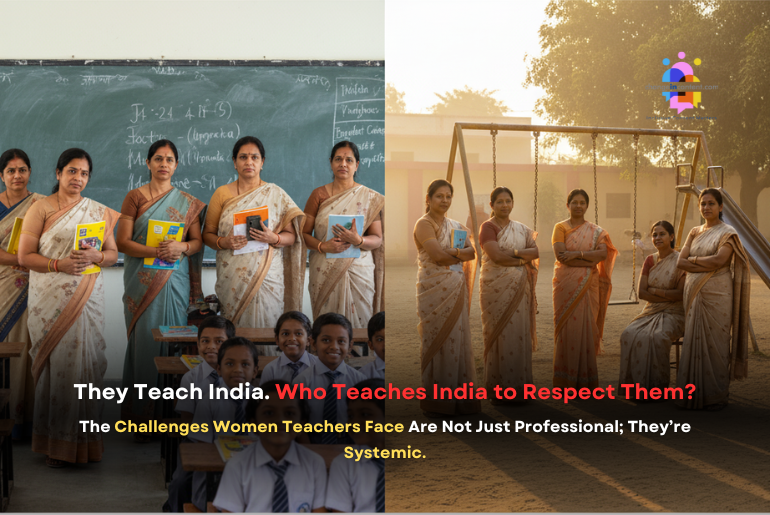
The challenges that women teachers face in India go far beyond lesson plans and exam schedules. They carry the weight of building futures while often navigating job insecurity, wage gaps, and gender bias themselves. On Teacher’s Day, these stories deserve as much attention as their contributions.
Women Teachers: Backbone of schools, yet overlooked
Every year on September 5, India celebrates Teacher’s Day to honour teachers across the country. The day marks the birth anniversary of Dr. Sarvepalli Radhakrishnan, an eminent educationist and former President of India. When his students and friends once wished to celebrate his birthday, Dr. Radhakrishnan suggested that instead of celebrating the day as his birthday, it would be a greater privilege if September 5 were observed as Teachers’ Day.
As we honour teachers on this day, it also becomes necessary to confront the issues women teachers continue to experience despite being a large part of the teaching workforce.
Women in the school education system
According to the UDISE+ 2023–24 report, women now form 54.2% of the total teaching workforce in India. This feminisation of school teaching has become more visible in recent years, especially in government primary and secondary schools. Private schools, particularly at the primary level, have long preferred to employ women, often at lower wages.
However, only 45% of women teachers work in rural areas, compared to 57% of men. The representation of women in secondary schools declines further, with only 25% of teachers teaching in rural locations. Alarmingly, there is a near-complete absence of women as physical education teachers in rural areas.
Representation challenges that women teachers face
Representation also varies by social group. Women teachers from Scheduled Tribes (32%) and Scheduled Castes (15%) are more visible in rural areas but remain underrepresented in urban schools. On the other hand, women from other social categories dominate urban teaching positions, comprising approximately 44% of the workforce.
Higher education and gender gaps
The gender disparity is more in the higher education teaching group, where women no longer hold the same presence they do in schools. The All India Survey on Higher Education (AISHE) 2021–22 reveals that women comprise only 43% of faculty members in universities and colleges. In elite institutions like IITs and NITs, women faculty members make up less than 20%. Less than 25% of full-time professors in public universities are women, and fewer than 10% of vice-chancellors in India’s top 50 universities are women.
The US and the UK also struggle with low representation of women professors in STEM. However, the scale of underrepresentation in India is even more serious. A BiasWatchIndia study covering 98 universities and institutes between June 2020 and December 2021 found that only 13.5% of STEM faculty were women, with engineering showing the lowest share at 9.2%. Biology stands out with 25.5% representation, but this is often dismissed as a “soft science,” mostly due to the stereotype that women are more suited for certain subjects.
Contracts, employment security, and pay gaps
Employment security remains a major concern for women in teaching. The 2021 UNESCO report says that 42% of Indian teachers, across private and government schools, work without a formal contract and earn less than ₹10,000 per month. In government primary schools, 32% of women reported working without contracts compared to 19% of men. In private schools, over 50% of teachers, especially women, reported working without any contract.
Only 6 to 24% of private school teachers report having contracts longer than three years. Gender differences are notable here. In government schools, 30% of women teachers in ECCE work without contracts compared to 24% of men. Among secondary school teachers, 28% of women are without contracts compared to 21% of men.
Although more than 94% of teachers in India are in regular wage employment, the proportion drops for women compared to men in certain roles, particularly in rural schools. Fields such as music, art, and drama exhibit higher levels of casual employment. This casualisation of women’s employment suggests that the feminisation of teaching, especially in low-fee private schools, is not necessarily empowering. Instead, it often reflects institutions hiring women at lower wages under less secure terms.
The unequal journey of women teachers
One of the biggest obstacles women teachers face is bias in recruitment and promotions. Even today, women still face challenges in advancing up the career ladder, as committees often view them through outdated stereotypes rather than evaluating them on merit. This creates an invisible ceiling that limits how far they can advance, regardless of their performance.
Career breaks, especially those taken after maternity leave, reduce the chances of women securing tenure or advancing to senior roles. According to NITI Aayog, women faculty often take longer breaks, which slows their progression compared to their male counterparts. There is also the dual burden of professional and household responsibilities.
Balancing classrooms and caregiving
Many women shoulder a disproportionate share of domestic work. That leaves them with less time for research, conferences, or networking opportunities. Men in the same profession are rarely expected to manage this additional workload.
The University Grants Commission (UGC) mandates that every university establish an Internal Complaints Committee (ICC) to address cases of sexual harassment and maintain a safe work environment. However, a 2019 UGC report showed that more than half of Indian universities had not set up an active ICC. Without these committees, women faculty and staff lack a proper system for reporting grievances, which discourages them from pursuing academic careers.
Final thoughts on the challenges that women teachers face
Teacher’s Day is not only about honouring the contribution of educators but also about recognising their struggles. Women form the backbone of school education in India, yet many work under contracts with no job security and low wages.
Teacher’s Day should not only be about giving thanks, flowers, or chocolates to teachers. Instead, it should also be used as an opportunity to address the challenges that teachers in India face. Recognising their contribution on one day is meaningful, but real change comes when workplaces adapt to their needs.
Changeincontent perspective
At ChangeInContent, we believe celebrating teachers means more than flowers once a year. It means confronting the inequality they face every day. Women teachers are not just shaping classrooms, but holding up the very foundation of India’s education system, often with little support in return. Until we fix the structures around them, their dedication will continue to be exploited, not honoured.
Also Read: Period poverty and the school dropout crisis.
Disclaimer: The views expressed in this article are based on the writer’s insights, supported by data and resources available both online and offline, as applicable. Changeincontent.com is committed to promoting inclusivity across all forms of content. We broadly define inclusivity as media, policies, law, and history. It encompasses all elements that influence the lives of women and marginalised individuals. Our goal is to promote understanding and advocate for comprehensive inclusivity.
