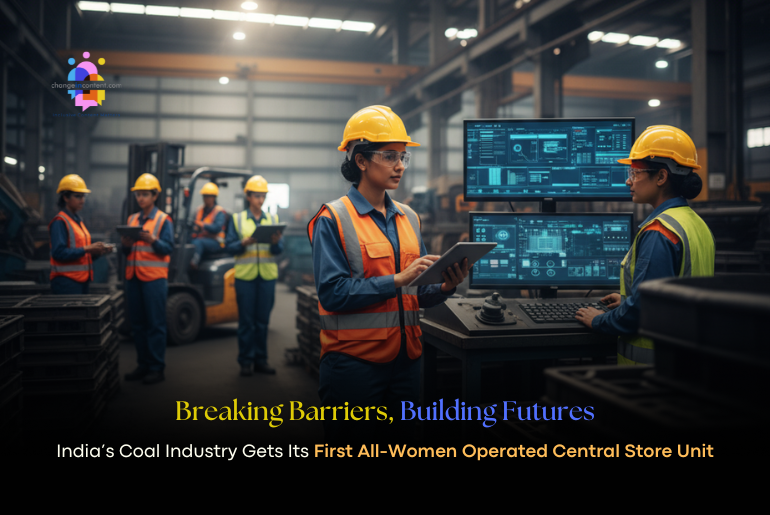
India’s coal sector, long seen as a male-dominated industrial fortress, has just taken a transformative step. On 5 October 2025, South Eastern Coalfields Limited (SECL), a subsidiary of Coal India Limited (CIL), inaugurated Coal India’s first all-women-operated central store unit at its Central Workshop in Korba, Chhattisgarh.
The initiative, launched under the Government of India’s Special Campaign 5.0, is more than just symbolic; it is structural. By entrusting an entire operational hub to women, SECL has signalled that gender inclusion in core industries must go beyond token representation. This marks a bold move towards normalising women’s leadership in one of the country’s most physically and technically intensive sectors.
Beyond symbolism: The story behind the central store unit
This milestone follows SECL’s earlier success with Coal India’s first all-women-operated dispensary in Bilaspur. It demonstrates the company’s growing commitment to gender parity within its operations.
The newly inaugurated Central Store Unit is led by Ms Sapna Ikka, Senior Manager (E&M) and an alumna of IIT (ISM) Dhanbad. She heads a team of eight women officers and staff responsible for the supply of spare parts and inventory management. These are functions crucial to the seamless operation of mining operations.
What sets this initiative apart is its integration of technology. The facility operates through a modern SAP-based digital platform, ensuring transparency, traceability, and efficiency. It illustrates how gender inclusion and digital transformation can work in tandem to modernise legacy sectors.
Recognition from the top
The inauguration was marked by the presence of SECL’s top leadership, including Shri Harish Duhan (CMD), Shri N. Franklin Jaykumar (Director – Technical/Operations), Shri Biranchi Das (Director – HR), Shri R.C. Mahapatra (Director – Technical/Planning & Projects), and Shri Himanshu Jain (Chief Vigilance Officer).
During his address, CMD Shri Duhan said:
Following the success of the women-operated dispensary at Bilaspur, we are proud to see women taking charge of a core operational unit at Korba. Such initiatives resonate with the vision of Union Minister of Coal, Shri G. Kishan Reddy, who emphasises enhanced participation and leadership of women in the coal sector.
The women employees of the workshop were also felicitated for their exceptional contributions. It is a reminder that recognition plays a crucial role in retaining and motivating women in industrial roles.
Reimagining inclusion in core industries
For decades, coal mining and associated industries have represented one of the most rigid gender divides in India’s workforce. Women’s participation was largely limited to administrative or medical roles. But the SECL initiative disrupts this pattern. It underscores that leadership and operational excellence are not gender-bound; they are capability-driven.
What is equally significant is that this move comes not as a corporate CSR initiative, but as part of core business restructuring. By institutionalising all-women teams in essential operational units, Coal India is setting a precedent for what true inclusion in industrial ecosystems can look like. It is functional, measurable, and replicable.
A step towards sustainable inclusion: Coal India’s first all-women-operated central store unit
The establishment of Coal India’s first all-women-operated central store unit at SECL Korba is a step forward. However, it is not the destination. It signals a shift in mindset, where inclusion is being integrated into operational design rather than being relegated to public relations campaigns.
For ChangeInContent, this represents the kind of systemic shift we advocate for. That is where “Nari Shakti” is not a slogan, but a structural reality. As India’s core industries evolve, the question now is not whether women can lead, but how many more such milestones we can create and sustain.
Related Article: The rise of the female workforce in India: A milestone or just a statistical win?
Disclaimer: The views expressed in this article are based on the writer’s insights, supported by data and resources available both online and offline, as applicable. Changeincontent.com is committed to promoting inclusivity across all forms of content. We broadly define inclusivity as media, policies, law, and history. It encompasses all elements that influence the lives of women and marginalised individuals. Our goal is to promote understanding and advocate for comprehensive inclusivity.