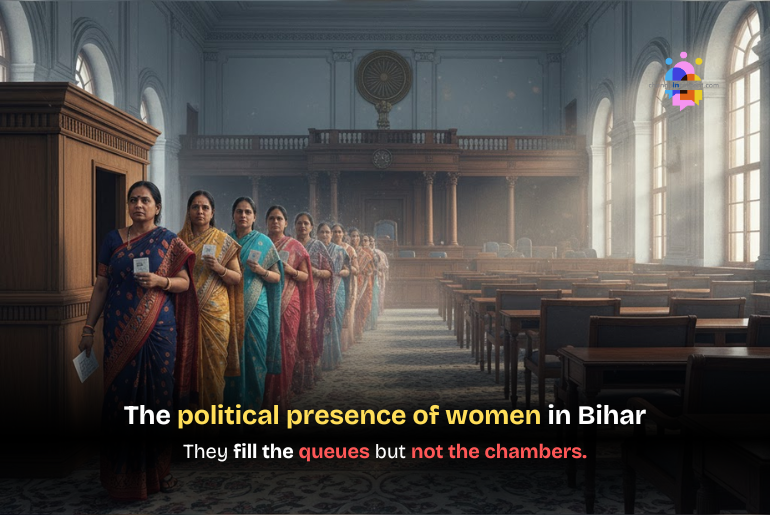
In our previous feature, we highlighted how Bihar’s women voters changed the course of the 2025 Assembly Election. They recorded a 71.8% turnout, the highest in state history. Their participation was not symbolic; it determined who would form the government. Yet, when the results arrived, the celebration turned into a question on the political presence of women in Bihar. At changeincontent, we ask: Where did all those women go?
Despite being half the electorate, women now make up only 12% of Bihar’s new Assembly, roughly 29 out of 243 MLAs. In a state where women queued in the millions to vote, their presence in the halls of power remains strikingly small.
This is not just a political gap. It is a democratic contradiction.
Record women voters, but only 12% women in the new assembly
The results of the 18th Bihar Legislative Assembly were released on November 14, 2025. The assembly has 243 elected seats. Out of the 250 MLAs who served in the previous term, 192 entered the 2025 race again. Of these, 111 won another term, which is about 58%.
Only about 12% of the new assembly are women, which means roughly 29 women won seats. The previous Assembly had 26 women members. Among these 29 women, 13 fall within the 25-39 age group, while 9 fall within the 40-54 age group. Younger women continue to enter electoral politics, although their overall presence remains limited.
Now, look back at voter turnout. The 2025 Bihar election recorded the highest number of women voters in the state’s history. Yet, at the same time, the state saw the lowest number of women candidates in 15 years.
Declining representation of women candidates
One of the most significant reasons for the declining political presence of women in Bihar is the lack of candidature. Women voters make up almost 48% of Bihar’s electorate, yet the number of women candidates remains low. This year, 2,615 people entered as candidates, and only 258 were women, while 2,357 were men. The BJP fielded 13 women and more than 225 men. JD(U) also fielded 13 women, a clear drop from its 22 in 2020. Congress had only 5 women candidates.
On the other hand, BSP had the highest count of women candidates at 26. Even so, the gap remained large, as most parties still listed more than 200 men and kept their male numbers well above double digits. None of them brought the number of male candidates anywhere close to the single- or low double-digit range.
What previous elections say about the political presence of women in Bihar
A look at previous elections explains how women’s representation in the elections as well as the Assembly drops further over time. In 2020, 370 women contested for 243 seats, a nearly 36% increase from the previous election. In 2015, the number stood at 343, but in 2010 it was 368. The number of women contesting elections goes up in some years and goes down in others, but even at its highest point, the number is still far lower than it should be.
Smaller candidate pools keep women out of legislative seats
Women enter elections in smaller numbers and face tougher paths to victory. So women have a harder time turning a candidacy into an actual win. This does not happen because women lack ability. It happens because they often have fewer resources, weaker support from party networks, and less visibility in campaigns.
In 2020, 26 women out of 370 candidates won, giving them a success rate of about 7%. Men reached close to 10%. In 2015, 28 women out of 273 won, which again placed them near 10%.
A success rate of 7% for women and 10% for men may make the gap seem small. However, hundreds more men enter the race, so even a 10% success rate brings a large number of male winners. Women contest in much smaller numbers, so a 7% or even a 10% success rate gives them far fewer seats. This is why the overall presence of women in the assembly stays low, even when their success rate seemingly appears close to that of men.
Representation gap for marginalised women in state politics
Another angle to consider is the position of women from marginalised communities in state politics. Scheduled Castes (SCs) make up about 19.65% of the population, or nearly 2.6 crore people. The share of SC women in the last assembly was about 2.8%, which is very low given their population size. In the 2025 assembly, 29 women hold seats out of 243. Out of these, five come from SC-reserved constituencies. The share of Scheduled Tribe women was even smaller, at just 0.4% in the last assembly.
While Muslim men find a seat, Muslim women are left out
Muslim women see the same kind of gap. According to the 2022–23 state caste survey, Muslims form 17.7% of the state’s 13.07 crore population. Yet the number of elected Muslim MLAs dropped to 11 in 2025, marking the lowest count in years and a decline of about 42% from the 2020 assembly. Once again, not a single Muslim woman reached the assembly.
The last time Muslim women won seats was in 2010, when two candidates entered the assembly: Razia Khatoon from Kalyanpur in East Champaran and Parveen Amanullah from Sahebpur Kamal in Begusarai. Both contested on JD(U) tickets. In 1937, Anees Fatima became the first woman MLA in the state after contesting and winning as an independent candidate.
When women from marginalised communities, especially SC, ST, and Muslim groups, remain almost invisible in decision-making spaces, it limits whose needs and experiences are reflected in policy.
Conclusion: Representation is the next revolution
The 2025 election shows two very different realities. Women are voting in record numbers, shaping outcomes and proving their strength as a political force. Yet this influence does not carry forward into the assembly, where their presence remains small and uneven. The gap becomes even wider for women from marginalised groups, who continue to be left out almost entirely.
This mismatch between participation and representation affects the kinds of policies that get attention, the lived experiences that enter public debate, and the priorities that shape governance. Closing this gap will require more than high voter turnout from women.
Parties must put forward more women candidates, support them through campaigns, and ensure that women from all backgrounds have a fair chance. Only then will the assembly reflect the people who vote for it, and only then will women’s political power translate into women’s political presence.
Changeincontent perspective
At Changeincontent, we believe democracy cannot be called inclusive if half its voters remain spectators in governance.
The story of the political presence of women in Bihar is not about capability, but about access. Women are turning up at polling booths with determination, but their numbers vanish in the corridors of policy.
This is what happens when political parties celebrate women voters but fail to trust women leaders. When their faces appear in campaign posters but not in cabinet meetings.
Bihar has shown that women can decide elections. It is now time for its politics to show that it can trust them to lead.
Disclaimer: The views expressed in this article are based on the writer’s insights, supported by data and resources available both online and offline, as applicable. Changeincontent.com is committed to promoting inclusivity across all forms of content. We broadly define inclusivity as media, policies, law, and history. It encompasses all elements that influence the lives of women and marginalised individuals. Our goal is to promote understanding and advocate for comprehensive inclusivity.