
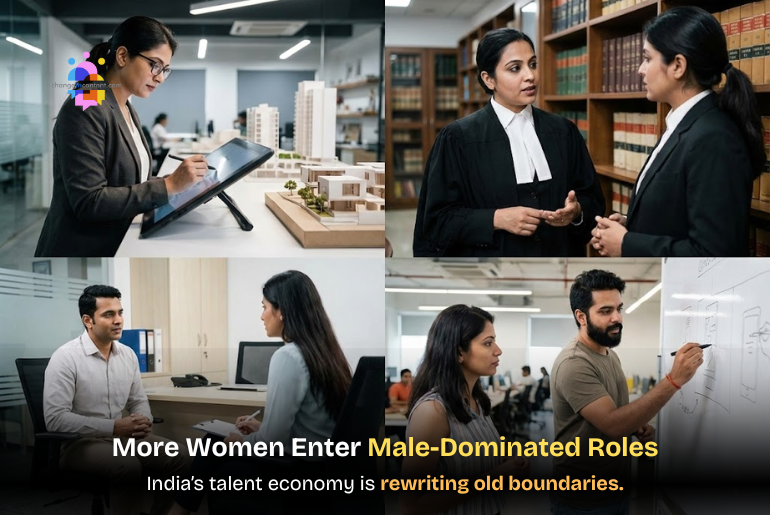
A new WorkIndia report shows a striking shift in India’s labour market: More women enter male-dominated roles than ever before. Combined with the latest Periodic Labour Force Survey (PLFS) from the Ministry of Statistics and Programme Implementation, the data points to a workforce where gender boundaries are slowly but steadily dissolving.
Between July and September 2025, India’s women’s labour force participation rate rose to 33.7%, and the unemployment rate for women dropped to 3.2%. That is one of the lowest in recent years.
The trend is more apparent than ever. Women are moving into high-skill, specialised, and previously male-led fields, while men are stepping into professions long labelled as “women’s work.” India’s job market is quietly reshaping its gender map.
More women enter male-dominated roles: Engineering-aligned creative and technical design roles
A new report from the recruitment platform WorkIndia shows that more Indian women are moving into high-skill, engineering-aligned creative roles. The platform studied hiring data from 2024 and 2025 and found that women’s participation in engineering-aligned creative and technical design roles increased 98% over the previous year.
In technical design, women’s applications increased 87%, and employers responded by raising openings by 34% in 2025. This also indicates the tech industry’s acceptance and readiness to recruit more women for roles that require specialised knowledge, software proficiency, and a strong design-to-engineering interface.
Why women are missing from India’s core design jobs
People often assume women dominate design, but in reality, women are underrepresented in many important design roles. In technical areas such as product design, industrial design, architecture, or tech-heavy creative roles, women remain far fewer than expected.
A 2021 report by the National Design Council of India shows that women hold only 20% of design roles nationwide. In 2025, even though women make up 65% of students in design colleges, they account for only 35% of the professional design workforce. The student-to-workforce ratio imbalance is that many do not enter or stay in the design workforce. They face workplace bias, family pressures, slower promotions, and unequal pay.
Men enter HR and creative roles, once seen as women’s work
Men are also stepping into fields long seen as women-led. Data shows that male applicants in Human Resources increased by 73% in 2025 compared to the previous year. There was also a 58% rise in HR job postings aimed at men. It shows that companies now want more gender diversity in recruitment, training, and people operations.
Men are also entering Creative and Design roles in large numbers, with an 81% increase. Earlier, many men avoided these roles because they were often seen as “softer,” more artistic, or less technical. But now, men are choosing them more freely.
Women applicants in law jumped 137% in one year
WorkIndia’s report shows that the legal sector saw the highest rise in women applicants. Their applications for legal roles increased by 137% between 2024 and 2025, the largest jump across all industries covered in the study. At the same time, law firms are also creating space for women with a 55% rise in legal openings for women.
Earlier, women often entered law school but did not always continue into full-time practice due to long working hours, courtroom culture, and limited support. Now, more women are choosing legal careers, and more firms are opening up roles that match their skills and expectations.
WorkIndia CEO Nilesh Dungarwal said the country is moving toward a talent economy where ambition leads, and gender plays no role. “The rise of women in engineering-aligned creative roles and law, alongside men moving confidently into HR and beauty, shows that young Indians are rewriting long-held stereotypes. This shift is not temporary; it marks a permanent transformation in how the country views talent and opportunity.“
The closing thoughts
Both women and men are stepping out of the traditional boxes that once limited their career choices. Instead of choosing jobs based on gender norms, young workers now choose fields that align with their skills, interests, and long-term goals. They look for work that feels right for them, not for what society expects of them.
Changeincontent perspective
This data matters. When more women enter male-dominated roles, it signals a shift more profound than hiring trends. Instead, it reflects changing norms in families, workplaces, and society. But the real test comes next: whether organisations convert these entry-level gains into long-term retention, safety, and leadership opportunities. Gender progress is not measured by who applies; it is measured by who stays, thrives, and leads. India now stands at the edge of a cultural reset — if workplaces allow the momentum to continue.
Also Read: Women in plumbing: The need for redefining the role of women in a male-dominated industry.
Disclaimer: The views expressed in this article are based on the writer’s insights, supported by data and resources available both online and offline, as applicable. Changeincontent.com is committed to promoting inclusivity across all forms of content. We broadly define inclusivity as media, policies, law, and history. It encompasses all elements that influence the lives of women and marginalised individuals. Our goal is to promote understanding and advocate for comprehensive inclusivity.
