
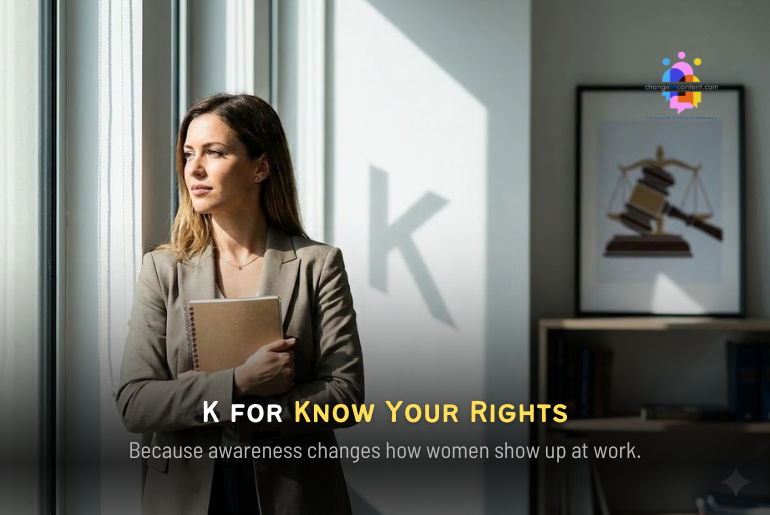
As we reach the letter K in our A–Z of Women and Work glossary, the focus shifts from experiences to empowerment. Know Your Rights is not just a phrase; it is a necessity. India has several laws that protect women’s right to work with dignity, safety, and fairness. Yet many women remain unaware of what the law actually guarantees them.
Whether a woman is starting her first job, returning after a career break, or navigating a hostile workplace, knowing her rights can change how she responds, what she tolerates, and what she challenges. This chapter brings together the most important legal protections every working woman in India should be aware of.
Know Your Rights: Key laws protecting women at work in India
Over the years, India has passed several laws and labour reforms to protect women at work and make workplaces safer. Knowing these rights is important, especially today, as more women join the workforce and speak up about their experiences.
1. The POSH Act
The Sexual Harassment of Women at Workplace (Prevention, Prohibition and Redressal) Act, 2013, called the POSH Act, states that sexual harassment at work includes any unwelcome behaviour of a sexual nature. This can be:
Physical contact and advances
For instance, touching, brushing against someone intentionally, or sexually invading personal space.
Demanding or requesting sexual favours
This can take the form of a quid pro quo, such as promising a better appraisal, a salary change, or a project allocation in exchange for sexual favours.
Sexually coloured remarks
Comments about a woman’s body, clothing, or personal relationships that create discomfort or humiliation.
Showing pornography
This includes sharing explicit content in person, via messages, emails, or group chats.
Any unwelcome physical, verbal, or non-verbal sexual conduct
Such as leering, inappropriate gestures, repeated unwelcome messages, or stalking within workplace premises.
Every organisation with 10 or more employees must establish an Internal Complaints Committee (ICC). According to the PoSH Act, at least half the total members of the IC must be women. Read more about the PoSH Act here.
2. Women Can Work Night Shifts
In the last few years, India has updated several labour laws to make work opportunities more equal. One of the most important changes is that women can now work in all types of establishments and during night hours, provided they consent, and the employer provides appropriate safety measures. Night hours generally mean work before 6 AM or after 7 PM, and these rules apply across many sectors, from manufacturing and hospitality to IT and logistics.
States such as Uttar Pradesh, Delhi, Madhya Pradesh, Himachal Pradesh, Maharashtra, and several others have already introduced reforms to support women who wish to work night shifts.
These updates recognise that women are fully capable of working the same hours as men, but also that employers must take responsibility for their safety. This typically includes secure transportation, well-lit work areas, surveillance systems, emergency support, and trained on-site supervisors.
3. Bharatiya Nyaya Sanhita (BNS, 2023) for Digital Abuse
The Indian Penal Code (IPC) and the new Bharatiya Nyaya Sanhita (BNS) provide a legal framework for dealing with online harassment, stalking, threats, and abuse. The newly introduced BNS revised the definitions and stricter penalties for cyberstalking, voyeurism, online threats and harassment, and non-consensual sharing of personal content.
Section 354D, IPC – Stalking (including cyberstalking)
This section specifically addresses repeated online contact or digital stalking.
- Repeatedly following, contacting, or attempting to contact someone online despite their disinterest.
- Tracking someone’s online activity or using the internet to monitor them
Punishment:
- First offence: Up to 3 years of imprisonment and a fine
- Subsequent offence: Up to 5 years of imprisonment and a fine
Section 354A, IPC – Sexual Harassment
This includes unwelcome sexual remarks, advances, messages, images, or any online behaviour intended to harass or humiliate a woman.
- Sexually coloured messages
- Requests for sexual favours through chats or DMs
- Sending inappropriate images or comments
Section 509, IPC – Insulting the Modesty of a Woman
Punishes online acts that degrade or humiliate a woman’s dignity.
- Obscene comments on social media
- Vulgar messages or gendered insults
- Offensive emails or posts targeting a woman
Sections 499 & 500, IPC – Defamation
Covers false or harmful content posted online with the intention to damage a woman’s reputation.
- Posting rumours
- Sharing misleading images or edited videos
- Publishing defamatory posts or stories
Sections 503, 506 & 507, IPC – Criminal Intimidation
These sections address threats, blackmail, and attempts to intimidate or coerce individuals online.
- Threatening messages or emails
- Blackmail using personal photos or information
- Anonymous threats sent through apps or social media
4. The Equal Remuneration Act
Pay discrimination is something women continue to face in many industries, in India and around the world. Even today, it is common to find women doing the same work as men but being paid less or being denied certain roles because of outdated assumptions. The Equal Remuneration Act, 1976, was enacted to ensure that women are not undervalued, underpaid, or treated unfairly in employment, including in hiring and wages.
What the act requires from employers
- Employers must pay men and women equally for the same or similar work. This includes wages, bonuses, allowances, and all other forms of remuneration.
- Employers may not prefer men over women during recruitment, training, promotions, or transfers unless a specific law prohibits women from working in certain roles or environments.
- Organisations must maintain consistent wage structures so that women are not placed in lower pay brackets for identical tasks.
5. The Maternity Benefit Act
The Maternity Benefit Act, first introduced in 1961, was significantly amended in 2017. Key Features of the Amended Law:
- Longer paid maternity leave: Section 5 increases paid leave to 26 weeks for the first two children. Adoptive and commissioning mothers are entitled to 12 weeks of leave under Section 5(4).
- Mandatory crèche facilities: Section 11A requires any workplace with 50 or more employees to provide a crèche and allows mothers four visits a day, including a rest break.
- Protection from unsafe or forced work: Section 4 makes it illegal to employ a woman during the first six weeks after childbirth.
- Stronger job security: Employers may not dismiss or disadvantage a woman on the basis of pregnancy or maternity leave.
Concluding Thoughts on Know Your Rights
Rights and laws matter only when they are known, applied, and upheld. When women understand what the law guarantees, they can challenge unfair treatment, ask the right questions, and hold organisations accountable. K stands for Know Your Rights because information empowers. It helps women navigate workplaces with confidence, protect themselves when necessary, and stand up to gender bias.
ChangeInContent will return with the next letter in The A–Z of Women and Work as the series continues.
Changeincontent perspective
Rights do not protect people automatically. They protect those who know them, speak about them, and insist on them. At Changeincontent, we believe that information is one of the strongest tools women can bring to the workplace. Knowing your rights does not make you difficult or confrontational; it makes you informed. And informed women are far harder to silence.
Disclaimer: The views expressed in this article are based on the writer’s insights, supported by data and resources available both online and offline, as applicable. Changeincontent.com is committed to promoting inclusivity across all forms of content. We broadly define inclusivity as media, policies, law, and history. It encompasses all elements that influence the lives of women and marginalised individuals. Our goal is to promote understanding and advocate for comprehensive inclusivity.
