
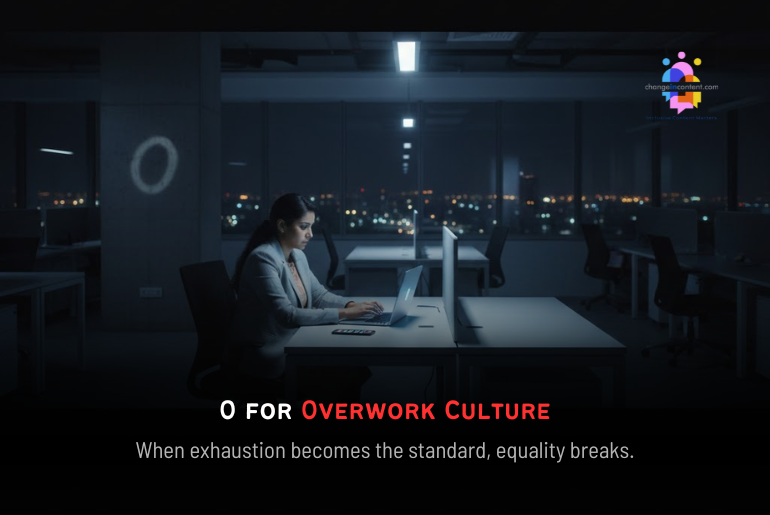
If there is one workplace issue that has dominated conversations this year, it is the overwork culture. Across industries, long hours, constant availability, and hustle-driven narratives have been framed as ambition and dedication. Over time, exhaustion has been normalised and, in some cases, rewarded, while rest is quietly treated as a weakness.
As the overwork culture deepens, its unequal impact is becoming impossible to ignore. Women often carry out paid work alongside unpaid domestic labour, caregiving responsibilities, and emotional work that rarely appears in job descriptions. When long hours become the default, recovery disappears. That is why O for Overwork Culture matters. It reminds us that productivity cannot be measured by burnout and that progress at work should not come at the cost of health, dignity, or life outside the office.
Overwork, burnout, and women at work
Overwork-related stress places a heavier mental burden on women. In the first quarter of 2024, mental health accounted for 11% of all leave of absence, and women and women-identifying workers accounted for 69% of these absences. Nearly 75% of women reported feeling burned out, compared with 58% of men. The reasons are long hours, constant pressure, and especially when paid work runs alongside unpaid domestic and caregiving responsibilities.
In India, the average working week now stretches close to 47 hours, placing the country among the most overworked labour forces in the world. Many workplaces prioritise availability over efficiency, leading employees to work longer without addressing productivity or well-being.
Deloitte’s 2024 Women @ Work survey adds that many working women experience chronic fatigue and frequent illness as prolonged stress weakens their immune systems. Mental health also suffers, with women reporting higher levels of anxiety, depression, and emotional detachment from work.
When overwork pushes women out of the workforce
Across India, more women are leaving their jobs because they can no longer manage rising workloads alongside their personal responsibilities. Far more women leave their jobs to protect work–life balance, while only about 4% of men report making the same choice. The Women in India Inc HR Managers Survey by Ashoka University’s Centre for Economic Data, conducted with the Udaiti Foundation, reports that poor work–life balance is among the top three reasons women leave their organisations.
Deloitte’s report also identifies increased workload as the main reason women exit the workforce. For working mothers, the need to stay available at all hours often leaves them with little flexibility in return. Over time, this constant demand takes a serious toll on mental health and leaves many women with no sustainable way to continue.
How overwork culture reinforces traditional gender roles
As overwork culture becomes normalised, it quietly pushes households back toward conventional gender roles. When workplaces expect long hours and constant availability, families often adjust responsibilities at home. In most cases, women absorb this adjustment.
When work demands become unsustainable, women are more likely to step back, reduce hours, or leave the workforce altogether. This shift returns them to primary roles at home, including caregiving, household management, and emotional labour. At the same time, men often remain in full-time roles with longer hours, reinforcing the idea that paid work belongs to men while unpaid work belongs to women.
If workplaces fail to challenge overwork culture, they risk undoing years of progress toward gender equality.
How workplaces can address overwork culture
Overwork culture does not fix itself. Organisations need to make changes to help employees stay healthy, productive, and engaged.
- Define reasonable working hours and respect them across teams. Leaders should avoid sending messages or setting deadlines outside these hours.
- Measure performance through outcomes and quality of work, not through visibility, late nights, or constant availability.
- Allow flexibility without penalty. Employees should feel safe using flexible schedules or remote work options without fear of judgment or of their career growth being stalled.
- Plan workloads realistically by setting achievable timelines and ensuring teams have enough support to meet expectations.
- Encourage shared responsibility so work does not rely on one person being available at all times.
- Regularly track burnout, working hours, and attrition, and act on the findings before overwork leads to long-term talent loss.
The final thoughts
If organisations want to retain women and build truly equitable workplaces, they must move away from glorifying exhaustion and start valuing sustainable work. Challenging the overwork culture means creating conditions in which people can perform, grow, and thrive without sacrificing their health or their lives outside of work.
With that, we close O for Overwork Culture in The A–Z of Women and Work: A Year-End Glossary. We will be back with the next letter.
Changeincontent perspective
Overwork culture is not a badge of honour. It is a structural failure disguised as ambition. When organisations reward exhaustion, they quietly push women out, reinforce traditional gender roles, and undo years of progress. Sustainable work is not a perk. It is a requirement for equity, retention, and long-term success. Challenging the overwork culture is not about working less. It is about working smarter, more fairly, and more humanely.
Also Read: The A–Z of Women and Work: A Year-End Glossary | L for Leadership Gap.
Disclaimer: The views expressed in this article are based on the writer’s insights, supported by data and resources available both online and offline, as applicable. Changeincontent.com is committed to promoting inclusivity across all forms of content. We broadly define inclusivity as media, policies, law, and history. It encompasses all elements that influence the lives of women and marginalised individuals. Our goal is to promote understanding and advocate for comprehensive inclusivity.
