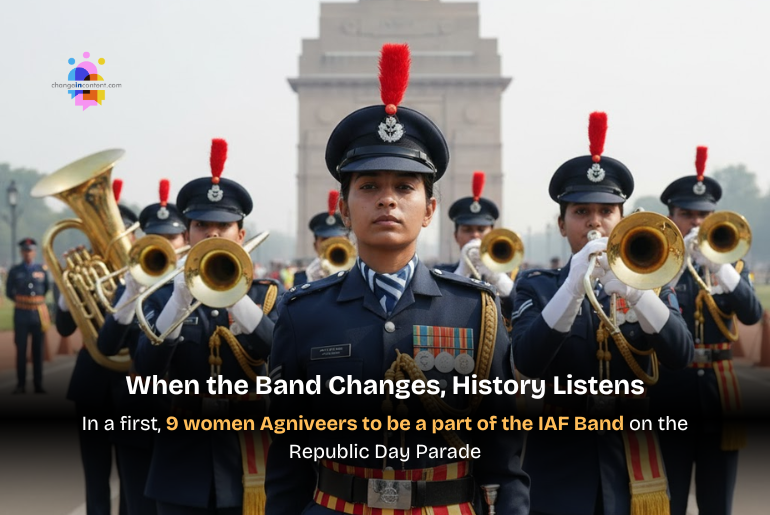
The Republic Day Parade has always been about sightlines, such as marching columns, weaponry, formations, and flags. But in 2026, we will hear something equally powerful. For the first time, nine women Agniveers will march as part of the Indian Air Force band contingent. They will play music as they move down Kartavya Path. The highlight of this story is Women Agniveers in the IAF Band. However, the meaning runs deeper than the phrase suggests.
Let us not think of it as a ceremonial footnote. It is a structural moment. And this moment forces us to rethink where women are allowed to exist in uniform, and how visibility itself becomes a form of power.
Women Agniveers in the IAF Band: Why this first matters
Military bands occupy a peculiar space in public memory. They are not combat units, yet they are never dismissed as “soft”. They carry rhythm, discipline, breath control, precision, and an almost ritual authority.
Until now, this space (especially in the Indian Air Force) remained overwhelmingly male.
The inclusion of nine women Agniveers in the IAF band contingent at the Republic Day Parade is not about optics alone. It is about access. Who gets to represent the nation in sound? Who gets to be seen as part of military culture, not just its margins?
Agnipath to Kartavya Path: What this journey represents
People often discuss the Agnipath scheme in terms of numbers, contracts, tenure, and workforce churn. What gets lost is how women Agniveers navigate a system that was not originally designed for them.
For these nine women, marching with the IAF band means more than playing instruments. It means surviving training environments where you earn visibility. Furthermore, it means holding posture under scrutiny. It means performing national duty in a role that is public, symbolic, and deeply gendered.
Music here is not softness. It is stamina.
The Republic Day Parade and the politics of visibility
Visibility in uniform has always been selective.
People celebrate combat roles. They archive ceremonial roles. Moreover, they forget support roles. And women, historically, have been pushed into the least remembered corners of all three.
When women Agniveers play with the IAF band this Republic Day, they do something radical:
They refuse invisibility. Now, they become part of the national soundtrack. That is impossible to ignore, difficult to erase.
A pattern, not an exception
This moment follows a visible pattern.
Only days earlier, a woman officer from Jammu and Kashmir was announced as the commander of an all-men CRPF contingent at the Republic Day Parade. Before that, women officers briefed the nation during active operations. Across services, women are moving from participation to presence and now to representation.
The Women Agniveers in the IAF Band story belongs to this same arc. It is quieter. But it is no less disruptive.
What this means for women watching from home
For young women (especially those considering defence careers), this moment sends a message that recruitment posters never could.
- You do not have to fit a single template to belong.
- You can march.
- You can lead.
- You can play.
And you can still be taken seriously.
Representation does not always arrive with medals. Sometimes, it arrives with music.
The changeincontent perspective
At Changeincontent, we believe inclusion is real only when it reshapes public memory.
The inclusion of women Agniveers in the IAF band is not about gender-balancing a parade. It is about rewriting who gets remembered when the nation looks back at its milestones.
If institutions want women to stay, they must let women be seen. It should not be about them being quietly absorbed. Instead, it should be about an explicit acknowledgement.
Women Agniveers in the IAF Band: Final Thoughts
On January 26, 2026, as the Republic Day Parade moves down Kartavya Path, the sound will carry further than usual.
It will carry the labour of nine women who trained, endured, and earned their place in uniform.
It will carry a reminder that nationhood is not just defended, but also performed.
And this year, women will perform it too.
Disclaimer: The views expressed in this article are based on the writer’s insights, supported by data and resources available both online and offline, as applicable. Changeincontent.com is committed to promoting inclusivity across all forms of content. We broadly define inclusivity as media, policies, law, and history. It encompasses all elements that influence the lives of women and marginalised individuals. Our goal is to promote understanding and advocate for comprehensive inclusivity.