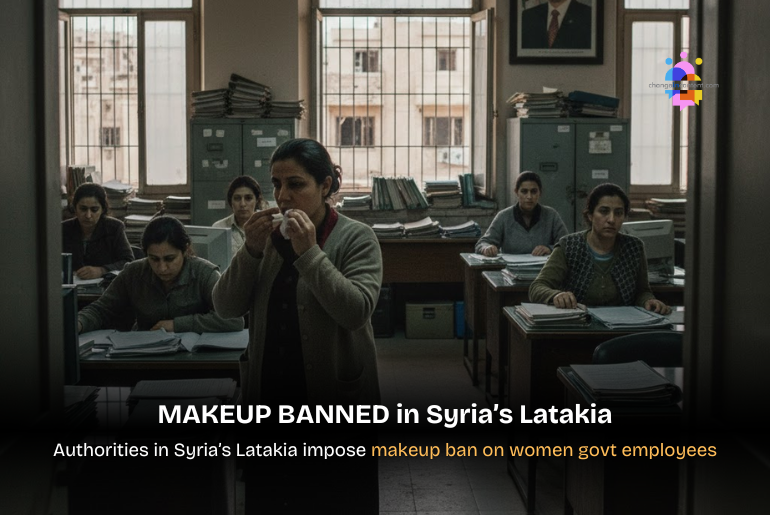
The makeup ban for women Government employees in Syria has become the latest flashpoint in the country’s uneasy transition after regime change. In the coastal province of Latakia, local authorities have barred women working in government offices from wearing makeup during official hours. This order has sparked public anger, internal dissent, and renewed scrutiny of how women’s bodies and appearances are being regulated under the new administration.
What the makeup ban in Latakia says, and what it does not
The directive, issued by provincial authorities in Latakia, applies specifically to women employed in the public sector. While the instruction does not reference religious law or name specific cosmetics, it prohibits visible makeup in government offices, framing the move as a measure to maintain “professional appearance” and institutional decorum.
Following backlash, the province’s media directorate issued a clarification stating that the decision did not aim to restrict personal freedoms. Instead, the idea was to prevent “excess” and preserve the formal image of public institutions. However, the clarification failed to define what constitutes excess, leaving the enforcement open to subjective interpretation and criticism.
Why the makeup ban for women Government employees in Syria has provoked anger
The reaction to the ban has been swift and vocal, particularly among women working in government offices. Activists and civil society observers argue that regulating women’s appearance, rather than addressing workplace inefficiencies, corruption, or economic precarity, reflects misplaced administrative priorities.
Several women employees consider the order as humiliating and dismissive of their professional identity. One government worker told regional media that competence, service delivery, and accountability had been sidelined in favour of monitoring how women look. The sentiment echoed across social media: makeup had never been a measure of performance, yet it had become a tool of control.
The political context: Syria after Assad
It is not right to view the ban in isolation from Syria’s political transition. The current administration came to power after rebels led by Ahmed al-Sharaa ousted longtime ruler Bashar al-Assad in December 2024. While the new leadership has sought to project moderation and inclusivity, several subsequent decisions have raised questions about continuity in authoritarian governance, particularly regarding gender norms.
Although there is no nationwide law restricting personal appearance, local directives, such as the Latakia makeup ban, suggest that control is exercised through administrative orders rather than legislation. That makes them harder to challenge and easier to normalise.
A pattern of gendered regulation in public spaces
The makeup ban for women Government employees in Syria follows earlier controversies in the same province. In mid-2025, Latakia authorities issued advisories urging “modest” clothing at beaches and swimming pools. These guidelines were widely interpreted as targeting women. After criticism, officials claimed the advisory was non-prescriptive and aligned with regional norms.
Elsewhere in the country, local councils are imposing restrictions that indirectly reinforce gender segregation. These restrictions involve banning men from working in women’s clothing stores in certain towns near Damascus. Taken together, these measures point to a broader pattern. It gives a glimpse of regulating women’s presence, visibility, and labour through informal rules rather than transparent policy.
Governance through appearance control
Human rights observers note that such measures often emerge when administrations struggle to deliver economic stability or institutional reform. Regulating appearance is administratively easy, politically symbolic, and disproportionately affects women. That makes it a recurring tactic in fragile governance systems.
A Syrian rights advocate described the Latakia order as less about professionalism and more about submission. They argue that when governments fail to address structural crises, they often redirect authority toward women’s bodies and behaviour. The makeup ban, critics argue, does little to improve public services. Still, it sends a clear message about who is expected to adjust and comply.
The changeincontent perspective
At Changeincontent, we view the makeup ban for women Government employees in Syria as a governance signal. It is not a cultural footnote. When women’s appearance becomes an administrative concern, it raises deeper questions about autonomy, dignity, and institutional power.
Across regions and regimes, societies often frame control over women’s bodies as a matter of neutrality, professionalism, or public order. Yet these justifications rarely apply equally across genders. Policies that single out women (especially in the workplace) reveal how easily administration can erode equality through everyday directives.
Makeup Ban for women Government employees in Syria: Conclusion
The Latakia makeup ban exposes fault lines in Syria’s post-regime governance. That is where promises of moderation coexist with administrative decisions that restrict women’s freedoms. While framed as a professional guideline, the order has reignited public debate about authority, accountability, and the persistent regulation of women’s bodies in public life.
Whether the directive is rolled back or quietly enforced, it has already achieved something else. It reminds Syrian women (and the world) that rights are often tested not through sweeping laws but through small, everyday controls that shape who is allowed to belong and on what terms.
Also Read: Makeup for kids: Is the beauty industry turning childhood into a market?
Disclaimer: The views expressed in this article are based on the writer’s insights, supported by data and resources available both online and offline, as applicable. Changeincontent.com is committed to promoting inclusivity across all forms of content. We broadly define inclusivity as media, policies, law, and history. It encompasses all elements that influence the lives of women and marginalised individuals. Our goal is to promote understanding and advocate for comprehensive inclusivity.