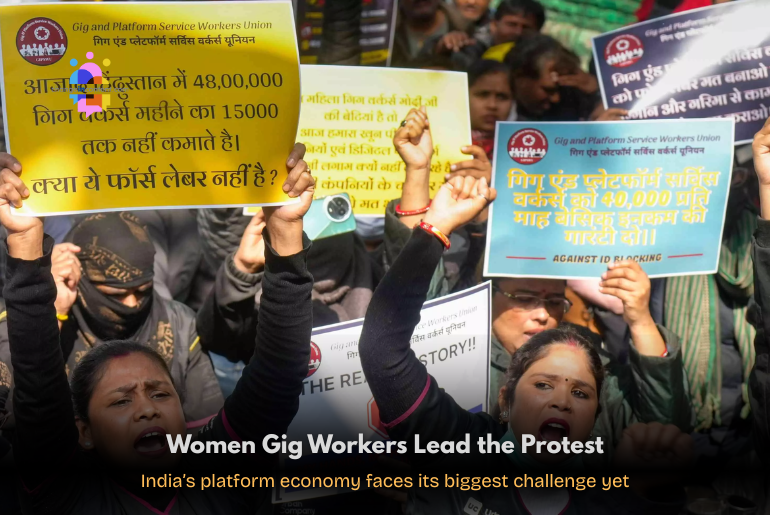
On a winter morning in Delhi, the anger was measured, not loud, but unmistakable. The “Women Gig Workers Lead Nationwide Protest” became more than a headline this week as thousands of gig and platform workers, led largely by women, gathered across India to call out what they describe as systemic exploitation in the platform economy.
The demonstrations, coordinated by the Gig and Platform Service Workers Union, were held in several states, with a major mobilisation at Jantar Mantar.
What unfolded was not just a protest against low pay or arbitrary penalties. It was a public reckoning with how India’s rapidly expanding gig economy treats the women who keep it running.
Women gig workers lead nationwide protest: But why?
Years of unresolved grievances sparked the nationwide protest. Women working across food delivery, home services, grocery delivery, and hyperlocal logistics report being trapped in a system. It is a system in which algorithms determine income, safety is an afterthought, and complaints often lead to retaliation rather than redress.
At Jantar Mantar, women associated with platforms such as Zomato, Swiggy, Urban Company, Zepto, Blinkit and Instamart described daily realities of forced auto-assignments, sudden ID blocking, income deductions through penalties, and the absence of basic facilities such as toilets during long shifts.
The protest expanded simultaneously across Rajasthan, Karnataka, Maharashtra and other states, underlining that these are not localised problems but structural ones.
“We are workers, not app users”: The core demands
Following the demonstrations, workers submitted a Memorandum of Demands to the offices of the state Chief Ministers. They called for urgent government intervention. At the heart of the appeal was the demand for a separate, enforceable, worker-centric law for gig and platform work. The law must go beyond advisory guidelines and voluntary platform policies.
The memorandum outlined five central demands:
- Legal recognition of gig workers as workers
- Fair and predictable wages
- Social security coverage, including health insurance and accident compensation
- Transparent grievance redressal mechanisms
- An end to opaque algorithmic practices that penalise workers without explanation or appeal
Stories that explain the system better than data ever could
For many women at the protest, policy failures were not abstract; they were personal. Several workers reported that filing complaints had cost them their livelihoods.
One woman recounted how, after reporting an assault by a customer, her platform blocked her ID instead of investigating the complaint. Another described filing repeated harassment complaints that went unanswered, while ratings dropped and bookings disappeared.
Others spoke about income instability caused by double cancellation penalties, bundled bookings that increased workload without proportional pay, and delivery targets that prioritise speed over safety.
These experiences, shared openly at the protest site, exposed how power in the gig economy flows one-way (from platforms to workers) with little accountability.
Women gig workers lead nationwide protest: The numbers behind the anger.
The protest was also grounded in data. According to union estimates shared during the demonstrations, nearly 48 lakh gig workers earn less than ₹15,000 per month. This income barely covers basic living costs in urban India. Women, who often enter gig work for its perceived flexibility, are disproportionately affected when long hours intersect with unpaid care responsibilities at home.
Union representatives also criticised instant delivery models. They argued that aggressive timelines compromise worker safety while platforms escape liability for accidents, injuries or deaths.
The absence of meaningful provisions for gig workers in the Union Budget 2026 further fuelled frustration. It reinforces the sense that platform labour remains politically invisible despite its scale.
A legal vacuum that women pay for
India’s labour laws have not kept pace with platform capitalism. Gig workers fall outside traditional definitions of employees. It leaves them excluded from protections related to minimum wages, maternity benefits, workplace safety, and redress for sexual harassment.
Trade union leaders at the protest pointed out that even existing laws (such as the Sexual Harassment of Women at Workplace Act) are rarely implemented in the gig sector. It is due to the ambiguity around employer responsibility.
For women gig workers, this legal vacuum translates into daily vulnerability. When something goes wrong, there is no HR department, no labour officer, and often no human point of contact. What exists is only automated emails and algorithmic silence.
The changeincontent perspective
At changeincontent, we see this protest as a defining moment in the conversation about India’s gig economy. When women gig workers lead nationwide protests, they are not asking for charity or sympathy. Instead, they are demanding recognition, rights, and dignity. We often celebrate the platform economy as innovation-driven and inclusive. However, its foundations rest on labour that is underpaid, under-protected and overwhelmingly invisible.
As a platform committed to equity and inclusion, we will continue to document these movements, amplify women’s voices, and question policies that celebrate growth without accountability. Because progress that excludes women workers is not progress; it is extraction with better branding.
The final thoughts
The nationwide protest led by women gig workers has drawn a clear line. On one side is a booming digital economy that promises convenience and speed. On the other hand are workers (especially women) who bear the human cost of that convenience. Whether the state responds with symbolic gestures or meaningful reform will determine the future of gig work in India. For now, one thing is undeniable: women gig workers have forced the country to listen.
Also Read: Women and Gig Work: What the gig economy really offers, and takes away.
Disclaimer: The views expressed in this article are based on the writer’s insights, supported by data and resources available both online and offline, as applicable. Changeincontent.com is committed to promoting inclusivity across all forms of content. We broadly define inclusivity as media, policies, law, and history. It encompasses all elements that influence the lives of women and marginalised individuals. Our goal is to promote understanding and advocate for comprehensive inclusivity.