
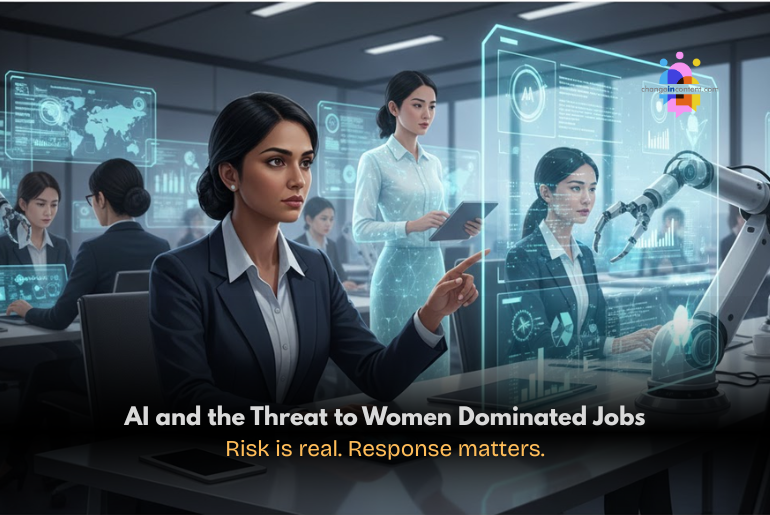
The conversation around AI and women-dominated jobs has reached a critical point. Recent research shows that artificial intelligence is not just transforming work; it is disproportionately threatening roles where women are overrepresented. Administrative support, customer service, clerical work, data processing, and entry-level professional roles are among the most at risk of automation and algorithmic replacement.
But this is not a story about inevitability. It is a story about preparedness, policy design, and institutional choices. AI does not eliminate jobs on its own. People and systems determine how to deploy technology, whom to retrain, and whom to leave behind.
The question is no longer whether AI will change women’s work. It is whether we will respond with intent or indifference.
Why are women-dominated jobs more exposed to AI?
Multiple global studies now converge on the same conclusion. Jobs with high levels of routine cognitive tasks are the most susceptible to automation. It is no secret that women constitute the majority of these roles.
A recent analysis by the Brookings Institution found that roles dominated by women face significantly higher exposure to generative AI tools than male-dominated occupations. The reason is structural rather than biological. Women have historically been channelled into support functions, coordination roles, and service-oriented work. Now, AI systems can easily replicate these jobs at scale.
Similarly, a United Nations report warned that AI poses a greater threat to women’s employment, especially in clerical, retail, and administrative sectors. At the same time, men remain disproportionately concentrated in roles involving system design, AI governance, and advanced technical oversight.
This imbalance reflects decades of occupational segregation, not individual choice.
The gender digital divide is amplifying the risk.
AI exposure is only one part of the problem. The second, more dangerous layer is access.
Globally, women have limited access to advanced digital training, fewer opportunities to transition into technical roles, and less representation in AI development. According to UN data, women make up less than one-third of the global technology workforce. At the same time, they have an even smaller share of AI researchers and engineers.
It means women are more likely to be affected by AI, but less likely to shape it.
When we design technology without diverse perspectives, it reinforces existing inequalities. The risk is not only job loss, but long-term exclusion from the future of work.
What the data actually shows
The concern about AI and women-dominated jobs is not speculative. Concrete, comparative data back it.
A recent CBS News analysis, based on research by the Brookings Institution and the International Labour Organisation, finds that women’s jobs have significantly more exposure to AI-driven disruption than men’s.
Women in the high-income countries
According to the data, nearly 79% of women’s jobs in high-income countries are exposed to artificial intelligence, compared with 58% of men’s. Exposure here does not automatically mean job loss. However, it indicates that substantial portions of these roles can be automated, augmented, or fundamentally altered by AI systems.
High-risk exposure
The gap widens further when looking at high-risk exposure. Around 21% of women’s jobs are considered highly exposed to AI. That means AI can replace or radically transform a substantial share of tasks, compared to 13% of men’s jobs. This difference is not marginal. It reflects the disproportionate concentration of women in clerical, administrative, and service-oriented roles. That is where AI can already perform many functions more cheaply and faster.
The same analysis shows that one in four clerical and administrative roles (overwhelmingly held by women globally) fall into the highest AI exposure category. By contrast, jobs involving complex manual work, system design, or AI governance remain far less exposed and are male-dominated.
Limited access
The International Labour Organisation also notes that women are less likely to transition into AI-complementary roles. That is not because of capability gaps, but because of limited access to advanced digital training, fewer internal mobility opportunities, and structural barriers within organisations.
Taken together, the data point to a clear conclusion. AI does not threaten women’s jobs because women are less adaptable. It threatens women’s jobs because of how labour markets have historically allocated women to roles that technology now finds easiest to automate.
Source: CBS News analysis based on research by the Brookings Institution and the ILO, 2025.
AI and women-dominated jobs in the real world
The impact is already visible.
Conversational AI is replacing customer service roles. Administrative positions are shrinking as automation handles scheduling, documentation, and reporting. Entry-level professional roles that once served as career gateways are disappearing faster than new pathways the being created.
For many women, these roles were not just jobs. They were entry points into financial independence, career mobility, and stability.
That is why the discussion cannot remain theoretical. AI disruption is not coming. It is here.
The problem is not AI. It is how organisations are using it.
Technology is neutral. Strategy is not.
Most organisations adopt AI with a narrow efficiency lens. Cost reduction, speed, and scalability dominate decision-making. Workforce impact, reskilling pathways, and gender equity are often afterthoughts.
This approach creates avoidable harm.
Let’s be clear. AI should be a productivity multiplier, not a blunt replacement tool. When organisations fail to invest in reskilling women into higher-value roles, they lock inequality into their operating models.
What organisations must do now?
Organisations cannot claim neutrality while implementing systems that disproportionately displace women.
- The first responsibility is anticipation. Employers know which roles are transitioning to automation. They must match that knowledge with structured transition plans, not silent redundancies.
- Second, reskilling must be intentional. Training women only in basic digital literacy is insufficient. Programmes must focus on analytical thinking, AI oversight, data interpretation, ethical oversight, and cross-functional roles that machines cannot easily replace.
- Third, organisations must track impact. Gender-disaggregated workforce data should accompany AI adoption to identify who is being displaced, promoted, or excluded.
Organisations must recognise that doing so is not an act of philanthropy. It is workforce sustainability.
What women need to prioritise individually
This moment demands clarity, not fear.
Women cannot control the pace of AI adoption, but they can control how they respond. The most resilient roles are those that combine domain knowledge with decision-making, context, and human judgment.
Women should prioritise skills that are aligned with AI, not opposed to it. These include AI-assisted project management, quality assurance, compliance oversight, human-AI interaction design, and strategic coordination.
Equally important is visibility. Women must be present in conversations about AI implementation within their organisations. Silence creates vulnerability.
Read more on why women are holding back in AI.
What governments and administrations must fix
Public policy cannot remain reactive.
Governments must treat AI disruption as a gendered labour issue, not a generic technology challenge. It starts with recognising women-dominated sectors as high-risk and directing reskilling funds accordingly.
Second, labour laws must evolve to protect workers during technological transitions. Social security frameworks, transition benefits, and public training infrastructure need urgent reinforcement.
Finally, governments must invest in women’s participation in STEM and AI development, not merely in AI use. Without representation at the design stage, inequality becomes embedded in systems.
Changeincontent perspective
At changeincontent, we believe the conversation around AI and women-dominated jobs must shift from alarm to architecture.
Technology does not determine outcomes. Institutions do.
This moment offers a choice. Either AI becomes another chapter in the long history of women being pushed out of economic power, or it becomes an opportunity to redesign work more fairly.
We advocate for intentional AI adoption that values people alongside productivity. Furthermore, we advocate for policies that treat gender equity as a core economic strategy rather than a secondary concern.
AI and women-dominated jobs: Summing up
AI will reshape work. That much is inevitable.
What is not inevitable is who benefits, who adapts, and who gets left behind. Women face higher exposure today not because they are less capable, but because systems have historically limited their access to power, training, and design roles.
Algorithms alone will not decide the future of work. The choices that governments, organisations and individuals make today will decide the future of work.
Disclaimer: The views expressed in this article are based on the writer’s insights, supported by data and resources available both online and offline, as applicable. Changeincontent.com is committed to promoting inclusivity across all forms of content. We broadly define inclusivity as media, policies, law, and history. It encompasses all elements that influence the lives of women and marginalised individuals. Our goal is to promote understanding and advocate for comprehensive inclusivity.
