
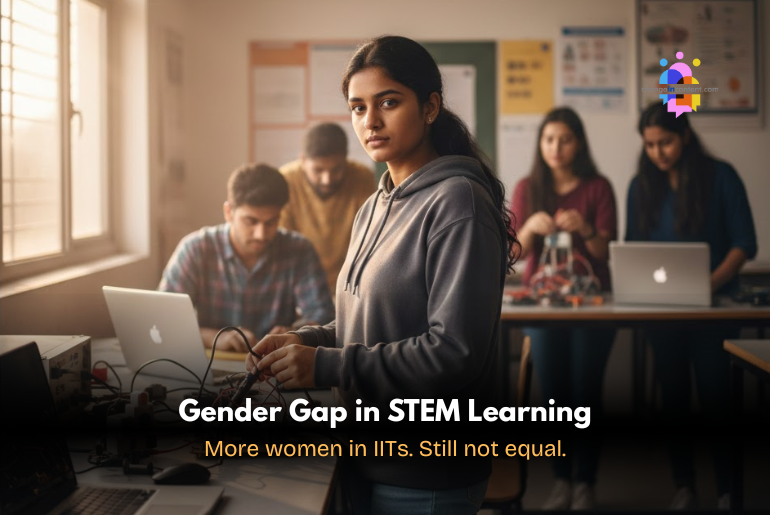
The Gender Gap in STEM Learning is widening even as IITs report a sharp rise in women’s admissions. That is not a headline built for shock. It is a reality built from data, and it demands a serious, India-first conversation about what happens before a girl reaches an IIT, and what happens after she does.
This piece breaks down the numbers, what they actually mean, and why “more admissions” is still not the same thing as “more women in STEM”.
What the numbers say: More women, but not equal
In recent years, IITs have significantly increased the intake of women, supported by policy interventions. Yet the gender gap remains stubborn and, by many measures, structurally intact.
The Indian Express report flags this uncomfortable truth: female intake has risen, but the overall gap in STEM learning and participation continues to widen. It suggests that the system is adding seats without fixing the pipeline.
A major reason for the improvement in admissions is the creation of supernumerary seats for women in IIT undergraduate programmes. That increased female enrolment from 8% (2018–19) to 20% (2020–21). That is a big policy win, and it should be acknowledged as one.
But the point of STEM equity is not to “reach 20% and stop”. It is intended to remove the reasons for its 8% in the first place.
The real story sits before IITs: Where the pipeline thins out
The gender gap in STEM learning begins long before the JEE.
It starts when science becomes “too hard”, then “too male”, then “too risky” as a career choice. It starts when families advise a bright girl to pick what is “safe” over what is ambitious. Moreover, it begins when families assess the costs of coaching, relocation, and uncertainty and decide that the investment is better elsewhere.
The outcome is predictable: women who do enter STEM often do so despite the ecosystem, not because of it.
What “STEM learning” misses when we only measure admissions
The obsession with admissions hides three other gaps:
- First is the confidence gap. Many women arrive in elite STEM spaces having been trained to be perfect, not bold. That matters in labs, projects, hackathons, patents, and research.
- Second is the belonging gap. A classroom can be co-ed and still be coded male. The culture of who gets heard, who gets mentored, and who gets assumed competent is where many women quietly lose ground.
- Third is the continuity gap. Women’s STEM journeys are often interrupted by financial pressure, family responsibilities, safety concerns, and the sheer exhaustion of navigating biased spaces daily.
When we discuss the widening gender gap in STEM learning, we refer to the underlying dynamics that underlie the observed numbers.
India is not starting from zero: Women’s STEM enrolment is rising
Nationally, women’s enrollment in STEM has been improving. Government-cited AISHE data show that female enrolment in STEM courses increased from 38.4% (2014–15) to 42.6% (2021–22, provisional).
That is a strong macro signal. But it sits alongside another truth: enrollment is not the same as power. Representation in classrooms does not automatically translate to representation in research leadership, high-growth tech roles, innovation funding, or decision-making positions.
That is where India needs to shift focus: from entry to outcomes.
The global context makes this urgent, not optional
Globally, UNESCO has repeatedly highlighted that women remain underrepresented in many STEM fields and in research leadership, even as access to education improves.
India’s story is therefore not unique, but it is uniquely high-stakes because STEM is now a national capability issue. If we continue pushing women out of STEM pathways, India loses half its potential in the very sectors it calls “future-ready”.
If you are reading this because you care about the broader ecosystem, you might want to revisit our piece on the International Day of Women and Girls in Science 2026, where we unpack why visibility days matter and why they are not enough on their own.
What could actually reduce the gender gap in STEM learning
India already knows how to increase a number. The IIT supernumerary seat intervention proved that. Now the challenge is deeper: make STEM retention and growth easier than STEM survival.
That requires action in three places:
- In schools: better science confidence-building, teacher training that removes bias, and structured exposure to real STEM careers, not just textbook achievement.
- In coaching and entrance ecosystems: scholarships, local access, safer mobility options, and better academic counselling for first-generation learners.
- Inside colleges: mentorship that is not symbolic, reporting systems that work, lab and project opportunities distributed fairly, and strong career pathways into research and industry.
We must not view it solely as “encouraging girls”. It is about redesigning the system so girls do not have to fight it to learn.
We can also draw from changeincontent thoughts on India and global female STEM enrolment and gender parity. That is because the Indian story is part of a larger global pattern with local consequences.
Changeincontent perspective
At Changeincontent, we do not treat the Gender Gap in STEM Learning as a motivational problem. We treat it as a structural one. Admissions can increase while inequality persists because it is not solely about access. It concerns culture, safety, opportunity, mentorship, and the costs women pay to persist.
Our position is simple: India does not need more “women in STEM” headlines. India needs fewer women quietly exiting STEM rooms. And that will only happen when institutions are measured not just on intake, but on outcomes. We must build graduation pathways, placements, research opportunities, and leadership representation.
The final thoughts on the gender gap in STEM learning
Yes, the admission of more women to the IITs is a step forward. The data proves that policy can move the needle. But the widening gender gap in STEM Learning tells us the needle is moving inside a system that still favours men.
The next phase of the conversation must be harder and more honest: not “how do we bring women in”, but “why do we keep building STEM spaces that women have to endure?”
Disclaimer: The views expressed in this article are based on the writer’s insights, supported by data and resources available both online and offline, as applicable. Changeincontent.com is committed to promoting inclusivity across all forms of content. We broadly define inclusivity as media, policies, law, and history. It encompasses all elements that influence the lives of women and marginalised individuals. Our goal is to promote understanding and advocate for comprehensive inclusivity.
