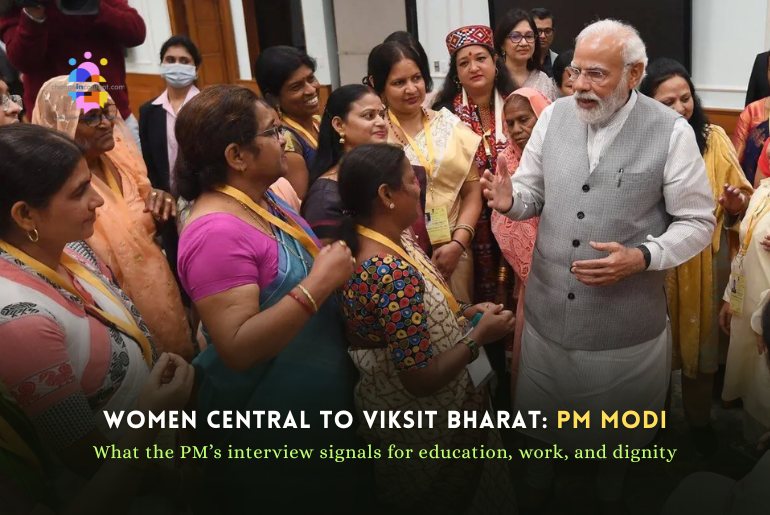
The role of women in Viksit Bharat is far beyond the slogans we casually read. In a recent interview, Prime Minister Narendra Modi said he is convinced that women will play the most important role in building a developed India. He also highlights that the government’s initiatives are designed to empower women at every step, from education to enterprise.
What matters now is the “how”. What exactly did the PM point to, and what is being funded, and what changes on the ground? And what gaps still need urgent attention if India wants women’s participation to rise without women paying the hidden costs?
What PM Modi said, and why this interview matters
In his interview, PM Modi framed women’s participation as both a moral commitment and an economic necessity. He notes that Indian women are increasingly leading in science and technology, including space and start-ups.
He also said that “the welfare of women guided every decision” of his government, and then mapped that statement to specific initiatives mentioned in the Budget and ongoing flagship schemes. That is important because it gives a measurable checklist. If women are central to Viksit Bharat, the proof must show up in enrolment, skilling, jobs, incomes, safety, and retention, not just in announcements.
Women in Viksit Bharat: The new “STEM Hostels in Every District” push
One of the most prominent mentions in the interview was the plan to establish girls’ STEM hostels in every district. As per the Prime Minister, this could significantly improve women’s education and innovation.
If implemented well, this is not a small intervention. In India, the pipeline problem is not only about merit or ambition. It is often about distance, safety, travel time, family permissions, and the cost of staying near quality institutions. A district-level hostel network can reduce friction for girls who do not live in big cities, especially in families where commuting daily is seen as unsafe or socially unacceptable.
What we will watch for is execution detail. Where will these hostels be located? Who will run them? What safety standards and grievance systems will be in place? How will access be prioritised for first-generation learners, marginalised communities, and girls from districts with low female higher education continuation?
Women in Viksit Bharat: 1.5 lakh caregivers and the question of “Dignified Work”
Another major point was the decision to train 1.5 lakh caregivers next year, alongside expanding institutions for allied health professionals. The Prime Minister positioned this as a way to formalise care work currently concentrated in the informal sector and to create dignified, certified employment for women while strengthening healthcare capacity.
It matters because care work in India is a paradox. It is essential work and is women-heavy. Yet it is commonly underpaid, undervalued, and under-protected. Certification and structured pathways can help women move from low-wage, high-risk informal care roles into better-paid formal roles.
But formalisation must not become a new form of extraction in which women are trained and certified yet still paid poorly. “Dignity” needs to be measurable as well. Wages, hours, contracts, social security, safety protocols, and clear escalation routes for abuse are the real test.
Women in Viksit Bharat: AVGC Creator Labs in 15,000 schools and 500 colleges
The Prime Minister also highlighted a push into “sunrise sectors” through AVGC Content Creator Labs in 15,000 schools and 500 colleges. As per the PM, it will build formal creative infrastructure and drive record levels of women’s participation in animation, visual effects, gaming and digital content.
That is a smart signal, because future jobs are not only in conventional STEM. They sit at the intersection of creativity and technology. India’s creator economy is already large but uneven. Women creators face higher harassment, higher reputational policing, and a stronger burden of “respectability” expectations.
If the state is building education infrastructure here, it must pair it with digital safety literacy, platform reporting awareness, and basic rights education for young women entering public digital work.
Flagship schemes mentioned: A broad basket, one big question
PM Modi referenced multiple flagship schemes as part of a “women at every step” approach, including Beti Bachao Beti Padhao, Swachh Bharat, scholarships for girls, PM Awas Yojana, Jal Jeevan Mission, MUDRA, and PM Surakshit Matritva Yojana.
This list reflects a broad governance philosophy: combine infrastructure, welfare, and credit access to expand women’s capabilities. The key question is coordination and outcomes. When a woman is healthier, has access to water, has a toilet, has a house, has credit, and has pathways to work, participation becomes more realistic.
But the lived reality is that many women still drop out because of unsafe workplaces, an unpaid care load, lack of childcare, discrimination in hiring, and fear of commuting. So the basket matters, but so does the bridge between the basket and the workplace.
Markets, value chains, and “Women Owning Access”
One interesting part of the interview was the emphasis on community-owned retail outlets supported by innovative finance models. The Prime Minister argues that when women control market access, supply chains and retail platforms, they move up the value chain and face fewer barriers to capital and scale.
It is powerful framing because it shifts women from labourers to owners and operators. It also aligns with the broader narrative around Self Help Groups and women’s entrepreneurship, including the Lakhpati Didi push.
If we implement this approach with transparency, mentoring, and strong procurement support, it can help women move out of precarious income cycles. If executed poorly, it can become another scheme where we use women’s names while real control remains elsewhere.
The changeincontent perspective
At Changeincontent, we take every statement on the role of women in Viksit Bharat seriously. That is because women are usually the first we celebrate in speeches and the last we offer protection in systems.
The interview offers a clear trail of measurable promises: district STEM hostels, caregiver skilling at scale, and creator-economy infrastructure that could reshape participation. Our role is to follow the trail beyond announcements. We track implementation, clarify what “dignified work” means in terms of pay and safety, and keep the conversation grounded in women’s experiences at work and on the way to work.
Women in Viksit Bharat: The closing thoughts
The interview is optimistic, and optimism is not the enemy. But it needs a spine. When the Prime Minister says women will play the most important role in building a developed India, the country owes women more than applause. The country owes safe mobility, predictable childcare support, fair pay, enforceable workplace safety, and serious investment in the sectors where women already work and the sectors where women are being asked to lead next.
That is the difference between “women are central” as a line and “women are central” as a lived national reality.
Disclaimer: The views expressed in this article are based on the writer’s insights, supported by data and resources available both online and offline, as applicable. Changeincontent.com is committed to promoting inclusivity across all forms of content. We broadly define inclusivity as media, policies, law, and history. It encompasses all elements that influence the lives of women and marginalised individuals. Our goal is to promote understanding and advocate for comprehensive inclusivity.