
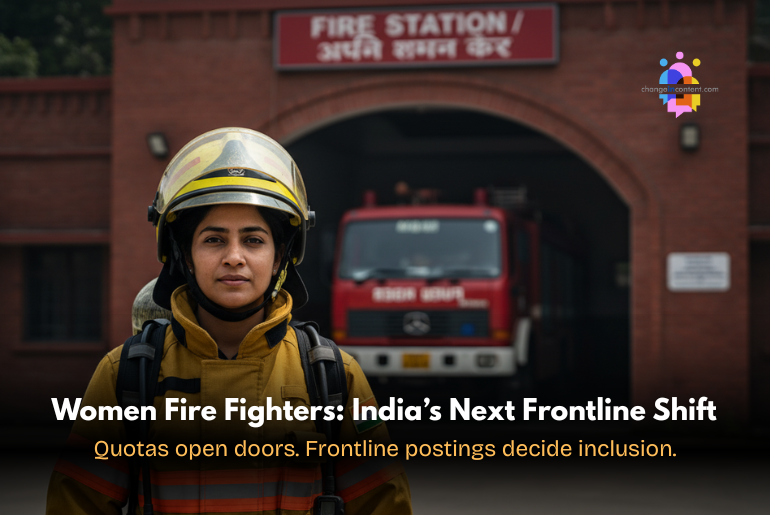
Karnataka is preparing to induct its first set of Women Fire Fighters into the State Fire and Emergency Services Department, with 10% reservation. It is a long-overdue shift in a profession that has remained almost entirely male, despite being a public service for everyone.
This announcement matters for one simple reason: Recruitment is not the finish line. Real progress begins when women are trained, equipped, posted, trusted with frontline duty, and promoted fairly. Otherwise, “inclusion” becomes a headline rather than a lived workplace reality.
Women Fire Fighters in India: Quotas are rising, but frontline roles are not
Karnataka will soon induct its first group of women into the State Fire and Emergency Services Department. The government recently introduced a 10% reservation for women in the service. Officials also plan to replace the title “Fireman” with the gender-neutral term “Firefighter” across all records and future recruitment notices. With this step, the state ends an 84-year-long male-only norm in the department.
Several other Indian states have also begun recruiting women into fire services in recent years. However, many departments still keep women away from frontline fire response duties. That is why true inclusion will depend on equal training, field postings, gender-inclusive safety gear, and fair promotion opportunities for women firefighters.
Which Indian states are recruiting women firefighters (and what they are not saying yet)
In 2022, the Tamil Nadu Fire and Rescue Services announced that it had submitted a proposal to the state government regarding the gender gap. At that time, the department had 22 women officers, but none served in firefighter roles.
In Odisha, the Fire Service suggested a 15% reservation for women in recruitment in July 2018. The plan has not seen any actual progress so far. While Odisha Police has steadily increased the number of women in its ranks over the years, the fire service has remained hesitant to do so. Officials often point to the high-risk and physically demanding nature of firefighting.
The Odisha Fire Service has around 5,700 personnel, including just 500 women. Most of these women work in operations support, control rooms, training support, and administrative wings. Very few get opportunities in active fire response units. [The Times of India]
The state of affairs in Delhi
The presence of women in the National Capital’s firefighting service does not look very encouraging. As of late 2022–2023, the Delhi Fire Service (DFS) has started training women for operational roles. However, recent reports do not clearly state the total number of active women firefighters in the city, and the figure remains very low.
Officers such as Priya Ravindran, who joined the service in 2013, were the only women in their training batch, which highlights the slow pace of change.
India saw its first woman firefighter only in 2010, when Harshini Kanhekar created history by entering the profession. Even today, the numbers show that women’s entry into frontline firefighting continues to move slowly.
However, there are instances of more serious effort. In March 2024, Kerala inducted its first batch of 84 women firefighters into the Fire and Rescue Services. This intake marks the largest single batch of women firefighters inducted by any Indian state to date.
Hiring Women Fire Fighters is step one. Posting them on the frontline is step two.
It is encouraging to see recent steps that open the firefighting profession to women, especially in a field long dominated by men. Policy changes, new training calls, and fresh recruitment plans show that departments have begun to acknowledge the gap. However, the teams continue to have very few women, indicating that policy announcements alone do not ensure equal representation on the ground.
Gender bias, both direct and subtle, continues to steer many women away from frontline emergency roles. Questions about physical strength, safety during night duty, and lack of proper facilities often surface during hiring discussions.
Tracking Women Fire Fighters after recruitment: Postings, retention, promotions
After states induct a new batch of women firefighters, very little public information emerges about what happens next. We need regular follow-up reports that track their postings, field exposure, promotions, and retention rates. Without this data, it becomes difficult to judge whether these initiatives are delivering lasting change or simply creating headline moments.
Departments would benefit from actively listening to women already in the workforce. Their feedback can highlight practical gaps across gear fit and station facilities, shift safety, and career progression. These insights can guide areas that need improvement and help build a more supportive work environment.
Changeincontent perspective
If the system wants to call itself modern, it has to stop treating women in public safety as a “special category” and start treating them as professionals. Fire services do not become inclusive the day a quota is announced. They become inclusive when women are posted on active response units, given the same training exposure as men, and evaluated by the same operational standards.
We must support them with gear, facilities, and leadership that do not assume a male body as the default.
What should happen next?
- Publish posting data, retention data, and promotion data for women recruits every year.
- Mandate gender-inclusive PPE procurement (boots, gloves, breathing masks, suits that actually fit)
- Ensure safe station infrastructure (washrooms, changing spaces, night duty protocols)
- Create zero-tolerance systems for harassment and informal gatekeeping.
Inclusion cannot depend on whether a supervisor is “progressive.” It has to be built into policy, budgets, and accountability.
The closing thoughts
India has spent many years celebrating individual milestones, such as the first woman to join, the first women’s batch to train, and the first posting in a field unit. While these moments deserve recognition, they also show how slowly the system has moved.
The next phase must focus on sustained participation, transparent tracking, and steady workplace reform so that women in a particular field no longer remain rare exceptions but become a routine part of the service.
Also Read: Women in the Workplace Report 2025: Why women are still working harder, but aspiring less.
Disclaimer: The views expressed in this article are based on the writer’s insights, supported by data and resources available both online and offline, as applicable. Changeincontent.com is committed to promoting inclusivity across all forms of content. We broadly define inclusivity as media, policies, law, and history. It encompasses all elements that influence the lives of women and marginalised individuals. Our goal is to promote understanding and advocate for comprehensive inclusivity.
