
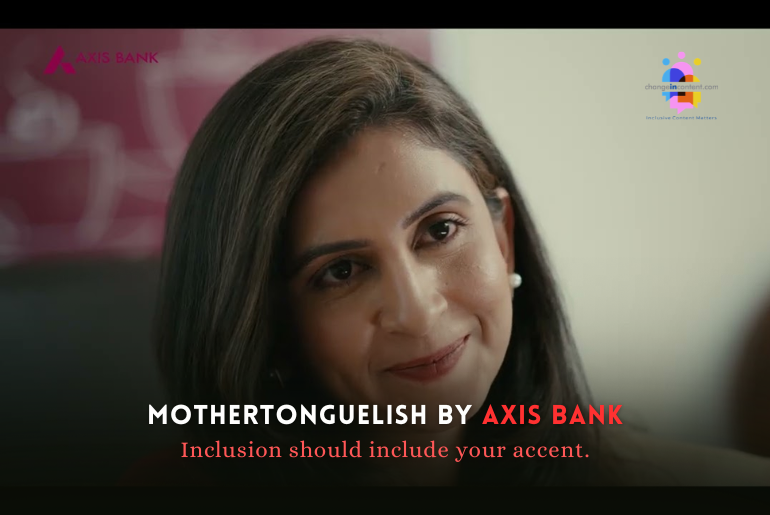
If you have ever hesitated before speaking in a meeting because of how your English sounds, you already understand why MotherTonguelish matters. Axis Bank’s latest campaign puts a spotlight on a bias most Indian workplaces still pretend does not exist. It is about the quiet judgment attached to dialects, accents, and pronunciation.
Released around International Mother Language Day (21 February), the film shows a simple moment inside an Axis Bank office. An employee asks for a loan “form”, but his accent turns it into “pharam”. Instead of correcting him, the manager mirrors his pronunciation and makes the point clearly. It does not matter how you say it. What matters is what you mean.
MotherTonguelish: Axis Bank’s accent-inclusion message, explained
Axis Bank launched a new campaign, #MotherTonguelish, to celebrate International Mother Language Day on February 21. Conceptualised by Curativity, the ad film highlights that language inclusion should also include support for Indians across dialects and accents.
The film begins inside an Axis Bank office. An employee asks his manager if the loan “form” is available. He speaks in English, but his native accent turns the word into “pharam.” Instead of correcting him, the manager repeats the word in the same accent and reassures him. She explains that it does not matter whether someone says form, fome, or pharam. Every version is valid. She also points out that accents carry traces of one’s mother tongue and give Indian English its own identity.
The story then moves through scenes of staff and customers speaking in their own dialects and accents. In one moment, a recruit worries about not speaking polished English. The manager reassures him, saying that sincerity and effort count more than perfect pronunciation.
The film ends by tying this message to the bank’s Dil Se Open philosophy, underlining that every voice deserves space and respect.
[penci_video url=”https://www.youtube.com/watch?v=xVi-fgAlrEs” align=”center” width=”1280*720″ /]
Dialect inclusion is the missing layer of “Language Inclusion”
India is home to a large number of languages. Census data over the decades shows thousands of reported mother tongues, which officials later grouped into smaller language sets for clarity. Today, researchers often note that the country has more than 19,500 speech varieties, including dialects and minor languages, across about 121 languages. Yet the Constitution formally recognises only 22 of them. Moreover, even within one state, you may find several dialects, communities, and cultural practices coexisting.
Behind every dialect or accent stands a community that carries it into offices, meeting rooms, and customer counters. Yet many workplaces still accept only standard or polished English. When companies overlook dialect diversity, employees often become careful about how much they speak. They may avoid sharing ideas in meetings or second-guess their words, not because they lack skill, but because they fear judgment about how they sound.
Banking and service desks need accent-friendly communication.
In sectors such as banking and other service industries, customers do not walk into branches speaking in one uniform way. They arrive with regional accents, mixed languages, and local speech styles. When frontline staff respond with impatience, repeated corrections, or confusion, the customer experience suffers. On the other hand, when staff listen without bias and adapt their communication, customers feel more comfortable and willing to engage.
Training AI for the way India actually speaks
At the same time, teams that build AI models and virtual assistants must also account for India’s regional languages and dialects. Many voice tools still struggle with diverse accents, mixed language use, and local speech styles. When developers train systems only on standard English or a narrow set of voices, large user groups face errors, poor recognition, or exclusion. Inclusive datasets, region-aware testing, and accent diversity in training can help AI systems serve India’s full linguistic landscape more fairly and effectively.
When AI systems support regional languages and dialects, they become easier and more useful for everyday users. People can speak naturally instead of forcing themselves to imitate standard English. This helps first-time digital users, rural customers, and older users who feel more comfortable in their native language (dialect).
Better recognition also reduces errors in banking, customer care, healthcare access, and public services. Over time, inclusive AI tools can expand digital access, build trust in technology, and enable more people to benefit from voice-based services.
In a country with thousands of dialects and accents, campaigns such as #MotherTonguelish bring long-ignored gaps into the spotlight.
Changeincontent perspective
Most companies love inclusion when it looks good on a poster. Accent inclusion is harder because it requires everyday behaviour change, not policy PDFs. Campaigns like MotherTonguelish matter because they call out a very Indian form of gatekeeping. People are judged as “smart” or “junior” based on how close they sound to a made-up idea of polished English.
But here is the uncomfortable truth: respect cannot end with a warm film. Organisations have to operationalise it.
What “doing it properly” looks like:
- Stop “correcting” in public: correction culture kills participation, especially for junior staff and first-generation professionals.
- Train managers on communication bias: accent bias is a leadership issue, not an employee issue.
- Build inclusive customer standards: frontline teams should be rewarded for clarity + patience, not for sounding elite.
- Fix hiring signals: if “excellent communication” secretly means “sounds urban-English”, you are filtering talent unfairly.
- Bring AI into the conversation responsibly: voice tools and speech analytics used in banking and customer support must be tested on Indian accents, not imported speech patterns.
If workplaces in India want genuine DEI, they should treat accent inclusion as seriously as they treat dress code, attendance, or compliance. Because the moment you police how someone speaks, you also shrink who gets heard.
The closing thoughts on MotherTonguelish
Language inclusion in India cannot stop at recognising multiple languages. True inclusion must also respect the many dialects and accents people bring into the workplace and service counter. Organisations that listen with openness, rather than policing pronunciation, will build stronger teams, better customer relationships, and more inclusive workplaces.
Also Read: Words we throw at women: A language that needs to change.
Disclaimer: The views expressed in this article are based on the writer’s insights, supported by data and resources available both online and offline, as applicable. Changeincontent.com is committed to promoting inclusivity across all forms of content. We broadly define inclusivity as media, policies, law, and history. It encompasses all elements that influence the lives of women and marginalised individuals. Our goal is to promote understanding and advocate for comprehensive inclusivity.
