
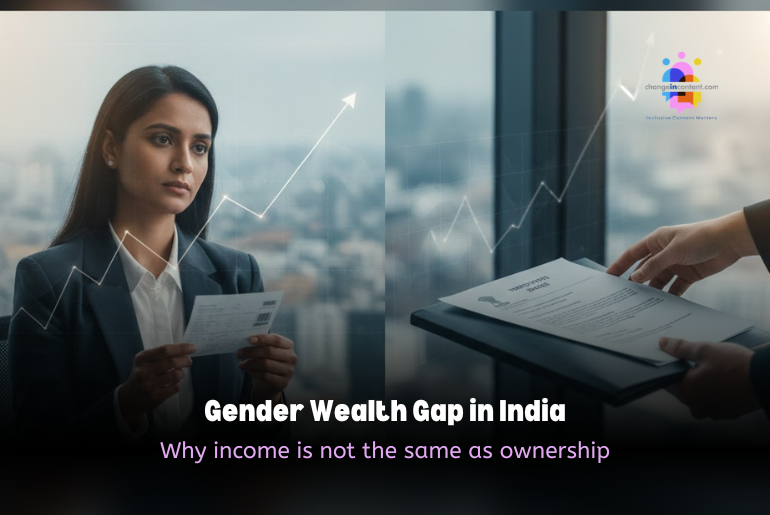
The gender wealth gap in India is one of those realities that hides in plain sight. You can see women everywhere today: in offices, on factory floors, in gig work, in entrepreneurship. Yet when you look at ownership, inheritance, investing, and long-term financial security, the ground story shifts.
Wealth is not salary. Wealth is what remains after you spend your salary. It is what you save after you spend, save, invest, inherit, and protect. And in India, too many women are still being asked to build futures without access to the same financial levers.
Globally, the gap is not closing fast either. The World Economic Forum’s gender gap score (across broad dimensions of equality) still sits far from parity, with Iceland leading at about 92.6% and overall progress remaining slow. That matters because national progress stories often mask what families do with money inside homes. And that is exactly where the wealth gap is born.
What is the gender wealth gap in India, really?
The wage gap is about the monthly income. The wealth gap is about accumulated advantage. It includes land, property, gold, financial assets, business ownership, pensions, insurance, and the power to decide how to invest money.
The wealth gap widens quietly because wealth compounds. Missing a few years of work, delaying investing, or being excluded from asset ownership does not just reduce today’s income. It reshapes the next twenty years.
That is why many global institutions argue that the wealth gap is often more stubborn than the wage gap. Legal and structural inequalities, caregiving burdens, and unequal access to economic tools reinforce it across lifetimes.
Why the gender wealth gap in India persists even when women “Progress”
No single factor solely drives India’s wealth gap. A stack of disadvantages that look normal only because we have normalised them is what creates the wealth gap.
1. Work and money still do not meet at the same place
Women’s work in India is often underpaid, informal, or interrupted. Even when women earn, their income is more likely to be treated as “support” rather than “core”. That shapes how much they save, whether they invest, and whether they take financial risks early enough for compounding to work.
2. Unpaid care work is not just emotional labour. It is an economic tax
Care work eats time, energy, and continuity. The official Time Use Survey factsheets show that women in India spend far more time on unpaid domestic and caregiving work than men do. That directly reduces time available for paid work and skill-building. It is not an abstract inequality. It is one of the clearest reasons why women’s careers tend to have more breaks, slower wage growth, and weaker compounding.
3. Asset ownership is still unequal, and that is where wealth begins
In India, wealth is still anchored in assets like land and housing. Multiple analyses using NFHS indicators show that women’s ownership of houses and/or land remains limited compared to men’s, even when ownership is “joint” on paper.
And here is the uncomfortable truth: joint ownership often does not mean joint control. A woman may be “included” in documentation without being included in decisions.
4. Inheritance is the silent pipeline that keeps men ahead
Even after legal reforms, family negotiations, social pressure, and the fear of conflict shape inheritance. A woman who declines her share is still considered mature. A woman asserting her share is still treated as a disruption. That is how a legal right becomes a social taboo.
5. Wealth inequality at the top mirrors the story at the bottom
A sharp way to see how gendered wealth remains is to look at the extreme top. One study analysing India’s billionaire lists notes how few women appear among top wealth holders, and how large the net-worth gap remains in that bracket.
That is not just trivia about billionaires. It signals how hard it still is for women to reach positions where wealth scales exponentially.
Is anything changing in India? Yes. But not fast enough.
More women are earning than before. Similarly, more women are opening bank accounts. More women are building micro-enterprises, especially through self-help groups. These shifts matter. They also create a dangerous illusion: that access equals control.
The real test is not whether women are “included” in the economy. The test is whether women can accumulate and defend wealth across life stages: early career, marriage, motherhood, mid-career, caregiving years, and retirement. Without that continuity, progress remains fragile.
The ground story: Why progress still feels thin
If you ask many professional women what money anxiety feels like, the answers are rarely about salary. They are about being one crisis away from losing autonomy. They are about being the “responsible one” in the family, but not the decision-maker. They are about earning well, yet being expected to fund everyone else’s stability first.
And then there is longevity. Women typically live longer than men, which means retirement planning must be different by design, not by suggestion. When women have lower lifetime earnings, fewer assets, and longer lifespans, the wealth gap becomes a future security gap.
What can actually close the gender wealth gap in India?
This is where the conversation needs to mature. Not motivational. Not performative. Practical.
What women can do without waiting for permission
Women should be encouraged to treat investing as a life skill, not a luxury. Start early, even if small. Build a separate emergency fund that is truly yours. Ensure insurance covers health risks and life disruptions, not just tax savings. And critically: insist on being part of family financial decision-making. Not as a helper, as a stakeholder.
What families must stop calling “culture”
If a family can educate a daughter, it can also give her equal inheritance without framing it as generosity. At the same time, if a family can list a woman’s name on an asset, it can also give her equal control over it. And if a family trusts a woman with caregiving, it can trust her with money.
What employers can fix immediately
The compounding problem is often a continuity problem. Employers that offer real childcare support, return-to-work pathways, and flexible structures that do not punish ambition help women preserve career continuity. That continuity is the difference between income that pays bills and income that builds wealth.
What the state and regulators must take seriously
Gender budgeting, welfare schemes, and inclusion programmes cannot remain the headline. Implementation is the story. Financial inclusion must move beyond account-opening to financial capability, investment access, property rights enforcement, and legal support systems for women asserting ownership. The law matters, but the system around the law decides whether women can use it.
Changeincontent perspective
At Changeincontent, we want to push this conversation beyond the familiar gender pay gap framing. The gender wealth gap in India is where power hides. It hides the name of the person whose property it is. Moreover, it hides in who decides the investments. And it hides in who can afford to take risks. It hides in who gets to inherit without asking.
If you are building equality through policies, HR practices, or social initiatives, you cannot stop at income. You have to design for ownership, control, and compounding.
We have explored one critical part of this puzzle before: equal pay. If you want the wage-side context that feeds into wealth outcomes, read our earlier piece on International Equal Pay Day, here.
Gender wealth gap in India: Closing thoughts
The gender wealth gap in India is not a woman’s problem. It is an economic design problem. And it is a problem of cultural honesty. Women do not need symbolic inclusion. They need structural access to the same wealth-building engines men inherit by default: assets, continuity, decision-making power, and time.
Until we treat wealth as the core equality metric, we will keep celebrating women’s entry into the workforce while ignoring what happens to their money once they come home.
Disclaimer: The views expressed in this article are based on the writer’s insights, supported by data and resources available both online and offline, as applicable. Changeincontent.com is committed to promoting inclusivity across all forms of content. We broadly define inclusivity as media, policies, law, and history. It encompasses all elements that influence the lives of women and marginalised individuals. Our goal is to promote understanding and advocate for comprehensive inclusivity.
