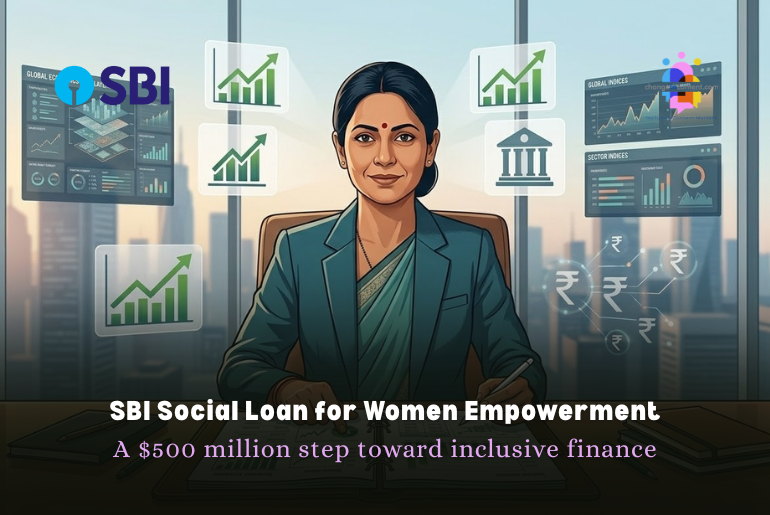
Finance has often been described as the backbone of economic opportunity. Yet for decades, women across the world have struggled to access credit, capital, and financial tools needed to grow businesses and build financial independence. The SBI social loan for women empowerment aims to address this gap with a $500 million syndicated loan to strengthen women’s economic participation.
Announced ahead of International Women’s Day, the initiative reflects a growing shift within global finance. Banks and financial institutions are increasingly recognising that economic growth cannot be sustainable if half the population continues to face barriers to capital.
By directing funds toward projects and enterprises that support women’s economic empowerment, the State Bank of India is attempting to combine financial innovation with social impact.
The question now is not only what the initiative promises, but how effectively it can translate into real opportunities for women.
Understanding the SBI social loan for women empowerment
The new initiative introduced by the State Bank of India is a $500 million syndicated social loan facility. In simple terms, this means that multiple financial institutions collaborate to provide a large pool of funding directed toward a specific social objective.
In this case, the objective is clear. The funds aim to support projects and financial opportunities that contribute to women’s economic empowerment and help reduce gender inequality. SBI described the initiative as a step toward strengthening inclusive economic growth while also supporting global sustainability goals.
Unlike traditional lending structures, social loans are designed to generate measurable social outcomes alongside financial returns. The model reflects the growing importance of sustainable finance, where banks increasingly integrate social and environmental goals into lending strategies.
Why gender-focused finance matters
Access to credit remains one of the biggest barriers for women entrepreneurs and professionals. According to the International Finance Corporation (IFC), women-owned small and medium enterprises worldwide face an estimated $1.7 trillion financing gap.
In India, the situation reflects a similar challenge. While women increasingly participate in entrepreneurship and small business ownership, access to formal financial credit remains uneven.
The Sixth Economic Census of India revealed that only about 13–14% of Indian entrepreneurs are women. Many of them rely on personal savings, informal borrowing, or family support rather than institutional credit.
Without access to capital, scaling businesses becomes difficult. This limits job creation, innovation, and financial independence.
Initiatives such as the SBI social loan for women’s empowerment attempt to address this gap by directing institutional capital toward women-focused economic initiatives.
The role of ESG finance in women’s economic empowerment
The SBI initiative is part of a broader financial shift toward Environmental, Social, and Governance (ESG) financing. ESG frameworks encourage financial institutions to evaluate not only profitability but also social impact and sustainability.
Gender equality has increasingly become a core theme within ESG finance. Investors and global institutions now recognise that empowering women economically can generate broader economic benefits.
Research from the McKinsey Global Institute suggests that advancing gender equality in the workforce could significantly addto global GDP.
By linking its social loan to ESG principles, SBI is aligning its lending practices with global investment trends that prioritise inclusive growth.
A financial move aligned with global development goals
The initiative also aligns with the United Nations Sustainable Development Goal 5 (SDG 5), which focuses on achieving gender equality and empowering all women and girls.
SDG 5 calls for:
- Equal economic participation
- Improved access to financial resources
- Elimination of discrimination in economic opportunities
Banks increasingly play a role in supporting these goals by directing capital toward inclusive economic initiatives.
SBI Chairman C. S. Setty emphasised this during the announcement of the programme, stating that women’s empowerment remains a cornerstone of sustainable development. He highlighted that responsible financial institutions must help build an economy where opportunities extend to communities that have historically faced structural barriers.
What this initiative could mean for women
While large financial programmes often appear abstract, their impact can be significant when implemented effectively. The SBI social loan for women empowerment may contribute to several areas of economic advancement:
- Women entrepreneurs may gain better access to credit and financing.
- Women-run small businesses could receive support to expand operations.
- Financial inclusion programmes may reach underserved communities.
- Women-led enterprises could attract greater institutional investment.
However, the real success of the initiative will depend on how the funds are distributed and whether they reach women across different sectors and regions. Urban entrepreneurs may benefit first, but the long-term impact will require extending financial opportunities to women in smaller towns and rural areas.
The challenges that still exist
While financial initiatives such as this represent progress, structural barriers remain. Many women continue to face challenges, including limited financial literacy, a lack of collateral for loans, and cultural biases that discourage entrepreneurship.
Even when credit schemes exist, navigating banking processes can be difficult for first-time entrepreneurs. At Changeincontent, we previously examined some of these barriers in our article on the challenges surrounding loans for women entrepreneurs. Read the full article here.
Understanding these structural challenges is essential if financial initiatives are to produce meaningful results.
The changeincontent perspective
Large financial commitments toward gender equality are significant milestones. But financial inclusion requires more than capital allocation. It requires financial literacy, accessible lending frameworks, and institutional willingness to support first-time women entrepreneurs.
Banks must also ensure transparency in how funds are distributed and which projects receive support.
For women, access to finance can represent more than economic opportunity. It can transform decision-making power within households, enable entrepreneurship, and strengthen long-term financial independence.
The SBI social loan for women empowerment signals that mainstream financial institutions are beginning to recognise these realities. The true measure of its success will lie in how many women can convert access to credit into sustainable economic opportunity.
SBI Social Loan for Women Empowerment: Closing Thoughts
The launch of the Social Loan for Women Empowerment by SBI reflects an important shift in how financial institutions approach gender equality. By linking financial capital with social outcomes, the initiative highlights the growing role of sustainable finance in addressing structural inequalities.
Yet the journey toward economic equality is far from complete.
Financial literacy, supportive policies, and cultural acceptance of women as entrepreneurs and economic leaders must accompany access to credit. When financial systems evolve alongside social change, initiatives such as this can become catalysts for meaningful economic transformation.
Disclaimer: The views expressed in this article are based on the writer’s insights, supported by data and resources available both online and offline, as applicable. Changeincontent.com is committed to promoting inclusivity across all forms of content. We broadly define inclusivity as media, policies, law, and history. It encompasses all elements that influence the lives of women and marginalised individuals. Our goal is to promote understanding and advocate for comprehensive inclusivity.