
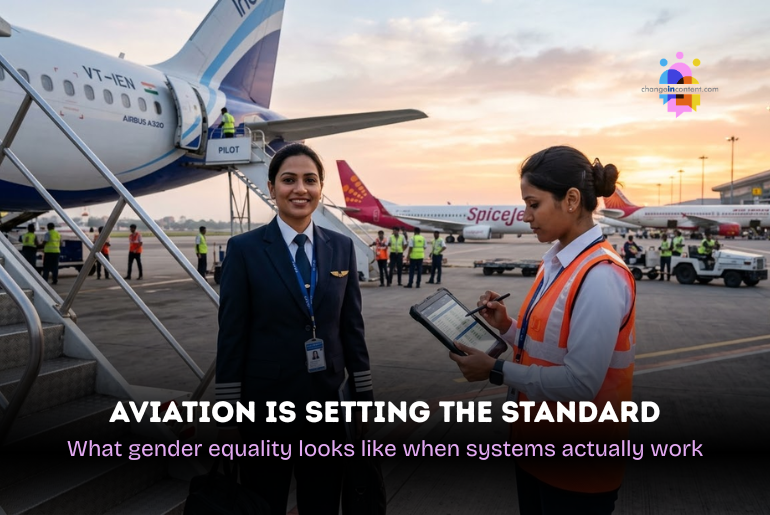
Gender Equality in India’s Aviation Industry is standing out for a reason. At a time when many sectors still struggle with pay gaps, broken career pipelines, and poor return-to-work systems for women, aviation has quietly built a more practical model of inclusion. Earlier, changeincontent covered how India’s aviation industry shows one of the most promising examples of gender progress at work.
Recent milestones make that visible.
- IndiGo now employs over 1,000 women pilots, the first airline in India to cross that mark.
- Women pilots make up 17.5% of its pilot workforce, far above the global average.
- At the same time, Noida International Airport is preparing to open with women in key leadership and operational roles.
These are not isolated headlines. They point to an industry that has started treating gender equality as an operational reality rather than a branding line.
Why does India stand out when it comes to gender equality in aviation? Or perhaps the right question should be what exactly aviation is doing differently, and whether other industries can learn from it.
Equal Pay in India’s Aviation Industry starts with skill, rank, and seniority, not gender.
Pilot salaries in India can vary widely depending on factors such as license type, years of experience, airline, and whether the pilot flies domestic or international routes. But when it comes to pay between men and women, the rules apply to everyone.
One of the few professions in India where gender does not influence pay. Many other sectors still struggle with a major gender pay gap. In retail and manufacturing, the gap reaches 35–40%, while BFSI records a gap of around 15–17%.
Airlines in India follow standardised pay structures, which means pilots earn based on their rank, flying hours, and seniority, not gender. Male and female pilots receive the same pay for the same role and experience level. Compensation packages also include additional benefits such as medical insurance, allowances, and retirement plans.
A pilot’s salary mainly depends on how long they have worked in the industry, the type of aircraft they operate, and the number of hours they have spent flying. The more experience and flying hours a pilot builds, the higher they move up the pay scale.
How Maternity Policies support gender equality in India’s Aviation Industry
Most major airlines in India offer 26 weeks of maternity leave, giving women the time and support they need before and after childbirth. While many industries still struggle to support employees during maternity, airlines in India increasingly treat these benefits as part of building a more inclusive workforce.
Air India’s “Making Our Mothers Soar” (MOMS) programme offers 26 weeks of maternity leave along with day-care support for women employees. The programme covers over 5,000 women across flying and non-flying roles, including pilots, cabin crew, and ground staff.
IndiGo also provides 26 weeks of fully paid maternity leave for women employees. The policy even covers adoption and surrogacy, helping more women access the same benefits. The airline also allows flexible work arrangements during pregnancy. For example, cabin crew members can switch to ground duties during this period, making it easier for them to continue working safely.
Return-to-Work programmes are keeping women in Aviation careers
Returning to work after maternity leave still remains one of the biggest hurdles for many women. According to the State of Inclusion: Where We Stand in 2025 report by Great Place To Work, many women struggle to re-enter the workforce after a career break.
India’s aviation sector is trying to tackle this problem through dedicated return-to-work programmes. For instance, IndiGo runs Takeoff 2.0, a programme designed specifically for women who took a break from their careers and want to return to work. The initiative invites experienced women professionals to rejoin the workforce through mentorship and training support.
Gender equality at work often sounds like a big, complicated goal. But sometimes the answer lies in small decisions companies make every day. such as how they design pay systems, support employees, and welcome people back after career breaks.
The changeincontent perspective
Aviation is proving something that many industries still resist. Gender equality does not arrive through one speech, one policy document, or one Women’s Day post. It grows when workplaces remove friction at the points where women are most likely to be pushed out. Equal pay matters. Maternity support matters. Return-to-work pathways matter. Structured systems matter.
Other industries should pay close attention here. Women do not leave because they lack ambition. They leave when workplaces make continuity too expensive, too exhausting, or too uncertain.
The lesson from aviation is simple. Build fair systems early, support women during key life stages, and stop treating career breaks like permanent exits. For women reading this, let aviation be a reminder that difficult industries can change. For companies, let it be a warning that excuses are running out.
Conclusion: Why Gender Equality in India’s Aviation Industry feels more practical than performative
The aviation industry shows that gender equality at work does not come from a single policy. It comes from a mix of decisions that remove barriers at every stage of a career. Equal pay ensures fairness from day one.
Maternity benefits and flexible work policies help women stay in the workforce during important life stages. Return-to-work programmes ensure a career break does not permanently close the door.
When industries design workplaces with these realities in mind, more women step in, stay longer, and move into leadership roles. Aviation in India proves that change becomes possible when companies focus on practical solutions rather than just conversations about diversity.
Disclaimer: The views expressed in this article are based on the writer’s insights, supported by data and resources available both online and offline, as applicable. Changeincontent.com is committed to promoting inclusivity across all forms of content. We broadly define inclusivity in terms of media, policies, law, and history. It encompasses all elements that influence the lives of women and marginalised individuals. Our goal is to promote understanding and advocate for comprehensive inclusivity.
