
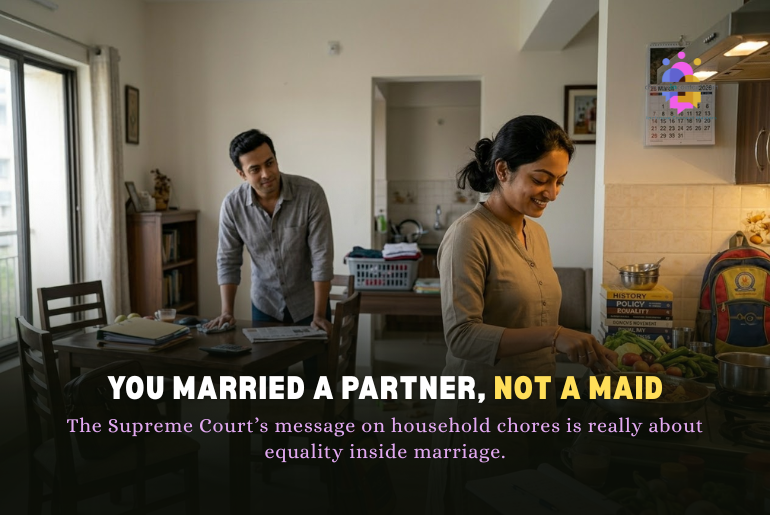
Household Chores have long been treated in Indian homes as a woman’s default responsibility. It remains the same whether she is employed outside the home, working from home, or managing full-time care work inside the home. That assumption not only shapes daily routines but also marriages, expectations, exhaustion, and the unequal normalisation of domestic labour.
Time-use data have repeatedly shown that women in India spend far more time than men on unpaid domestic and care work. Recent official data place women’s daily unpaid domestic services at 289 minutes, compared to 88 minutes for men. It also places unpaid caregiving at 137 minutes for women, compared to 75 minutes for men.
That is what makes the Supreme Court’s recent observation so significant. Below, we explore the ruling and why it matters.
Why the Supreme Court said household chores cannot define a wife’s “Cruelty”
While hearing a divorce matter, the Supreme Court of India rejected a common claim in many households. In the case, the husband sought a divorce on the grounds of cruelty. The argument was a common reality in many houses. The husband said his wife did not perform household chores adequately. And that amounts to cruelty.
The Court rejected this argument and made clear that failing to meet someone’s expectations for housework does not constitute cruelty under the law. Justice Vikram Nath and Justice Sandeep Mehta, who heard the case, also pointed out that such expectations do not fit in today’s reality. They stressed that a husband cannot expect his wife to take full responsibility for domestic work.
Justice Mehta reportedly told the husband that he had married “a life partner, not a maid.” That captures the Court’s broader message that one cannot reduce marriage to one-sided domestic service. Expecting one person to do it all is not just unfair, it is outdated.
That is why the ruling matters beyond one case. It speaks to a larger social truth that unequal domestic labour is still one of the most normalised forms of inequality inside Indian families. Many houses expect women to treat it not as labour, but as love, duty, or adjustment.
The invisible labour gap behind household chores
The invisible labour does not stop at physical chores. Women also carry the mental load that people often fail to notice. They keep track of meals, school schedules, doctor visits, groceries, birthdays, and every small detail that keeps a household running. Even when couples aim for a “50-50” split, it rarely feels equal in practice.
Pregnancy, childbirth, and early childcare already place a heavier physical and emotional demand on women. On top of that, many women continue to plan, remind, and manage everything behind the scenes. So while the work may look shared on the surface, the responsibility of thinking, organising, and making sure nothing falls through still falls largely on the women.
The ‘wife-as-maid’ syndrome
Researchers across sociology and gender studies have repeatedly examined what many now call the “wife-as-maid syndrome.” These studies show that marriage often places women into roles where they carry the bulk of the unpaid domestic work. Surprisingly, families treat that work as natural rather than as labour. As a result, people undervalue the time, effort, and skill that goes into running a household.
Even when women work full-time jobs, they still end up doing a second shift at home. That leaves them with less rest, fewer opportunities, and constant burnout.
How culture teaches women to normalise unfair labour
The deep-rooted patriarchal concepts like pativrata (devotion to husband) and grahini (homemaker) still influence how many families define a good wife. These ideas push women to see housework and caregiving as moral duties instead of actual work. Because of this, many women do not even question the unfair load they carry. If they do push back, families often label them as irresponsible or not adjusting, which makes it harder to challenge these expectations.
These cultural beliefs normalise inequality in marriages. When people treat domestic work as a woman’s duty, they excuse the lack of contribution from the other partner. Over time, this creates a system in which women give more but receive less recognition, support, and fewer choices in their own lives.
This unequal burden also connects to what we explored in Household CEO, Office Employee: the double shift and invisible labour that no one acknowledges, where the emotional and organisational load of domestic life remains heavily feminised.
The changeincontent perspective
The Supreme Court’s observation matters because it punctures a very old lie dressed up as tradition. The lie we are mentioning here is that a wife’s love must naturally express itself through endless domestic labour. But equality in marriage cannot survive on symbolic language alone. It has to show up in sinks, school runs, grocery lists, medicine reminders, laundry baskets, and the thousand invisible tasks that keep homes functional.
The real issue is not whether one partner occasionally cooks or helps. It is whether we still imagine domestic labour as a woman’s baseline duty and a man’s optional contribution. That difference shapes exhaustion, resentment, financial dependence, and even how women are judged inside families. If marriage is truly a partnership, then household labour has to be treated as shared work, not inherited gender destiny.
What needs to change is not only behaviour, but vocabulary. Men are not “helping” when they do household chores. They are participating in the home they live in. Until that becomes ordinary, equality inside marriage will remain more performative than real.
Supreme Court on household chores: Closing thought
When institutions like the Supreme Court of India call out these norms, they open the door for change. However, real change will only happen when families start treating domestic work as a shared responsibility rather than a gendered duty.
It is time to move on from outdated roles and build partnerships where both people contribute, both people benefit, and no one gets stuck doing it all.
Disclaimer: The views expressed in this article are based on the writer’s insights, supported by data and resources available both online and offline, as applicable. Changeincontent.com is committed to promoting inclusivity across all forms of content. We broadly define inclusivity in terms of media, policies, law, and history. It encompasses all elements that influence the lives of women and marginalised individuals. Our goal is to promote understanding and advocate for comprehensive inclusivity.
