
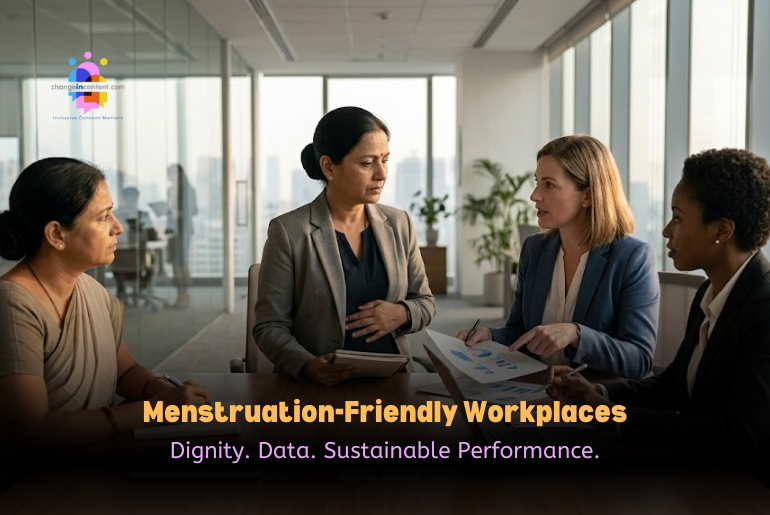
On any given day, around 800 million people across the world are menstruating. Millions of them are at work. They are in boardrooms, factory floors, hospitals, courtrooms, classrooms and start-up offices. They are managing teams, meeting targets and leading strategy. And many of them are doing so while experiencing pain, fatigue, inflammation, hormonal shifts and cognitive strain. Yet the professional script remains unchanged. Show up the same anyway. And that is where the idea of menstruation-friendly workplaces emerges from.
No, the idea of menstruation-friendly workplaces is not about special treatment. It is about acknowledging physiology as part of human sustainability. Organisations track sick leave, mental health days and burnout risk. They analyse productivity data and talk about long-term performance. But most organisations still treat cyclical health as a private inconvenience. That silence is costing talent, trust and long-term performance.
The scale of the issue: Not marginal, but structural.
Menstrual health is not a niche concern affecting a small minority.
According to the World Health Organisation, endometriosis affects around 10% of women of reproductive age globally. That translates to roughly 190 million people. PCOS affects an estimated 6-13% of women worldwide. Many studies place the average prevalence at around 9%. PMDD affects between 3% and 8% of women. Fibroids develop in 20-80% of women by age 50, with significantly higher prevalence among Black women.
For those who think these are rare conditions, let us get the facts right. These conditions are common, often invisible, and frequently unmanaged at work.
The CIPD Menstruation and Support at Work Report 2023 surveyed more than 2000 women aged 18 to 60. The findings were striking.
- 79% experienced menstrual symptoms.
- 69% reported that symptoms negatively affected them at work.
- More than half had at some point been unable to attend work because of symptoms.
The most unfortunate realisation was that only 12% reported that their organisation provided any form of support or guidance. At the same time, nearly half said they had never told their manager that their absence was due to their menstrual cycle.
To those who still think this is a wellbeing issue, it is not. It is an issue of culture.
Menstruation-friendly workplaces and the productivity question
There is often hesitation about policies related to menstruation due to perceived productivity risks. But the data suggests that ignoring the issue is more expensive than addressing it.
- Research published by Women’s Health Concern indicates that nearly 80% of women experience dysmenorrhea. Severe period pain can lead to absenteeism and presenteeism.
- A study in India examining menstrual symptoms and productivity found that a significant number of working women reported taking time off during their periods. They do it often without formally stating the reason.
When employees feel compelled to work through severe discomfort, performance does not improve. Concentration declines. Stress increases. Errors multiply. Long-term engagement erodes.
The case of high-performing organisations
High-performing organisations increasingly speak about sustainable performance. Sustainable performance includes bringing one’s true self to the organisation. An identical output is possible by supporting wellbeing.
In an ideal world, if a woman gets to communicate their discomfort with peers and team members and not feel alienated if she chooses to work from home on the day she is unable to commute in pain, they can still be productive from the comfort of their home.
Menstruation-friendly workplaces do not reduce performance standards. Taking menstrual leave cannot be considered absenteeism. We must see it as more inclusive of women. The change we need is to take a step towards performance management by redesigning it through a more humane, qualitative lens.
The policy debate: Empowerment or reinforced stereotypes?
In India, the conversation around menstrual leave has intensified. In 2025, Karnataka approved a policy granting one paid menstrual leave per month across sectors. Bihar and Odisha have long provided paid leave for women government employees. Kerala has extended menstrual leave to students in state universities.
The Right of Women to Menstrual Leave and Free Access to Menstrual Health Products Bill 2022 proposed three days of paid menstrual leave per month for working women and trans women. It also advocated universal access to menstrual products and anti-discrimination protections.
Supporters argue that menstrual leave validates lived experience, reduces stigma and protects health. Critics raise concerns about reinforcing gender stereotypes or increasing hiring bias against women.
What menstruation-friendly workplaces actually look like
A single policy document does not define a menstruation-friendly workplace. Integrated systems define it.
First, culture must change.
Leaders should be able to say the word period without discomfort. Internal communication must normalise menstrual health as part of wellbeing. Silence creates stigma. Open dialogue reduces it.
Second, policies must be clear and inclusive.
Menstrual health should be referenced within broader health, absence and flexible working frameworks. This includes recognising conditions such as endometriosis, adenomyosis, PMDD, PCOS and fibroids. Policies must protect privacy while enabling reasonable adjustments.
Third, line managers must be aligned.
Many managers feel awkward discussing menstrual health. A single training session does not bring about changes. Organisations must focus on accepting gender differences. It is a top-down approach that starts at the CXO level and percolates down to every employee.
Fourth, infrastructure matters.
Access to clean toilets and washing facilities is basic. Providing free or subsidised menstrual products signals seriousness. Flexible scheduling during severe symptom days can make a significant difference. Remote work options, temporary role adjustments or shift swaps are practical solutions, not radical concessions.
Fifth, data and feedback loops must exist.
Organisations should examine absence patterns, conduct listening exercises and monitor retention among women and menstruating employees. Menstrual health is measurable in its impact. It should be treated as such.
Sixth, Education and learning as a core strategy
Many employees, including women themselves, lack clear information about menstrual health conditions. Myths persist. Shame persists. Male colleagues often remain uninformed, which fuels awkwardness or dismissal.
Regular awareness sessions can transform culture. This includes:
- Basic menstrual health education for all employees
- Training modules for managers on supportive conversations
- Clear communication about available accommodations
- Inclusion of menstrual health within diversity and inclusion strategies
The economic case for menstruation-friendly workplaces
Organisations compete for talent. Younger generations increasingly prioritise inclusive and transparent cultures. Health equity is no longer a fringe conversation. Ignoring menstrual health can result in attrition.
There is also reputational capital at stake. Companies that lead on inclusive health policies signal a serious commitment to equity. Those who avoid the conversation risk appearing outdated.
The changeincontent perspective
At Changeincontent, we have previously examined menstrual leave through the lens of workplace justice in India. In our earlier article, Menstrual Leave and Workplace Justice in India, we explored the policy debates, the feminist tensions and the structural realities shaping this issue.
Also, as we have always stated, there are many Indias within one India. In a country where agriculture remains the mainstay of the economy, local and hyperlocal brands, agri-input companies, and conglomerates are growing in size, and many women are entering the workforce.
Case in point, the Rural Female Labour Force Participation Rate (LFPR) rose from 24.6% in 2017-18 to 47.6% in 2023-24. The source for the 47.6% rural female participation figure is the Periodic Labour Force Survey (PLFS) 2023-24 released by the Ministry of Statistics and Programme Implementation (MoSPI).
Regarding participation in locally owned businesses (excluding large MNCs), rural women are predominantly hired as informal employees or self-employed in the unorganised sector.
In Metro India, with all our privileges, we don’t speak about our period pain. What happens when women from rural areas join the workforce?
We will dig deep and find out more in our upcoming stories.
Disclaimer: The views expressed in this article are based on the writer’s insights, supported by data and resources available both online and offline, as applicable. Changeincontent.com is committed to promoting inclusivity across all forms of content. We broadly define inclusivity in terms of media, policies, law, and history. It encompasses all elements that influence the lives of women and marginalised individuals. Our goal is to promote understanding and advocate for comprehensive inclusivity.
