
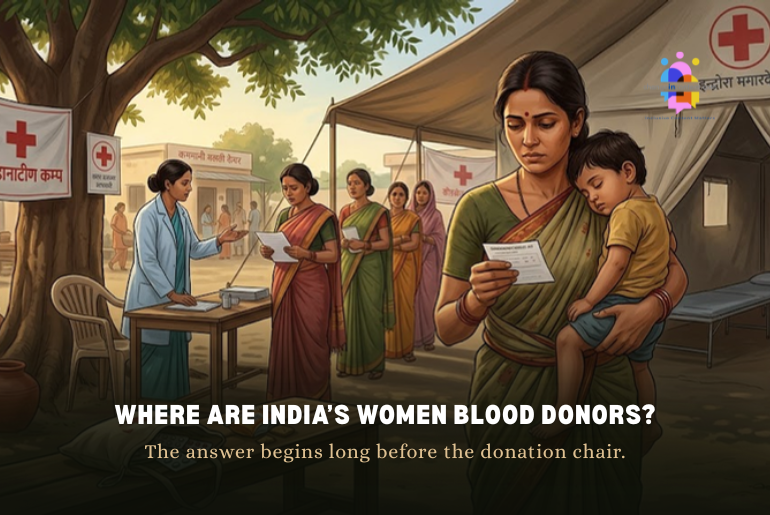
Every time someone donates blood, the act looks immediate. A chair, a needle, a few minutes, a life helped somewhere else. Over the course of a year, that demand rises to nearly 5 crore units. Yet, the country manages to collect only around 2.5 crore units. What we rarely ask is who does not make it to that chair and why.
In India, that question opens up a much bigger story than blood donation alone. It leads straight into women’s nutrition, anaemia, delayed health checks, and the invisible way women’s bodies are often expected to keep functioning without ever being fully supported.
That is what makes the story of women blood donors so revealing. India has improved its blood collection numbers in recent years, yet women remain a very small share of donors. WHO reports that women account for about 33% of blood donations globally, but in some countries the figure remains below 10%. India has long been part of that concern, and newer studies still show a striking gender imbalance.
Less than 10% Indian women are blood donors.
India’s large youth population should have built a strong base of regular blood donors, but that has not happened. Among those aged 18 to 25, nearly 85.5% have never donated blood.
Only about 10-12% of blood donors in India are women. It is not a recent concern. More than a decade ago, the World Health Organisation placed India among 13 countries where women made up less than 10% of blood donors.
What the numbers still show
Even today, the numbers have not moved much beyond that mark. Recent data from the whole-blood donor records maintained at the UPUMS Blood Centre in Saifai, Uttar Pradesh, indicate that males account for 97.6% of donations, while women contribute only 2.4%.
Anaemia is keeping many potential women blood donors out before they begin
Blood donation begins with a basic health check, and haemoglobin levels play a key role in that process. Anyone who does not meet the required level cannot donate. For many women in India, this step itself becomes a barrier.
Low iron intake remains a major concern. Nearly three out of four Indian women do not get enough dietary iron. That directly affects haemoglobin levels. It leads to widespread anaemia. Among adolescent girls, 59.1% were anaemic in 2019.
Around 30% of non-pregnant women, nearly 539 million globally, live with anaemia. At the same time, 37% of pregnant women, close to 32 million, face the same condition. In rural India, two out of every three women were anaemic, and only one out of four was anaemic with depleted iron storage.
Why does iron deficiency keep repeating across life stages
Anaemia is a major public health concern in India, with 58.6% of children, 53.2% of non-pregnant women, and 50.4% of pregnant women being affected by the condition. As a result, women who may want to donate blood often cannot do so. Many get turned away during screening due to low haemoglobin.
Low weight and poor nutrition further shrink the pool of women blood donors.
Low body weight often goes hand in hand with anaemia. Around 22.9% of adult women in India are underweight. India alone accounts for nearly 40% of the world’s underweight women. There is also a broader nutrition gap affecting women across age groups.
Women between 15 and 49 years, with about 23%, are classified as underweight compared to 20% of men in the same age group.
Women who were younger, rural, less educated, poor and middle class have a higher risk for being underweight with anaemia and a lower risk for developing overweight/obesity with anaemia. Regional patterns add to this, with women in parts of eastern, western, and southern India facing greater risk.
Time poverty also limits blood donation.
For many women, daily life revolves around meeting the needs of others first. They manage meals, childcare, elder care, and often a job, all within a limited time. In this routine, their own health receives no attention. Regular checkups get postponed, symptoms get ignored, and small health concerns build over time. This directly affects their eligibility to donate blood, as conditions such as low haemoglobin or poor nutrition remain unaddressed.
Even when women feel willing to donate, they rarely find the time to act on it. Blood donation requires planning, travel, and recovery time. For someone already handling multiple responsibilities, setting aside a few hours becomes difficult. Many also depend on family approval or support to step out.
As a result, blood donation moves down the list of priorities. It is not due to lack of intent, but because daily demands leave little space for women to focus on their own health or take part in activities like donation.
Low numbers of women donors do not start at the donation centre. They start much earlier, with what women eat, how often their health gets checked, and how their health gets pushed aside.
This pattern also connects to what we explored earlier in our piece on gender disparity in organ donation, where women’s bodies are relied upon within healthcare systems. Still, women themselves often receive care and participation under unequal conditions.
The Changeincontent perspective
The story of women blood donors is not really a story about reluctance. It is a story about how women’s health is quietly and early weakened. By the time many women arrive at a donation centre, anaemia, low weight, untreated nutritional gaps, and lack of regular health monitoring have already narrowed their chances.
That means the donor gap is not beginning at the blood bank. It is beginning in kitchens, family routines, school-age nutrition, delayed checkups, and the widespread assumption that women can continue to give while their own health remains secondary.
The solutions, therefore, cannot stop at donor drives. India needs better iron and nutrition support for girls and women, routine screening that detects low haemoglobin earlier, and donation systems that fit around women’s lives rather than assuming they have spare hours to give.
Mobile donation camps, workplace donation options, and clearer follow-up after failed screening could all help. But the larger lesson is simple: a country cannot expand women’s blood donation without first taking women’s health seriously.
Conclusion: India cannot grow women blood donors without first fixing women’s health
The low participation of women in blood donation is not due to selfish reasons. It begins with a deeper health crisis. High levels of anaemia and poor nutrition leave many women unable to meet basic eligibility criteria.
When haemoglobin levels remain low and body weight falls below the required limit, women get turned away even before they can donate. It keeps a large section of willing donors out of the system.
India cannot address its blood shortage without first addressing this reality. Improving iron intake, tackling anaemia, and ensuring better nutrition for girls and women must come first. Alongside this, access to health checks and flexible donation options can help more women step forward. India does not lack willing women; it lacks the support needed to enable them to qualify and donate.
Disclaimer: The views expressed in this article are based on the writer’s insights, supported by data and resources available both online and offline, as applicable. Changeincontent.com is committed to promoting inclusivity across all forms of content. We broadly define inclusivity in terms of media, policies, law, and history. It encompasses all elements that influence the lives of women and marginalised individuals. Our goal is to promote understanding and advocate for comprehensive inclusivity.
