
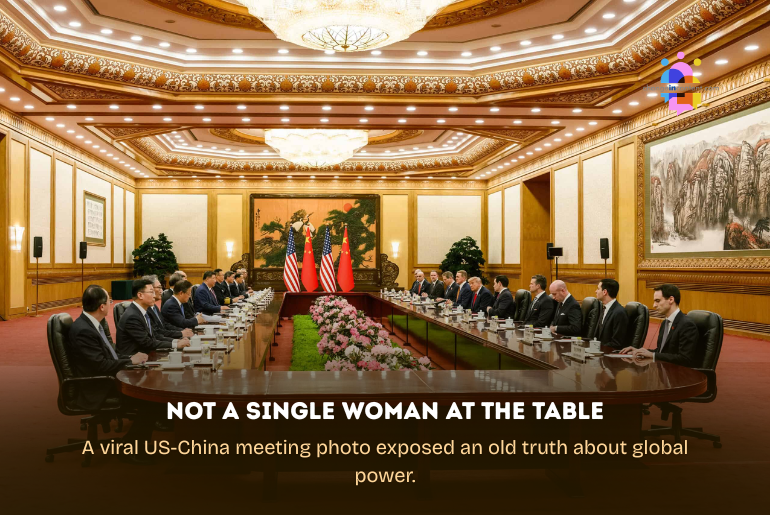
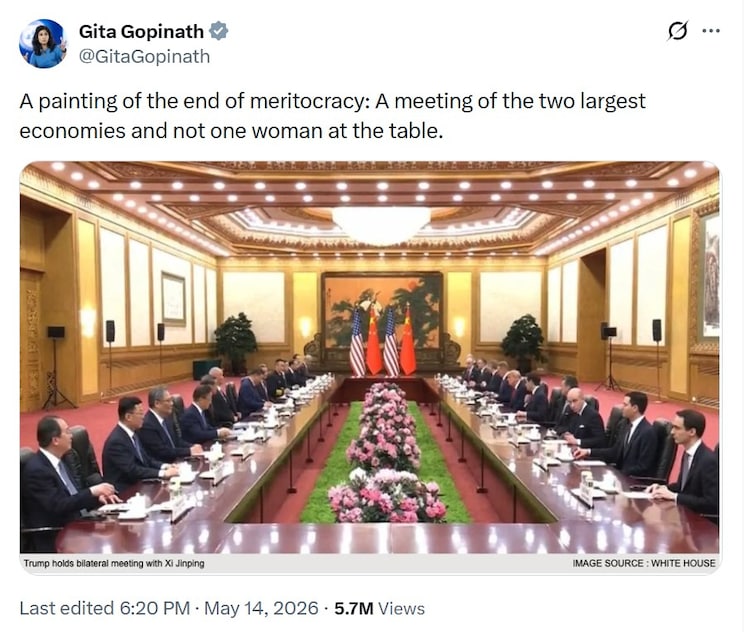
Women are still missing from the world’s most important decision-making tables. That is not just a phrase, which should become a part of the gender reports. It was visible in one photograph from the recent US-China bilateral meeting between US President Donald Trump and Chinese President Xi Jinping. The image showed the two largest economies sitting across from each other, with not one woman at the table.
Former IMF First Deputy Managing Director and Harvard economist Gita Gopinath shared the photo on X and wrote: “A painting of the end of meritocracy: A meeting of the two largest economies and not one woman at the table.”
The photo quickly triggered a global debate because it did what numbers often fail to do. It made exclusion visible. In one frame, the world saw how political power, economic strategy, security discussions, trade decisions, and global diplomacy can still be shaped inside rooms that look almost exactly as they did decades ago. The issue was not only that women were absent from one meeting. The issue was what that absence symbolised.
Key takeaway
When women are missing from the world’s biggest decision-making rooms, the loss is not symbolic. It affects the topic of discussions, the ignorance towards issues, whose experiences we treat as expertise, and whose lives we shape without meaningful representation. The viral US-China photo was a reminder that progress in education, corporate leadership, economics, diplomacy, and public life has not yet fully translated into power at the table.
Women are still missing from decision-making in the world’s most powerful rooms
Even in 2026, women continue to be missing from many of the rooms where major political and economic decisions are made. From international diplomacy to national policymaking, men still dominate leadership tables, including in discussions that directly affect women’s lives.
The lack of women at the US-China meeting did not start or end with that one photograph. Across politics, business, diplomacy, academia, and conference platforms, women are still less likely to get the highest visibility roles.
They are often absent from plenary talks, keynote sessions, invited panels, negotiation tables, advisory boards, and closed-door strategy spaces. These are spaces that set the agenda long before the public ever sees the outcome.
That points to a deeper, more systemic bias about who we see as an expert, who we invite into important rooms, and whose opinions we treat as valuable. Even today, men continue to dominate many strategic conversations around the economy, security, technology, climate, trade, healthcare, artificial intelligence, and global policy.
The photo was viral because the pattern was familiar
The US-China image travelled quickly because it did not feel like an exception. It felt familiar. Many women have seen versions of this room before.
- The conference panel where all the experts are men.
- The boardroom where women’s role is to take notes, not make decisions.
- The newsroom meeting where teams discuss women’s issues without women editors.
- The policy table where male officials debate maternal health.
- The economic summit where leaders present women as beneficiaries rather than architects.
That is why Gopinath’s comment struck a nerve. The absence was not only visual. It was structural.
Women still missing from decision-making: What does the data show?
The latest data from IPU and UN Women shows that in 2026, only 28 countries have a woman Head of State or Government. At the same time, 101 countries have never had a woman leader. UN Women also reports that as of January 2026, just 16 countries have a woman Head of Government.
Diplomacy shows a similar imbalance. A 2026 UN Women policy paper noted that women held only 22.5% of ambassador and permanent representative positions globally in 2025. That means the very systems built to negotiate peace, trade, cooperation, security, migration, climate, and development remain overwhelmingly male at the highest levels.
What happens when decisions about women are made without women?
Women are still struggling to get equal space in major political and policy discussions. The issue becomes even more concerning when laws related to women’s rights, safety, healthcare, work, education, reproductive freedom, public transport, social protection, conflict, and economic participation are discussed mainly by male-led leadership groups.
Women are often on the front lines of every major crisis. War, economic instability, climate disasters, rising food prices, healthcare breakdowns, displacement, migration, and public safety failures affect women in specific and often severe ways.
Women carry much of the social and economic burden during difficult times. Yet when we design policies to respond to these crises, women are frequently missing from the decision-making table.
That creates a dangerous gap between lived reality and elite decision-making.
- A policy can look complete on paper and still miss the daily risks women face.
- A diplomatic agreement can speak of stability while ignoring gendered violence.
- An economic plan can promise growth while failing to account for unpaid care work.
- A security discussion can address borders while overlooking women displaced by conflict.
- A healthcare decision can use the language of public welfare while ignoring women’s access, mobility, stigma, caregiving load, and reproductive needs.
In many cases, authorities draft laws and policies without directly taking input from the women most affected by them. That gap is not accidental. It reflects a system that still treats women’s experiences as secondary evidence.
Also Read: Women in Peacekeeping: The missing force in a world that cannot afford half its wisdom.
Presence is not power if women are still not heard
Being present in the room does not always mean being treated equally. Many women continue to face behaviours like:
- Mansplaining, where men explain things to women in a patronising way;
- Manterrupting, where women are interrupted while speaking;
- Bropropriating, where a woman’s idea is ignored until a man repeats it and receives the credit.
These behaviours may sound informal, but they shape professional power. They decide who appears confident, who comes across as difficult, who gets credit, who we remember, and who we invite back.
Research based on thousands of economics seminars found that women presenters were interrupted more often than men. The study also found that women faced more patronising and hostile questions and were more likely to be interrupted during their presentations.
The room can include women and still silence them.
That is one of the reasons why representation must go beyond optics.
- A room can include women and still silence them.
- A panel can have a woman speaker and still give her less time.
- A board can appoint women and still keep real decision-making elsewhere.
- A government can celebrate women’s participation while excluding them from the final negotiation table.
True decision-making power means women are not only a part of the room photograph. Instead:
- They shape the agenda
- They lead the discussion
- They challenge assumptions
- They influence outcomes
- They sign the agreement
- They define what counts as national interest, economic strength, security, development, and justice.
The absence of women from major tables also sends a message to younger women watching from outside. It tells them that merit may take them far, but networks, power structures, and old assumptions may still decide who gets the final seat.
That is why the phrase “end of meritocracy” felt so sharp. If the world’s biggest economies can meet without one woman at the table, then the question is not whether qualified women exist. The question is why power still behaves as if they do not.
The Changeincontent perspective on women still missing from decision-making
The viral US-China photo was not powerful because it shows something new. It was powerful because it showed something old refusing to disappear.
A room full of men deciding the future is not an accident. It is the result of systems that have long confused access with authority, participation with power, and token presence with equality.
Women have entered universities, workplaces, public institutions, research, economics, law, diplomacy, entrepreneurship, and politics. Yet the final rooms still too often remain guarded by habits older than the language of inclusion.
That is why the conversation cannot stop at “add women”. Women do not need decorative seats. They need decision-making power.
They need to be in the rooms where trade negotiations, war discussions, budget allocations, health system design, technology regulation, climate policy writing, and national priority setting occur. Not because they represent only women, but because no democracy, economy, or institution can claim excellence while excluding half the population from serious power.
The closing thoughts
The US-China image should bother us because it revealed how comfortable the world still is with male-only authority. It should also make every organisation, government, university, newsroom, board, conference, and policy body look at its own tables.
- Who is missing?
- Who is invited but ignored?
- Who is present but powerless?
- Who speaks, and who is interrupted?
- Who gets credit?
- Who signs the decision?
Women Still Missing from Decision-Making is not a slogan. It is a warning. A world built without women at the table will keep producing decisions that women are expected to survive.
Editorial Note and Disclaimer
This article is part of Changeincontent’s DEI Insights section, where we examine gender, power, leadership, institutions, public policy, and representation through an evidence-led editorial lens.
The article relies on publicly available reporting around Gita Gopinath’s comment on the US-China bilateral meeting, global data from IPU and UN Women on women’s political leadership, available research and reporting on women’s representation in diplomacy, and wider analysis of gendered participation in professional and decision-making spaces.
Changeincontent has used these inputs for public-interest commentary and does not claim to independently assess the full composition or internal advisory structures of the delegations beyond the publicly visible meeting image and related reporting.
Sources
Gita Gopinath on X: Shared the viral meeting image and called it “a painting of the end of meritocracy”.
SIB Diversity Focus Group: Women underrepresented at Conferences and Summits
Gender Differences in Economic Seminars: Shows how women presenters face way more interruptions than men in economic seminars.
UN Women Facts and Figures, 2026: Provides global data on women’s leadership and political participation.
IPU and UN Women, 2026: Reported that only 28 countries are led by a woman Head of State or Government, and 101 countries have never had a woman leader.
UN Women Policy Paper on Women in Diplomacy, 2026: Reported that women held 22.5% of ambassador and permanent representative positions globally in 2025.
