The Quick Read
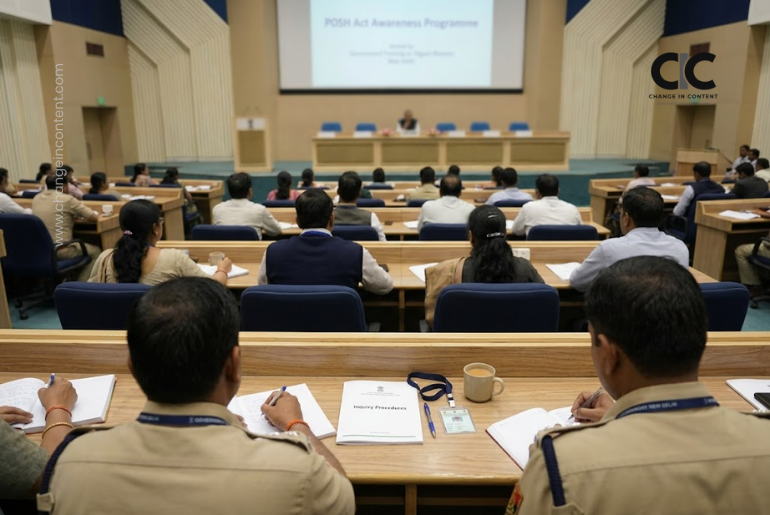
- The National Awareness Programme on POSH Act began at Vigyan Bhawan, New Delhi, on 17 July 2026.
- The two-day programme is being organised by the National Commission for Women.
- Union Minister for Women and Child Development Smt. Annpurna Devi attended as the Chief Guest.
- The programme focuses on stronger awareness, implementation, and inquiry procedures, as well as institutional accountability under the POSH Act.
- A Booklet on Inquiry Procedures for Internal Committees and Local Committees under the POSH Act was released at the event.
National Awareness Programme on POSH Act begins in Delhi
The National Awareness Programme on the POSH Act began at Vigyan Bhawan in New Delhi. It focuses on strengthening workplace safety and improving implementation of the Sexual Harassment of Women at Workplace (Prevention, Prohibition and Redressal) Act, 2013.
The National Commission for Women (NCW) has organised the two-day programme. It brought together senior government officials, legal experts, representatives of the Internal Committees and the Local Committees, civil society organisations, and other stakeholders.
Union Minister for Women and Child Development Smt. Annpurna Devi was the Chief Guest at the programme. Speaking at the event, she said safe, dignified and inclusive workplaces are essential to the vision of women-led development. She also notes that workplace safety is important for increasing women’s participation in the workforce. At the same time, it is vital for inclusive national development.
What the programme focuses on
The programme aims at boosting awareness and implementation.
That matters because POSH compliance cannot remain a paperwork exercise. A workplace may have an Internal Committee on record, which is great. However, women’s safety depends on whether employees know their rights, committees, and understand their duties. At the same time, it aims to ensure that the complaints are handled fairly, and organisations take prevention seriously.
The Minister highlighted the need for fair inquiry procedures, privacy protection, natural justice and timely disposal of complaints. She also called on employers and institutional leaders to show greater accountability in building workplaces based on dignity, sensitivity and zero tolerance towards sexual harassment.
That is where the programme connects with the larger workplace safety conversation. The Government’s SHe-Box 2.0 initiative has already pushed the idea of digital grievance redressal. The current awareness programme adds another layer: institutions must know how to respond properly when complaints are raised.
Booklet on inquiry procedures released
A key development at the event was the release of the Booklet on Inquiry Procedures for Internal Committees and Local Committees under the POSH Act, prepared by the National Commission for Women.
The booklet is intended as a practical guide for fair, transparent and time-bound inquiries under the POSH Act. This is important because many workplace safety failures occur not only when a complaint is ignored, but also when the inquiry process is poorly understood, delayed, insensitive, or mishandled.
The event also included technical sessions on key provisions of the POSH Act, such as the rights of complainants and respondents, complaint handling, and inquiry procedures for Internal and Local Committees.
Why does the National Awareness Programme on POSH Act matter now?
The workplace has changed since the POSH Act came into force in 2013.
Work is no longer limited to one physical office. Hybrid teams, remote work, digital communication, platform work, informal work arrangements and expanding professional networks have made workplace safety more complex.
That is why awareness programmes cannot be seen as ceremonial.
Women need to know where to complain. Employers need to know their legal duties. Internal Committees need proper training. Local Committees need capacity and visibility. Leadership must ensure that complainants are protected, timelines are followed, and retaliation is not tolerated.
The need for stronger implementation has also become sharper as the understanding of POSH compliance expands. The conversation is no longer limited to whether an organisation has a committee. It is about whether the committee is trained, independent, accessible and trusted. This is also central to the wider discussion on POSH compliance in 2026.
The Change in Content View
The National Awareness Programme on POSH Act is a useful policy and institutional signal.
Workplace safety cannot depend solely on the existence of a law. It depends on awareness, implementation, committee capacity, leadership accountability and trust in the redressal process.
The release of an inquiry procedure booklet is especially important. Many organisations still need practical clarity on how to conduct inquiries with fairness, confidentiality, empathy and respect for statutory timelines.
The next test will be on the ground.
- Do more employees understand their rights?
- Do more organisations train their Internal Committees seriously?
- Do Local Committees become more accessible?
- Do women feel safer reporting harassment?
- Do employers treat prevention as culture, not compliance?
A policy file does not create a safe workplace. It is created when every woman knows that dignity at work is not optional.
Editorial Note and Sources
This article is based on the official Press Information Bureau release issued by the Ministry of Women and Child Development on the National Awareness Programme on the POSH Act. It interprets the development through the Change in Content lens of women, work, dignity and institutional accountability. The article is intended for editorial and informational purposes only and should not be read as legal, HR compliance, employment or workplace advisory guidance.
Source used: Press Information Bureau, Ministry of Women and Child Development: Two-day National Awareness Programme on POSH Act begins at Vigyan Bhawan.