
The Quick Read
- Intersectionality in the workplace recognises that employees experience opportunity, bias, belonging and power through more than one aspect of identity at the same time.
- Legal scholar Kimberlé Crenshaw introduced the term “intersectionality” in 1989 while examining how discrimination law could fail Black women when race and gender were considered separately.
- Being a woman does not produce one universal workplace experience. Age, caste, disability, sexuality, class, religion, language, location, caregiving and other circumstances can alter how gender is experienced.
- Intersectionality does not mean creating different workplace rules for every imaginable identity. It means checking whether apparently fair systems produce blind spots for particular groups.
- For India, the lens is particularly useful because workplaces bring together enormous differences in caste, class, language, region, education, disability and family background. Change in Content has previously examined these gaps in its coverage of DEI blind spots in Indian workplaces.
- For women themselves, understanding intersectionality can help make sense of experiences that otherwise get dismissed as a confidence problem, a culture fit problem, or an individual failure.
- For organisations, the practical question is simple: who is benefiting from a policy, and who is still struggling to use it?
Intersectionality in the workplace: An introduction
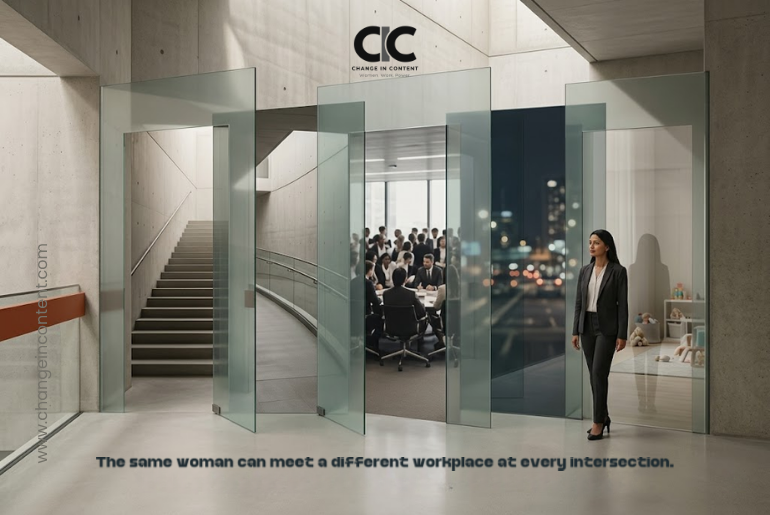
A woman walks into an appraisal meeting.
Already, we know very little about her.
- Is she 26 or 56?
- Does everybody in the room speak a language she grew up speaking?
- Did she attend an elite university?
- Is she the first person in her family to work in a corporate office?
- Does she have a visible disability? An invisible one?
- Does her surname reveal something colleagues notice?
- Has she returned after having a child?
- Does she have children at all?
- Is she queer?
- Does she travel two hours to reach this office?
- Can she stay for the famous 8.30 pm “informal discussion” where decisions mysteriously happen after the meeting supposedly ended?
- And is she the only woman in the room, or merely the only woman like her?
Welcome to intersectionality in the workplace.
The term sounds like something somebody might put into a 73-slide DEI presentation just before everybody discreetly checks their phones. The idea itself is much more useful.
It tells us that people do not arrive at work divided neatly into separate folders labelled: Woman. Age. Caste. Disability. Class. Parent.
One human being carries all of those realities into the same Monday morning.
Sometimes they barely matter. Sometimes they change everything.
Where did the idea of intersectionality come from?
Legal scholar Kimberlé Crenshaw coined the term in her 1989 paper, Demarginalising the Intersection of Race and Sex. Her argument emerged from examining how American anti-discrimination law sometimes treated race discrimination and sex discrimination as separate categories. That creates problems for Black women whose experiences could involve both simultaneously.
Her later work developed the idea further, particularly in relation to violence against women of colour.
The easiest way to understand the original insight is this: Imagine a road intersection. One road is gender. Another is race.
A person standing where the roads meet can experience traffic coming from both directions. Looking at only one road does not explain everything happening at the junction.
Over time, intersectionality has been used more broadly to examine how gender can interact with race, class, sexuality, disability, immigration status and other dimensions of social power.
Move that idea into a workplace, and things become surprisingly familiar.
The workplace version: 2 women can work for the same company and inhabit very different companies
Suppose a company proudly tells us: “Women make up 45% of our workforce.” Useful number.
Now keep asking.
- What percentage of senior leaders are women?
- How many women with disabilities work there?
- How many women from historically marginalised communities reach management?
- Where are women located geographically?
- Which women leave after childbirth?
- Who gets international assignments?
- Who occupies revenue roles?
- Who works contract jobs?
- Who feels comfortable speaking in leadership meetings?
- Who gets invited into informal networks?
- Who is still there at 50?
The 45% has not become false. It has become more informative.
That is one reason our recent story on workplace loneliness among women argued that gender alone cannot explain belonging. Language, caste, race, religion, disability, sexuality, age, class, parenthood and geography can influence whether someone feels naturally included in the social life of an organisation.
Intersectionality simply tells us to keep the camera zoomed in long enough to notice.
Let us try it on a few women
Theory becomes considerably less frightening once real life enters the room.
The young woman who keeps being called ‘promising’
She is 25. Excellent qualifications. 3 years of experience. Every appraisal says she has “great potential”. Which is lovely.
At some point she would quite like somebody to notice the part where the potential has already become competence. Gender bias can combine with age bias here.
Change in Content has previously examined how younger women can face a credibility problem created by age and gender together. A young man may be considered ambitious or precocious. A similarly assertive young woman can more easily be read as inexperienced, aggressive or impatient.
That is intersectionality in ordinary office clothing. Nobody had to announce: “Today we shall discriminate on two axes.” That is rarely how bias arrives.
The woman with a disability
Now imagine the organisation has a very good women’s leadership programme. There is one problem.
- The venue is inaccessible.
- Or the learning platform does not work properly with assistive technology.
- Or networking sessions rely heavily on environments that exclude someone with sensory needs.
- Or managers assume a disabled woman would not want a travelling role.
The programme is gender-inclusive. It is not necessarily inclusive for every woman.
Our earlier story on women with disabilities in India examined precisely this layered experience: gender, disability and socioeconomic barriers can operate simultaneously in employment and public life.
An intersectional approach does not create a more elaborate label for her. It asks whether the opportunity actually reached her.
The woman returning at 44
She has 18 years of experience. Then caregiving interrupted her career.
She returns to discover that she is somehow both: too experienced for junior roles and too out of touch for senior ones.
A remarkable piece of workplace geometry. Here, gender can meet age and caregiving.
Returnship programmes can help, but our coverage of women returning after career breaks shows why the challenge continues beyond simply creating an entry route. Women can encounter role downgrading, assumptions about commitment and penalties attached to interrupted careers.
Now add geography, disability or class. The experience shifts again.
The first-generation professional
2 people join the same graduate programme.
One has parents who understand corporate careers. She already knows that:
- You negotiate an offer;
- You ask what the promotion criteria are;
- A coffee with the VP can be useful;
- “Let’s catch up sometime” occasionally requires an actual follow-up;
- And people who say “visibility matters” are unfortunately not joking.
Another employee may be learning the unwritten rules while simultaneously trying to perform the written job.
Class and educational background influence access to cultural capital, networks and confidence navigating institutions.
India makes this especially relevant.
Our article on meritocracy and diversity in Indian workplaces explored how apparently neutral markers such as elite educational credentials can advantage people who had very unequal access to those institutions in the first place.
It does not mean achievement should stop mattering. It means we should occasionally inspect how the race was organised before admiring only the finish time.
In India, intersectionality cannot simply be imported from an American DEI handbook
Crenshaw’s original framework emerged from the experiences of Black women within the US legal system.
The underlying lens travels. The social categories need local intelligence.
In India, an intersectional workplace analysis could involve combinations of:
- Gender
- Caste
- Class
- Religion
- Disability
- Language
- Region
- Rural or urban background
- Age
- Sexuality
- Marital status
- Parenthood and caregiving
- Educational access
- Employment status
- Migration
- Socioeconomic background
Caste, for example, cannot be translated lazily into an American racial framework. It has its own history and workplace implications.
Change in Content has previously examined the barriers facing Dalit women in employment and economic participation, where gender can interact with caste, access to education and economic position.
India also has enormous linguistic diversity. A brilliant employee who is uncomfortable speaking polished corporate English may be judged differently from an equally capable colleague whose schooling made that language natural.
- Regional accents become signals.
- College names become signals.
- Addresses become signals.
- Surnames can become signals.
And sometimes, the workplace insists it sees none of these things while everybody inside it knows perfectly well that people do.
Intersectionality asks us to examine that contradiction.
Intersectionality is not ‘women have it worse’
Here is a part that deserves emphasis. Intersectionality is frequently flattened into a competition in disadvantage. It should not be.
The idea is not:
- Woman = disadvantaged.
- Woman + disability = more disadvantaged.
- Woman + disability + caste = maximum disadvantage.
Human life is not a loyalty-points programme for oppression. Different identities can produce disadvantage in one setting and advantage in another.
- A senior woman may encounter sexism while possessing considerable organisational power.
- A young man from a marginalised socioeconomic background may experience barriers a wealthy woman does not.
- A highly educated urban woman may benefit from class privilege while facing gender bias.
- A woman may be marginalised in one environment and powerful in another.
Context matters. So does power.
That is what keeps intersectionality from becoming a simplistic identity checklist.
Nor does every unpleasant workplace moment require an intersectional diagnosis
Your boss may disagree with you because your proposal was bad.
Sometimes, your colleague may have forgotten to invite you because your colleague forgets everything, including occasionally the existence of Tuesday.
A promotion may go to somebody else because that person performed better.
Intersectionality should help organisations see patterns. It should not eliminate evidence, performance standards or ordinary human complexity.
The questions are:
- Does the same pattern keep happening?
- Who repeatedly misses the opportunity?
- Does a supposedly neutral system disadvantage a particular group?
- Are some employees carrying frictions others rarely encounter?
That is where the lens becomes useful.
Intersectionality in the workplace: The great diversity-data problem
Intersectionality creates a measurement challenge.
Suppose an organisation looks at promotion rates for women. Fine. Then it looks at employees with disabilities. Also fine.
But what happens to women with disabilities?
The aggregate numbers can hide them. Something similar can happen when organisations analyse women; older employees; parents; employees from particular communities; LGBTQ+ people; and people from lower-income backgrounds as entirely separate groups.
The smaller intersections disappear statistically.
There is an obvious counterproblem: collecting increasingly granular personal data can create privacy, trust and even identification risks, particularly where groups are small.
So companies need judgement. Collect only data that is lawful, proportionate and genuinely useful. Protect confidentiality. Explain why it is being collected. And never turn people’s identities into a giant spreadsheet because HR discovered filters.
What does intersectionality change in an actual workplace?
Quite a lot, if we let it. Here are 8 places I would look first.
1. Recruitment
Stop asking only: Are women applying?
- Also examine where women drop out.
- Which campuses do you recruit from?
- Does the role unnecessarily require relocation?
- Does the application platform meet accessibility needs?
- Does an unexplained career gap quietly downgrade candidates?
- Does “excellent communication” actually mean one particular accent and manner of speaking?
- Do referrals reproduce the existing social network?
An intersectional recruitment audit looks at the route into the company, not merely the final gender ratio.
2. Promotion
A workplace may achieve gender balance at entry level and lose it progressively. That already tells us to inspect promotion.
Then go deeper.
- Are mothers promoted at the same rate?
- Women returning from breaks?
- Women outside headquarters?
- Women over 45?
- Women in operational roles?
- Women who do not belong to informal leadership networks?
Our coverage of tokenism in workplace inclusion makes the larger point: representation without access to authority can create the appearance of inclusion while leaving power largely untouched.
3. Flexible work
A universal flexible-work policy sounds wonderfully equal.
An intersectional question asks who can actually use it without consequences.
- Does the mother using flexibility get labelled less committed?
- Does an employee with a disability have to disclose private medical information repeatedly to receive an adjustment?
- Does the employee living far from an expensive city gain more from hybrid work?
- Do junior employees fear using a benefit senior leaders publicly endorse?
Same policy. Different experience.
4. Networking
This one deserves suspicion. Workplaces like to believe promotion happens through competencies and performance frameworks.
Then someone says: “You really need to build relationships.”
Which often means the actual organisation chart has a shadow version.
Golf. Drinks. Late dinners. Travel. Alumni groups. Old friendships. Language circles. Client entertainment. Informal WhatsApp groups.
Those spaces can advantage some employees and exclude others for reasons extending beyond gender.
That does not mean banning dinner. It means ensuring access to consequential relationships does not depend entirely on who can comfortably join one.
5. Workplace safety
Women do not all experience safety identically.
A late-night shift means something different depending on transport access, neighbourhood, disability, caregiving responsibilities and the nature of the work.
A harassment policy may exist while an employee in a contract role worries that complaining will simply end her assignment.
Power affects whether a right feels usable. That is the intersectional question.
6. AI
Yes, intersectionality has found AI too. It was inevitable. Everything has.
As algorithmic tools enter recruitment, performance management and workplace decision-making, employers need to consider whether broad categories conceal poorer outcomes at their intersections.
An AI system could perform acceptably for “women” overall and still perform poorly for particular groups of women. That is one reason research into algorithmic fairness increasingly examines intersectional effects rather than only one demographic category at a time.
The algorithm may not have office politics. It can still inherit ours.
7. Benefits
Consider parental benefits. Excellent.
Now consider employees caring for ageing parents. Single employees. Childfree employees. Employees supporting siblings. Workers undergoing treatment. People with disabilities.
A benefits package built around one imagined employee can exclude enormous portions of the real workforce.
Our recent analysis of childfree women and workplace culture showed one version of this problem: flexibility designed around parents can unintentionally lead colleagues without children to be treated as permanently available.
Intersectionality often improves systems because it forces organisations to stop designing around fictional average employees.
8. Belonging
This may be the least measurable and most immediately felt.
- Can I speak naturally here?
- Can I disagree?
- Do I have to change my accent?
- Hide my partner?
- Avoid discussing where I grew up?
- Straighten my hair?
- Downplay my disability?
- Pretend I do not have caregiving needs?
- Laugh at something I found offensive?
- Change how I dress?
- Change how I speak?
- Change enough pieces of myself that the company eventually congratulates me for fitting its culture?
That behaviour has a name in many contexts: code-switching.
Our earlier guide to code-switching at work explored why women and LGBTQ+ employees in particular may alter behaviour, language or presentation to reduce social and professional risk.
Belonging is when the performance becomes less necessary.
For women: How can an intersectional lens actually help you?
This should not remain an HR concept. It can be personally useful.
Name the friction accurately
Sometimes the quickest explanation offered to a woman is: “You need more confidence.”
Maybe. But ask another question: Would someone with exactly your behaviour but a different age, gender, accent, caregiving history or background be interpreted in the same way?
Do not assume discrimination. Do not automatically assume personal inadequacy either.
Look for evidence.
Separate what you can change from what the system needs to change
Improve skills. Seek feedback. Build relationships. Learn to negotiate. Ask for stretch work.
All sensible. But you cannot individually productivity-hack your way out of every structural problem.
If an inaccessible office prevents participation, the employee does not need more resilience. The ramp does.
Find people who understand different parts of your experience
One mentor does not have to contain the wisdom of civilisation.
You may need: a sector mentor; a senior woman; someone who understands disability; a peer who shares your family realities; a sponsor who knows how power works; and somebody who will tell you when you are simply wrong.
Build a network, not a guru.
Do not let an identity become a ceiling
Intersectionality explains barriers. It should not write destinies.
You are allowed to understand a structural disadvantage without converting it into an expectation of failure.
The point of identifying a barrier is to make better decisions around it.
And what should workplaces do without turning intersectionality into HR theatre?
Here is the short practical version.
-
- Segment outcomes carefully: Gender averages are useful. Sometimes look underneath them.
- Audit consequential moments: Hiring. Pay. Promotion. Performance ratings. Exits. Leadership programmes. High-value assignments.
- Listen before designing: Do not ask one woman to represent all women. Especially during lunch.
- Design for flexibility: Build systems that accommodate more than one respectable way of having a life.
- Make accessibility ordinary: Accessibility should enter planning before somebody has to request it.
- Examine informal power: Who gets information early? Who gets sponsorship? And who knows whom?
- Protect privacy: Intersectionality is not permission to demand intimate disclosures.
- Measure experience alongside representation: A wonderfully diverse workforce can still have a very uniform leadership culture.
And perhaps most importantly: Do not announce an intersectionality initiative unless somebody can explain what it is supposed to change.
The world already has enough workplace campaigns with excellent logos.
The easiest intersectionality test I know
Take any workplace policy. Then ask: For whom is this policy easiest to use? That question is surprisingly revealing.
- A mentoring programme.
- A late-shift policy.
- A leadership retreat.
- Remote work.
- A grievance system.
- Health insurance.
- Maternity support.
- Travel requirements.
- A promotion framework.
- A networking event.
- An AI recruitment tool.
- Who finds it straightforward?
- Who has to make three additional arrangements before participating?
- Who quietly opts out?
- And whose absence gets interpreted as lack of ambition?
There. You have started doing intersectional analysis. No Venn diagram required.
The Change in Content Perspective: Women are not a demographic setting
There is a reason intersectionality in the workplace belongs comfortably inside our conversation about Women. Work. Power.
Power is rarely distributed along one clean line.
A woman may be powerful because of her seniority and marginalised because of her gender. Advantaged by class and disadvantaged by disability. Confident professionally and constrained by caregiving. Included in the gender numbers and absent from the leadership table.
People are complicated. Good workplace systems can survive that complication.
The objective is not to create a bespoke HR policy for every possible combination of human identity. It is to stop designing organisations around one imaginary employee and then wondering why everybody else needs an exception.
Women do not need to be treated as one homogeneous group. Men should not be either.
What we should keep working towards is something simpler and considerably more ambitious: A workplace where differences do not unnecessarily determine access to opportunity, dignity, safety or power.
Intersectionality gives us a better map of where that has not happened yet. What we do with the map is up to us.
FAQs
Q: What is intersectionality in the workplace?
A: Intersectionality in the workplace is a way of understanding how different aspects of identity, such as gender, age, caste, race, disability, class or sexuality, can interact to shape an employee’s experience of opportunity, bias and belonging. The concept originates in Kimberlé Crenshaw’s work on overlapping race and sex discrimination.
Q: What is an example of intersectionality at work?
A: A woman may face gender bias, while a younger woman may simultaneously encounter gender and age-related assumptions about credibility. Similarly, a woman with a disability may experience barriers that a gender-only inclusion policy does not address.
Q: Why is intersectionality important for women at work?
A: Women do not share identical workplace circumstances. Intersectionality helps employers understand why a policy that appears inclusive for women overall may still exclude particular groups of women.
Q: Is intersectionality only about discrimination?
A: No. It can also help explain access, privilege, belonging, networks and power. A person can experience advantage in one part of their working life and disadvantage in another.
Q: How can companies apply intersectionality in the workplace?
A: Companies can examine hiring, pay, promotions, leadership programmes, benefits, accessibility and employee experience across relevant groups while protecting privacy. The aim is to identify patterns that broad averages may conceal.
Q: Does intersectionality mean lowering merit standards?
A: No. An intersectional approach can help organisations examine whether their definition or measurement of merit contains unnecessary barriers. Performance standards and fair evaluation remain important.
Editorial Note and Disclaimer
This Knowledge Hub article uses intersectionality as an analytical framework for understanding workplace experience. The concept originated in Kimberlé Crenshaw’s legal scholarship on race and gender discrimination in the United States and has subsequently been applied across wider contexts. Its application in India requires sensitivity to India’s distinct social, economic and cultural realities, including caste, class, language, religion, disability and regional difference. Examples in this article are explanatory illustrations unless specifically linked to research. The article is intended for educational and editorial purposes and does not constitute legal, HR or employment advice.
Sources
- Kimberlé Crenshaw, Demarginalising the Intersection of Race and Sex, University of Chicago Legal Forum, 1989
- Kimberlé Crenshaw, Mapping the Margins: Intersectionality, Identity Politics, and Violence against Women of Colour
- Encyclopaedia Britannica – Intersectionality
- Harvard University – Crenshaw’s foundational intersectionality scholarship
