
What You Must Know
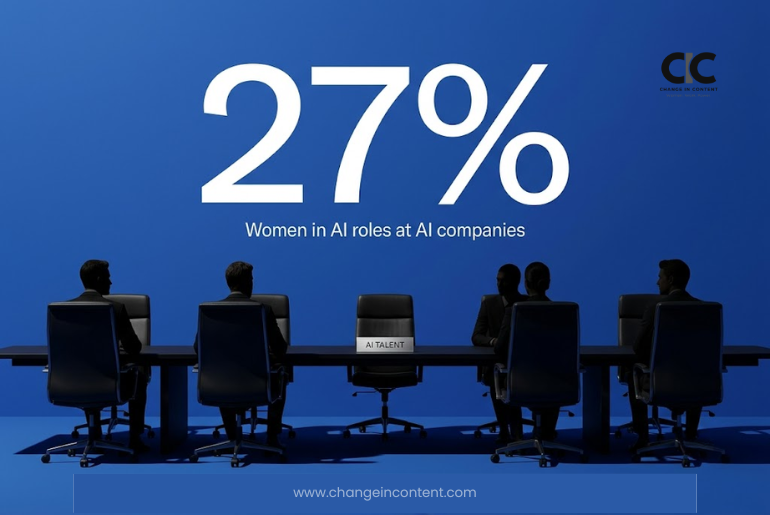
- Women are missing out on AI’s best-paid opportunities. LinkedIn says women accounted for just 26% of AI hires in the US in 2025, compared with 50% of hires into non-AI occupations.
- The gap widens higher up. Across 27 countries, women hold only 13% of C-suite AI leadership roles at AI companies.
- This is not only about hiring. Women are also underrepresented in AI roles, underrepresented at AI-focused firms, and far less visible in top AI decision-making roles.
- India cannot treat this as a foreign problem. Earlier LinkedIn data showed women made up 29% of AI talent in India. That is progress, but not parity.
- The real response is equal opportunity plus equal skilling. If women are to benefit from the AI economy, the pipeline into these roles has to be widened, not just talked about.
Women and the AI Jobs Boom
AI has become the career promise of this moment. That is why the women-and-AI jobs boom is not a niche conversation for coders or tech insiders. It is now a workplace issue, a policy issue, a skilling issue and, increasingly, a question of economic power.
The latest data makes one thing clear: AI is producing some of the fastest-growing and highest-paying jobs in the labour market. However, women are not entering these roles in equal measure.
LinkedIn’s latest research says AI job postings in the US have roughly doubled since 2023, and the typical AI job posting lists compensation of about $177,000, compared with $80,000 for a typical non-AI role. Yet women accounted for only 26% of AI hires in 2025, compared with 50% of hires into non-AI occupations. Across 27 countries, women hold only 13% of C-suite AI leadership roles at AI companies. Those are not small gaps. They are structural ones.
That is where the story becomes bigger than a headline.
The issue is not whether women can do the work
Too often, the conversation around women in AI slips into an old and lazy trap: if fewer women are in the room, perhaps fewer women are interested, qualified or competitive. The data does not support that comfort.
The World Economic Forum, in collaboration with LinkedIn, has already warned that AI-driven workplace change could deepen existing gender gaps if employers do not intervene properly. It notes that women remain underrepresented in STEM, especially in senior roles, but also points out that the current shifts offer a real chance to widen the talent pool if more women are equipped with the right skills.
That matters because the opportunity is not trivial. These are not side jobs. These are roles that shape products, systems, teams, pay scales and future influence.
The problem, then, is not a lack of female capability. It is that women are still encountering a thinner bridge into the AI economy.
The AI economy has a ladder problem
LinkedIn’s own research captures this well. The gender gap does not appear at one single stage. It compounds.
Women’s share in AI roles is lower than in non-AI roles. It drops further inside AI-focused companies. It drops even further in C-suite AI leadership. LinkedIn describes these as stacked penalties. In practical terms, that means many women are not only underrepresented in the field; they are also less likely to land at the firms where AI is core business. At the same time, they are still less likely to reach the level where decisions are made.
Then there is the pay pattern.
Women’s representation is lower in some of the best-paid AI roles, including Head of AI, Director of AI, and Member of Technical Staff. That means women are not merely absent in headcount terms. They are also less present where the money, authority and long-term influence are concentrated.
That is why this gap should worry anyone who cares about fair growth.
There is another side to the problem: Women are more exposed to AI disruption
The irony is hard to miss.
At the same time that women are underrepresented in high-value AI roles, they are also more likely to be in jobs that generative AI can disrupt. The World Economic Forum notes that women are more likely to work in roles that AI could disrupt, while men are more likely to be in AI-augmented roles. In other words, many women face a double squeeze: they are more exposed to the downside of AI, and less included in its upside.
That distinction deserves more attention in India too.
We have already seen on Change in Content that AI and employment risk for women are not abstract theories. Many women are concentrated in administrative, support, service and process-led jobs that are vulnerable to automation or redesign. If those same women are not supported in moving into higher-value digital and AI roles, the transition will not be fair.
India should read this as a warning, not a distant global story
It would be a mistake to read this as something happening elsewhere.
Earlier, LinkedIn data showed that women made up 29% of AI talent in India. That is not negligible, but it is still far from balanced. India is also moving deeper into AI-led growth, digital public infrastructure, enterprise AI adoption, AI services and platform-led work. That means the country still has time to build a better entry route before the gap hardens further. That is where India’s debate must mature.
We cannot keep celebrating digital progress in broad strokes while ignoring who gets access to the high-value end of it. We have already argued in Women and India’s Digital Policy: Access vs Agency that access alone is not enough. A woman may have a smartphone, a data connection and a LinkedIn profile, yet remain far from the networks, training, confidence and recruitment systems that unlock serious career mobility.
The next step is not symbolic inclusion. It is practical access.
So why are women being left behind?
No single reason explains this.
- Some of it begins early, with lower representation in technical pathways and uneven confidence-building around STEM and AI.
- Some of it comes from hiring systems that still reward narrow, familiar profiles.
- Some of it comes from job descriptions that are written for a mythical perfect candidate rather than a capable one.
- Some of it comes from workplace cultures that remain harder for women to stay in and rise through.
- And some of it is plainly about support: who gets mentorship, stretch work, sponsorship and skilling opportunities first.
There is also a behavioural layer. Many women still assess job fit more cautiously than men, especially in emerging or male-dominated fields. That does not mean women are less competitive. It means employers cannot keep designing opportunity around those who are loudest or earliest to self-nominate.
If organisations want more women in AI, the question is not, “Why aren’t women showing up?” The question is, “How have we designed the door?”
What would a better response look like?
A good response starts with honesty.
Companies that are serious about equal opportunity in AI should audit who is being hired into AI roles, which functions feed those roles, what the promotion routes look like, and whether women are reaching the high-value positions or being clustered in lower-paid AI-adjacent work.
Then comes the skilling piece. Women need targeted exposure to AI learning, not generic encouragement. That means employer-sponsored learning, hands-on project work, cross-functional AI assignments, internal apprenticeships, mentorship and better visibility into what different AI roles actually require.
The World Economic Forum has noted that women’s share among people listing AI engineering skills on LinkedIn rose from 23.5% in 2018 to 29.4% in 2025. So movement is happening. The challenge is scale, speed and progression.
This is also why Women and the Future of Digital Work in India remains a useful lens. Women do not need a narrow invitation into digital work. They need pathways into better digital work.
The Change in Content View
The AI boom is not gender-neutral.
It is already deciding who earns more, who learns faster, who builds the future and who gets to shape decisions around technology. If women remain underrepresented in the fastest-growing and best-paid roles, the cost will not be limited to individual careers. It will affect economic mobility, organisational intelligence and the fairness of the systems we are building.
The answer is not tokenism. It is not a decorative panel discussion either.
The answer is a sharper commitment to equal opportunity, earlier exposure, better skilling, more transparent hiring and stronger progression routes. Women should not be left carrying the burden of adaptation alone while institutions remain comfortably unchanged.
AI may be the future of work. But whether that future works for women depends on what we do now.
FAQs
Q: Why are women underrepresented in AI jobs?
A: Women are underrepresented for several reasons: weaker entry pipelines into STEM and AI, unequal access to skilling, hiring biases, lower visibility in AI-focused firms, and slower progression into leadership roles.
Q: Do AI jobs pay more than non-AI jobs?
A: Yes. LinkedIn says the typical AI job posting in the US lists compensation of about $177,000, compared with $80,000 for a typical non-AI role.
Q: Is this issue relevant to India?
A: Yes. Earlier LinkedIn data showed women made up 29% of AI talent in India. As India deepens AI adoption, the quality of access women receive will shape future career outcomes.
Q: What should companies do differently?
A: They should widen AI skilling opportunities, review hiring patterns, redesign narrow job descriptions, create internal pathways into AI roles, and measure whether women are progressing into better-paid and more influential positions.
Q: What can women do right now?
A: Women can start building practical AI familiarity through courses, certifications, project-based learning, prompt work, product understanding and peer communities. Early engagement matters.
Editorial Note
This article is based on publicly available research and data from LinkedIn and the World Economic Forum, along with Change in Content’s ongoing editorial work on women, technology and work. It is intended as an analysis piece rooted in labour-market trends and workplace equity.
Disclaimer: The article is for informational and editorial purposes and should not be treated as legal, investment or career counselling advice.
Sources
- LinkedIn Corporate Communications: New LinkedIn Research Finds Women Account for Just 26% of AI Hires as AI Jobs Surge
- World Economic Forum: Gender Parity in the Intelligent Age
- World Economic Forum: Can AI fix the gender gap in STEM? Here’s what the data says
- World Economic Forum: Future of Jobs Report 2025: 78 Million New Job Opportunities by 2030 but Urgent Upskilling Needed to Prepare Workforces
- LinkedIn News Asia: Addressing the AI gender gap
