
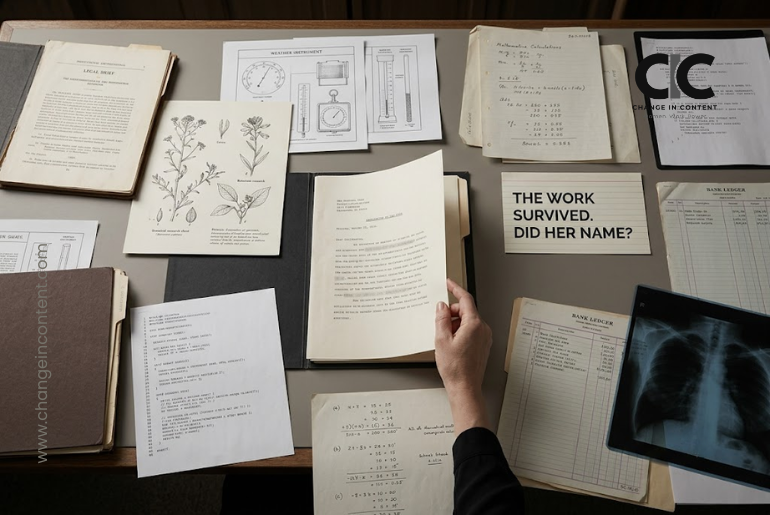
The Quick Read
- Why are women missing from history? In many professions, women entered systems in which education, formal titles, authorship, professional membership, and public recognition had traditionally favoured men. Even when women did consequential work, the historical record did not always give that work equal visibility.
- The phenomenon has been studied in science as the Matilda Effect, a term for the under-recognition or misattribution of women’s contributions. Contemporary research suggests disparities in recognition and citation have not entirely disappeared.
- India has its own remarkable professional history: Cornelia Sorabji worked as a lawyer when the profession was effectively closed to women; E.K. Janaki Ammal helped reorganise the Botanical Survey of India; Anna Mani helped build India’s meteorological instrumentation capability; and Asima Chatterjee became the first woman to receive a DSc from an Indian university.
- Globally, women such as Alice Ball, Maggie Lena Walker, Katherine Johnson, Margaret Hamilton and Rosalind Franklin made contributions to medicine, banking, spaceflight, software and molecular biology that were only later widely recognised.
- Recovering these careers does more than correct old history books. It changes our understanding of what women have always been capable of doing at work, including in professions where their presence is still sometimes described as new.
We may have been asking the wrong question about women’s progress
There is something peculiar about the way we talk about women at work.
A woman becomes the first chief executive of a major company, and we talk about how women are entering leadership. Women join factory floors, laboratories, engineering teams, law firms, or technology companies in greater numbers, and we describe the development as though someone had recently opened a door that women had never approached before.
Then you start reading history. Suddenly, the idea of women as newcomers becomes difficult to sustain.
Women missing from history include lawyers who worked before women could formally enter the legal profession, scientists who helped build national research institutions, bankers who created financial organisations, mathematicians who helped put astronauts into orbit and programmers whose work helped put human beings on the Moon.
Women were working; women were leading; women were inventing.
The historical record was simply much better at remembering some kinds of work, and some kinds of workers, than others.
This deserves attention now because representation does not begin with hiring numbers. It also begins with memory. If every generation of girls grows up believing women entered science, business, law or technology only shortly before they did, women inherit a much shorter professional lineage than actually exists.
And workplaces inherit a distorted story about who built them.
History has a workplace problem: It remembers titles better than labour
There are several ways a career can disappear without the work itself disappearing.
- Sometimes the person who receives formal credit becomes synonymous with a collaborative achievement.
- Sometimes the work happens in a role that society considers supportive rather than authoritative.
- Sometimes a woman contributes before professional rules allow her to acquire the title that normally preserves someone’s place in history.
- Sometimes records survive, but textbooks simplify.
- And sometimes there is genuine misattribution.
Historian Margaret Rossiter gave one version of this phenomenon a name in 1993: the Matilda Effect, describing the tendency for women’s scientific contributions to be under-recognised or attributed to male colleagues. Recent research continues to use the concept when examining gender differences in scientific recognition.
But science is only one place to look. The larger question is almost organisational: Who gets named when work becomes history?
That question leads to some extraordinary careers.
Cornelia Sorabji entered law before law was ready for her
Imagine qualifying for a profession that does not yet fully allow you to belong to it.
Cornelia Sorabji was the first woman to study law at Oxford and, according to Oxford’s Faculty of Law, became the first woman to practise law in India. She returned to India and worked as a legal adviser to women and children, including purdahnashins, women living in seclusion who could face serious difficulty accessing legal representation concerning property and other matters.
There is a wonderfully revealing detail in her story.
Sorabji completed the Bachelor of Civil Law examinations at Oxford in 1892. Yet women were still excluded from full membership of the university at the time. Formal admission to the profession would come much later.
Her career exposes something that contemporary conversations about women at work occasionally forget: capability can precede institutional permission by decades.
Women do not always enter professions late. Sometimes the profession arrives late to women.
And Sorabji’s work extended beyond courtroom history. Somerville College’s archives record her involvement with craftswomen working from home and her examination of working conditions in struggling industries during the First World War.
More than a century later, we still discuss whether women have adequate access to legal careers, professional networks and positions of influence. Our own examination of workplace barriers and women’s career progression looks remarkably contemporary; Sorabji’s career reminds us how old some of the underlying questions really are.
Janaki Ammal did not merely study plants. She helped rebuild an institution
E.K. Janaki Ammal is often introduced as a pioneering botanist and cytogeneticist. Accurate, but incomplete.
After Independence, the Government of India appointed her Officer on Special Duty for the revival of the Botanical Survey of India. The BSI records that the reorganisation plan she submitted was approved in March 1954, strengthening the institution’s work in exploration, documentation, taxonomy and conservation.
She also recommended the creation of BSI’s cytology section and initiated work towards a chromosome atlas of Indian flora.
Read that again as a workplace story rather than a scientific biography.
A woman scientist was helping shape institutional scientific capacity in a newly independent country in the early 1950s.
Janaki Ammal was not completely unrecognised. India honoured her with the Padma Shri, and a national taxonomy award now bears her name.
Yet ask an average professional to name one of the people involved in rebuilding India’s botanical research infrastructure and her name may not come quickly.
That is another form of disappearance: being present in institutional history without becoming part of popular professional memory.
Anna Mani helped India learn to measure its own weather
Anna Mani’s career includes another chapter in post-Independence institution-building.
An Indian physicist and meteorologist, Mani eventually retired as Deputy Director General of the India Meteorological Department. IMD records describe her work on meteorological instrumentation, solar radiation, ozone and wind-energy measurements. By 1953, she was heading a division with a large team working around meteorological instruments.
Her career coincided with India’s effort to become more self-reliant in scientific instrumentation. An Indian Meteorological Society account describes her as a pioneer meteorologist and the first woman Deputy Director General of Meteorology in the IMD.
We often narrate national development through ministers, industrialists, economists and large projects. Measurement rarely gets the same romance.
Yet countries cannot plan agriculture, aviation, energy, weather forecasting or disaster preparedness without people who build the scientific systems that make reliable measurement possible.
Some careers alter history noisily. Others calibrate the instruments on which history depends.
Asima Chatterjee built a scientific career when there was barely a path to follow
In 1944, Asima Chatterjee became the first woman to receive a Doctor of Science from an Indian university, according to the Indian Academy of Sciences’ historical scholarship. Her research career included work on vinca alkaloids and the development of anti-epileptic and anti-malarial drugs.
The Indian National Science Academy’s biographical memoir records another telling detail. She was the only one of the three women admitted to the chemistry department at Scottish Church College to complete higher education, amid considerable resistance to women studying science in a mixed institution.
Chatterjee eventually became an eminent scientist. That is precisely why these stories must not always be packaged as tales of victimhood.
The more compelling point is the scale of the ambition.
Women were not merely trying to gain entry. Some were reaching the highest levels of professional scholarship at moments when the educational pipeline behind them was scarcely established.
Change in Content has previously asked why women scientists in India remain less visible in laboratories, awards and recognition. Looking backwards adds another layer to that conversation: young women need to see not only where representation is heading, but how deep their professional ancestry already runs.
Alice Ball developed the treatment. Her name almost disappeared from it
Alice Augusta Ball’s story brings us much closer to literal loss of attribution.
At 23, the chemist developed a method for turning compounds from chaulmoogra oil into an injectable treatment for Hansen’s disease. The technique became the first successful treatment of its kind and was used on thousands of patients before newer drugs became available.
Ball died in 1916 at just 24, before she could publish the work fully.
For years, her contribution did not receive the recognition it deserved. The University of Hawaiʻi has since worked extensively to restore her place in the record, awarding her a posthumous Medal of Distinction, establishing commemorations and, in 2026, celebrating the designation of the Ball Method as a National Historic Chemical Landmark.
There is something powerful about that name finally sitting where it belongs. The Ball Method.
Recognition cannot return the career she never had the chance to build. It can ensure the discovery no longer travels without its inventor.
Maggie Lena Walker understood that economic power needed institutions
Women missing from history are not confined to laboratories.
In Richmond, Virginia, Maggie Lena Walker rose from modest circumstances after the American Civil War to become a formidable business leader.
In 1903, she founded the St. Luke Penny Savings Bank and became its first president. The US National Park Service identifies Walker as the first African-American woman to charter a bank in the United States. She also established a newspaper and led a large fraternal organisation, using business and finance as instruments of economic advancement.
Walker belongs in contemporary conversations about women and financial power for a reason. Banking was not simply her occupation. She understood ownership of institutions.
That difference feels strikingly current. Change in Content has been tracking the shift of women from workers to business owners, employers, and wealth creators. Walker was pursuing that economic proposition more than 120 years ago.
A century can separate two women and still leave them negotiating remarkably familiar questions about capital, customers, credibility and control.
Katherine Johnson was doing the maths while the astronauts became household names
Space history gave us heroes in spacesuits. Behind the missions sat rooms full of people whose names were much easier to lose.
Katherine Johnson joined the organisation that became NASA in 1953 and worked as a research mathematician. She performed trajectory analysis for Alan Shepard’s 1961 mission and worked on calculations connected with John Glenn’s orbital flight. NASA records that Glenn specifically asked for Johnson to check the computer-generated orbital equations by hand before his mission.
NASA’s women “human computers” had been doing complex aerospace calculations for years. By 1942, their contribution had become so important that NASA’s historical account records engineers acknowledging the women’s speed and accuracy.
The astronauts deserved their fame. But the history of work becomes far richer once we look beyond whoever stood in front of the camera.
A useful rule emerges here: Whenever history gives us one heroic individual, look for the team. Then look again for who inside that team was considered support.
There are often women there.
Margaret Hamilton’s software went to the Moon before software engineering had status
The famous photograph is almost absurdly good.
Margaret Hamilton stands beside a tower of printed Apollo software roughly as tall as she is. She led the Software Engineering Division at MIT’s Instrumentation Laboratory, which developed onboard flight software for NASA’s Apollo programme. NASA credits her and her team with pioneering concepts that became building blocks of modern software engineering.
During Apollo 11’s lunar descent, the software’s priority-processing design helped the guidance computer cope with an overload condition rather than derail the landing.
NASA eventually gave Hamilton an Exceptional Space Act Award in 2003. The NASA official who nominated her remarked that he was surprised her groundbreaking work had never been formally recognised by the agency before then.
The Moon landing happened in 1969. The formal NASA recognition arrived 34 years later.
Sometimes history does remember. It simply takes an extraordinarily long lunch break.
Rosalind Franklin shows why credit is rarely a tidy story
And then there is Rosalind Franklin.
Her X-ray crystallography at King’s College London produced Photograph 51, which demonstrated DNA’s helical structure and supplied information that helped James Watson and Francis Crick build their model.
King states that Franklin’s colleague, Maurice Wilkins, showed the photograph to Watson without Franklin’s agreement or knowledge.
Franklin and her student Raymond Gosling published their own paper alongside the Watson-Crick and Wilkins papers in Nature in 1953. She later led important research into viruses before dying from ovarian cancer in 1958 at the age of 37.
Her story is often simplified into a morality play with heroes and villains.
The professional lesson is more enduring.
Authorship matters. Access matters. Who presents the idea matters. Who controls the information matters. And who gets associated with the breakthrough once the story is retold thousands of times matters enormously.
Modern workplaces should recognise that pattern immediately.
Women missing from history: We are still deciding whose work becomes visible
It would be comforting to put all of this safely in the past. We cannot.
The mechanics have changed, but professional visibility still influences careers.
- Whose name goes on the presentation?
- Who presents the team’s work to leadership?
- Who receives the award?
- Who becomes the spokesperson?
- Whose contribution appears in the company announcement?
- Who gets invited onto the panel?
- Who is described as the visionary and who as the person who “helped”?
- Who receives sponsorship?
- Who receives citation?
- Who gets remembered when everybody moves on?
Contemporary research still finds disparities in recognition. A 2026 Scientific Reports paper notes the continuing relevance of the Matilda Effect in understanding how women’s scientific contributions can be undervalued, while broader research on citation equity argues that changing whose work is read and cited changes how the history of a discipline gets constructed.
So recovering historical women is useful. Preventing today’s women from requiring recovery later would be better.
What can workplaces do differently now?
This does not require companies to establish museums. It requires better habits of attribution.
When a team succeeds, name the people who did substantive work. When an employee originates an idea, preserve that contribution as it moves upwards. Give women opportunities to present their own work rather than allowing somebody more senior to become its permanent narrator. Audit nominations, awards and speaking opportunities. Record institutional history with enough depth to capture contributors outside the C-suite.
Women can play a role too.
Keep evidence of your work. Publish where appropriate. Claim authorship. Maintain a portfolio. Put your name on ideas and outputs. Speak about what you built without translating competence into apology.
And all of us can broaden what we read.
A canon changes every time a forgotten researcher is cited, an overlooked businesswoman enters a classroom, an archive is digitised, a biography is written, or somebody asks the deceptively useful question: Who else was working on this?
That question can rearrange history.
The Change: Give women a professional past as large as their future
There is a temptation to tell these stories because they inspire us. I would rather they make us reconsider the record.
Cornelia Sorabji did not need the twenty-first century to invent female legal ambition. Janaki Ammal did not need a modern DEI programme to imagine herself shaping a scientific institution. Maggie Walker understood economic ownership before “women’s financial empowerment” entered conference vocabulary. Katherine Johnson and Margaret Hamilton were doing mission-critical technical work before technology acquired today’s glamour.
Women have a much longer history at work than the popular story of women at work sometimes allows. That matters for the future.
- A young woman entering law should inherit Sorabji.
- A scientist should inherit Ammal, Mani, Chatterjee, Ball and Franklin.
- A banker or founder should inherit Walker.
- A technologist should inherit Johnson and Hamilton.
Professional history is a form of infrastructure too. It tells people who have belonged before them, what has already been possible and how much further they are entitled to go.
Perhaps the next time we celebrate a woman for entering a supposedly new frontier, we should check the archives first.
She may be returning to territory women helped build.
Editorial Note
This Knowledge Hub article was developed through secondary research using institutional, academic and government records, including the University of Oxford, Botanical Survey of India, India Meteorological Department, Indian National Science Academy, NASA, University of Hawaiʻi, King’s College London, US National Park Service and peer-reviewed research published by Nature Portfolio. The women included here represent a selection rather than an exhaustive history. “Missing from history” is used to describe uneven public memory, recognition or attribution; it should not imply that every featured woman was completely unrecognised during her lifetime. Biographical and historical interpretations may evolve as archives and scholarship expand.
Primary and authoritative sources used
- University of Oxford, Faculty of Law — Cornelia Sorabji: Oxford Faculty of Law biography
- Botanical Survey of India — E.K. Janaki Ammal and BSI reorganisation: Botanical Survey of India record
- Botanical Survey of India — Cytology Section: BSI Cytology history
- India Meteorological Department — Anna Mani: IMD publication on Anna Mani
- Indian National Science Academy — Asima Chatterjee: INSA biographical memoir
- University of Hawaiʻi — Alice Ball: University of Hawaiʻi Alice Ball history
- US National Park Service — Maggie L. Walker: National Park Service biography
- NASA — Katherine Johnson: NASA biography of Katherine Johnson
- NASA — Margaret Hamilton: NASA profile of Margaret Hamilton
- King’s College London — Rosalind Franklin: King’s College London biography
- Nature Portfolio — Matilda Effect and scientific recognition: Scientific Reports research
