The Brief
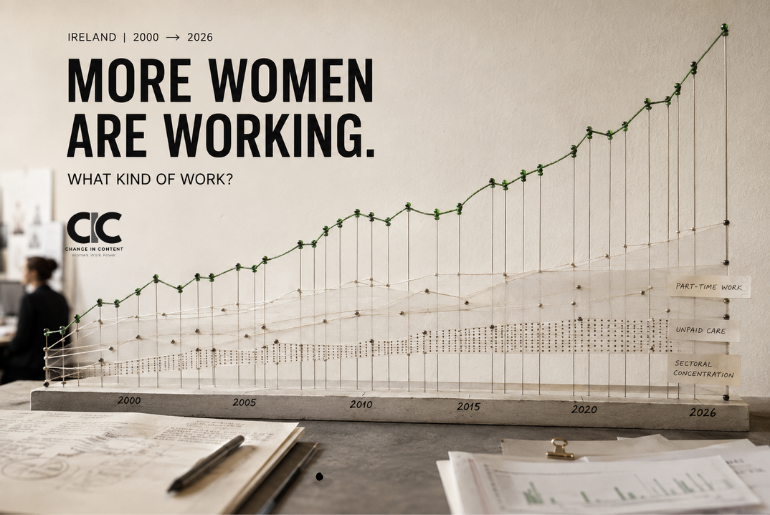
- More than 1.3 million women were employed in Ireland in Q2 2026, almost 90% more than in Q1 2000.
- Female labour-force participation stood at 61.3% in Q2 2026, compared with 70.8% for men.
- Women made up 67.1% of all part-time workers in Q4 2025, while only 41.7% of full-time workers were women.
- Nearly 30% of women working part-time cited caring for children or incapacitated adults as the main reason, compared with 7% of men.
- For India and other countries trying to raise women’s employment, Ireland offers two lessons at once: participation can improve dramatically, but the quality and structure of that employment still need attention.
Employment trends in Ireland
There is a statistic in Ireland’s latest labour market data that deserves attention well beyond its borders.
The number of women in employment has risen from roughly 730,000 in 2000 to more than 1.3 million today.
Ireland’s Central Statistics Office describes this as one of the country’s standout long-term employment trends. By Q2 2026, there were more than 1.3 million women at work, an increase of almost 90% since Q1 2000.
For countries still trying to bring significantly more women into paid work, that trajectory is worth studying. India is one of them.
But Ireland’s numbers also contain a warning against celebrating participation too early.
More women are working, but the gap has not disappeared
Ireland’s labour market remains historically strong despite some cooling in employment growth.
In Q2 2026, the country’s overall employment rate for people aged 15–64 stood at 74.3%. For women, it was 70.7%, compared with 78% for men. Female labour-force participation stood at 61.3%, while the male rate was 70.8%.
That is a sizeable improvement over the longer term. However, the composition of women’s employment tells a more complicated story.
Women accounted for 41.7% of people in full-time employment in Q4 2025 but 67.1% of those working part-time.
Why? Care remains a major part of the answer.
Among women working part-time, 29.7% said looking after children or incapacitated adults was their principal reason. Only 7% of men working part-time gave the same answer.
So Ireland’s experience shows that increasing women’s employment does not automatically redistribute the unpaid work happening outside employment.
That has consequences for hours, earnings and career progression.
Women are also clustered in familiar sectors
Women now represent more than three-quarters of employees in Ireland’s Human Health & Social Work sector and almost three-quarters of those working in Education.
These are essential industries and important sources of professional employment. But such concentration also reveals occupational segregation.
When women enter the labour market in larger numbers but remain disproportionately concentrated in particular sectors, participation rises faster than economic representation across the whole economy.
The earnings data reflects some of this imbalance.
Median weekly earnings for women rose to €654.07 in 2024, up 39.2% from 2014. Women’s presence among Ireland’s highest earners has also improved: their share of the top 1% increased from 22.6% in 2019 to 27.6% in 2024. Yet Ireland’s official gender pay gap was still 9.6% in the latest national Structure of Earnings Survey cited by the CSO.
Progress can therefore coexist with unfinished work. That is probably the most useful part of Ireland’s story.
What India should notice
Direct comparisons between India and Ireland need caution. Their economies, populations, labour structures, definitions and social conditions are very different.
India’s latest PLFS data places female labour force participation among people aged 15 and above at 34.4% in July 2026. The annual 2025 PLFS showed particularly sharp differences between rural and urban women, with female participation substantially lower in urban India.
So India’s immediate challenge remains bringing far more women into economic activity.
Ireland is further along that path. But Ireland’s experience suggests what India should consider as participation continues to rise.
More women working is valuable. What matters next is whether those women are:
- working sufficient hours when they want them;
- entering a wider range of industries;
- moving into higher-paid occupations;
- progressing into leadership;
- able to remain employed through periods of care;
- and seeing earnings rise with experience.
Change in Content has repeatedly examined this gap between women’s participation and the quality of women’s employment in India. Ireland’s numbers give that argument useful international context.
The objective should not be to reach another country’s participation rate. It should be to avoid waiting until participation rises before asking what kind of work women are entering.
Ireland has something else worth watching
One of the most striking changes is not employment itself. It is the decline in the number of women describing themselves as engaged in home duties. The number fell from 520,500 in 2010 to 198,800 in 2025, a decline of nearly 62%. That is a profound social shift.
More women have entered paid employment, while education levels have also risen. In Q4 2025, 63.6% of employed women held a third-level degree compared with 52.8% of employed men. Yet the part-time figures tell us that unpaid care did not simply disappear. It travelled with women into the labour market.
That pattern is relevant far beyond Ireland. Countries seeking to increase women’s employment cannot treat care infrastructure, flexible work, and men’s participation in unpaid work as separate social policy issues.
They influence the labour market itself.
Change in Perspective: Participation Opens the Door
Ireland’s employment story should be read as genuine progress.
Almost doubling the number of women in work over a generation is significant. But the next stage is visible in the same dataset.
- Women are still more likely to work part-time.
- Care remains disproportionately associated with women’s working patterns.
- Women are heavily concentrated in certain sectors.
- And pay differences remain.
For India, there is value in seeing both halves of that experience.
The country needs far more women earning and participating in the economy. It can also start thinking now about the labour market those women are entering. Because raising participation and improving employment quality do not have to happen one after the other.
They can be built together.
Editorial Note & Sources
This article uses official labour-market data from Ireland’s Central Statistics Office and India’s Periodic Labour Force Survey. Cross-country comparisons should be interpreted with caution because methodologies, populations, labour-market structures, and definitions differ. The article does not present Ireland as a direct policy template for India; it uses Ireland’s long-term female employment trends to identify broader questions around participation, working hours, care, sectoral concentration and earnings.
Sources
- Central Statistics Office Ireland — Employment Trends in Ireland: What CSO Data Tells Us, 31 August 2026: Latest overview of Ireland’s employment trends, including growth in women’s employment.
- Central Statistics Office Ireland — Labour Force Survey, Q2 2026: Latest employment and labour-force participation rates by sex.
- Central Statistics Office Ireland — Women in the Labour Market 2024–2025: Detailed data on female employment, part-time work, caring responsibilities, education, earnings and occupational concentration.
- Ministry of Statistics and Programme Implementation, India — PLFS 2025: Official annual labour-force indicators for India.
- MoSPI — PLFS Monthly Bulletin, July 2026: Latest female labour-force participation data for India available at publication.