The Brief
- ISO published ISO 45010:2026 on 7 September, calling it the world’s first International Standard on menstruation and menopause in the workplace.
- The 58-page standard is intended for organisations of all sizes and sectors and covers workplace culture, policies, manager awareness, workplace design, practical adjustments and measurement.
- It sits within the ISO 45000 occupational health and safety family and complements ISO 45001.
- ISO says the full text will be available to read at no cost to encourage wider global use.
- New BSI research cited alongside the launch found 68% of women surveyed across seven countries believe employers have a role in supporting menstrual and menopause-related health. At the same time, 7 in 10 want a clear workplace process.
ISO 45010 launched
Menstruation and menopause now have their own international workplace standard.
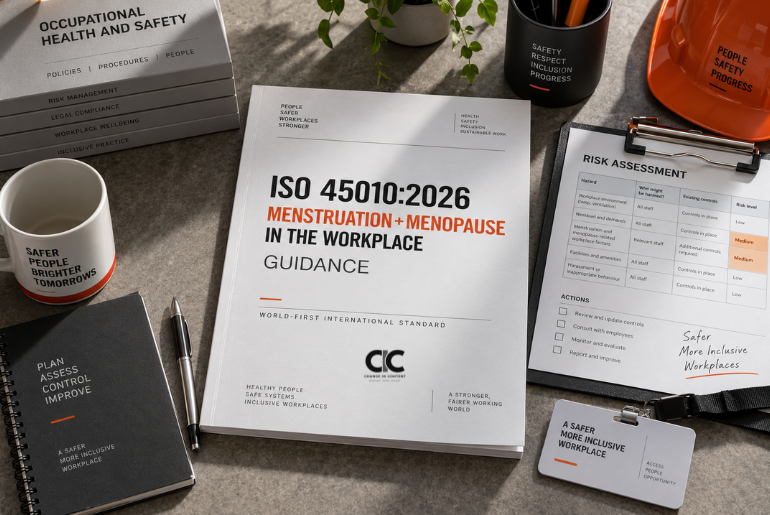
The International Organisation for Standardisation has launched ISO 45010:2026 – Occupational health and safety management — Menstruation and menopause in the workplace — Guidance, describing it as the first International Standard of its kind.
That wording matters. It is no longer framed solely as a women’s wellbeing initiative or an optional awareness topic for October.
ISO 45010 places menstrual and menopausal health within the much broader architecture of occupational health, safety and workplace management.
What does ISO 45010 cover?
The standard aims to help organisations identify workplace factors that can make menstruation or menopause harder to manage and decide what practical support may be appropriate.
ISO says the guidance covers:
- workplace culture;
- organisational policies and procedures;
- manager awareness and training;
- workplace design;
- practical adjustments;
- measurement and evaluation;
- and additional considerations for small and medium-sized organisations.
Its scope is deliberately broad. The standard can be used by organisations of different sizes and sectors, including workplaces involving physically or psychologically demanding work. That makes it relevant beyond corporate offices.
A woman experiencing heavy menstrual symptoms or menopause may be working in a hospital, factory, school, retail environment, warehouse, laboratory or field role where temperature, access to toilets, uniforms, shift patterns or physical demands matter very differently.
The standard is guidance, not a new certification mandate
Organisations should be careful not to misunderstand the announcement.
ISO 45010 is a guidance standard. It is not a new law, nor does its publication mean employers must immediately introduce a particular menopause or menstrual-leave policy.
Its purpose is to give organisations an internationally agreed framework for recognising barriers and incorporating appropriate support into existing workplace systems.
The document also makes an important distinction: menstruation and menopause are life-course experiences, not medical conditions. However, individuals may experience symptoms that affect their health or ability to work. Many workers will require no additional support, while others can benefit significantly from practical adjustments.
That helps prevent support from turning into another stereotype about women’s capability.
Why has ISO introduced the standard now?
The launch comes alongside new international research from the British Standards Institution involving 6,494 women across seven countries.
The findings show growing expectations for workplace support.
Around 68% said employers have a role to play in supporting workers dealing with menopause and menstruation-related health concerns. 7 in 10 wanted their employer to have a clear process or approach. Yet 6 in 10 said they had never heard their employer proactively discuss menopause support.
The gap between awareness and operational support is familiar.
Change in Content recently examined this in the Menstruation and Perimenopause at Work Report, where only 16% of respondents reported having workplace support despite far larger numbers saying symptoms had affected them at work.
Having a policy and having usable support are not the same thing. ISO 45010 attempts to bridge that gap by focusing on implementation.
What could this mean for employers?
A standard can do something that awareness campaigns often cannot. It creates a common reference point.
Instead of every organisation independently deciding what “menopause-friendly” or “period-friendly” means, employers can work from internationally agreed guidance.
That could influence how organisations approach matters such as flexibility, workstation temperature, access to toilets and rest areas, uniforms, shift arrangements, absence management, manager conversations, privacy and occupational health processes.
It also gives organisations a framework to review existing policies.
Our earlier guide to menopause action plans argued that the strongest workplace responses move beyond awareness and specify responsibilities, adjustments and routes to support. ISO 45010 now gives that principle an international reference point.
Why the free access matters
One notable decision is that ISO is making the standard’s full text available to read without charge through its Online Browsing Platform.
ISO Secretary-General Sergio Mujica said removing the financial barrier is intended to maximise global adoption, including by smaller organisations and employers in locations with fewer resources.
That makes ISO 45010 potentially more useful for organisations beyond large employers with specialist HR and occupational-health teams.
The standard also sits alongside ISO 45001 and forms part of the wider ISO 45000 occupational health and safety family. ISO identifies links to SDG 3 on health, SDG 5 on gender equality, SDG 8 on decent work and SDG 10 on reduced inequalities.
From awareness to workplace infrastructure
The significance of ISO 45010 is not that every organisation will now create a menopause policy. It is that menstruation and menopause are being treated as legitimate elements of workplace design and occupational health.
That changes the conversation.
The question is no longer only whether an employer is sympathetic. It becomes whether the workplace itself has been designed well enough for people experiencing these life stages to continue working with health, dignity and privacy.
That is a much more practical place to begin.
Editorial Note & Sources
ISO 45010:2026 is a guidance standard and should not be described as a legal requirement or certification obligation. It provides recommendations that organisations can adapt to their workforce, sector, and operating context.
ISO — ISO 45010 launch, 7 September 2026. Primary source for the launch, scope, BSI survey findings and free-access announcement.
ISO — ISO 45010:2026 standard page. Official standard description, publication details, 58-page length, scope and relationship with the Sustainable Development Goals.
ISO/TC 283 — ISO 45010 background. Context on the development of the standard and its relationship with occupational health and safety management.