
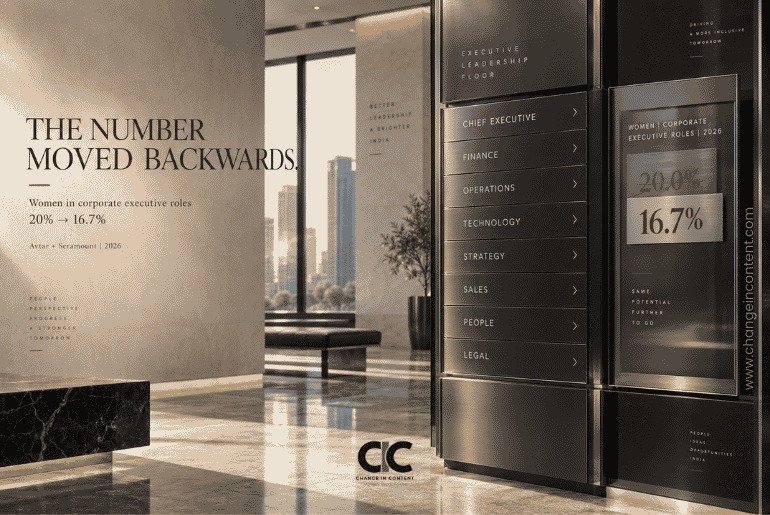
Women’s representation in corporate executive roles
Women now hold 16.7% of corporate executive roles among companies recognised in the 2026 Avtar–Seramount Best Companies for Women in India study, down from 20% in 2025.
Overall female representation among the Best Companies also edged down, from 35.7% to 34.6%. The share of hiring going to women fell from 38% to 36%.
One year does not establish a permanent reversal. But it does interrupt a comfortable assumption: that once companies begin investing in inclusion, women’s representation will continue moving upwards automatically.
The latest numbers suggest otherwise.
The fall becomes sharper closer to executive power
The study’s most visible number is the decline to 16.7%. But company origin reveals another layer.
Among Best Companies headquartered in India, women represented 31.4% of the overall workforce, compared with 41.1% at US-headquartered companies and 39.2% at organisations headquartered elsewhere.
At the corporate executive level, those numbers fell further:
- 14.2% at India-headquartered companies,
- 18% at US-headquartered companies,
- 20% at companies headquartered in other countries.
That is a useful distinction. The representation gap is not merely about getting women into companies. It widens when the organisation begins deciding who receives substantial executive authority.
Change in Content saw a similar pattern in the AIMA–KPMG 2026 study on women’s leadership in corporate India, where ambition among women remained high while progression slowed nearer the top.
The new Avtar–Seramount findings suggest the slowdown is worth watching, not treating as statistical noise.
Some industries remain much easier for women to enter than others
The sector differences are substantial.
Women accounted for:
- 45.6% of the workforce in professional services,
- 39.8% in IT-enabled services, and
- 38.1% in global capability centres.
- Manufacturing remained at the other end, with women at just 13.1%.
- Pharmaceuticals recorded a particularly large year-on-year drop, from 24.6% female representation in 2025 to 17.3% in 2026.
It is a reminder that “corporate India” is not one labour market.
A woman considering professional services in Bengaluru and another considering a manufacturing career are entering very different gender environments.
The same national diversity strategy cannot be assumed to produce the same result across both.
The maternity story does not end when a woman returns
One of the more useful findings sits away from the headline. The study reports that 94% of women return immediately after maternity leave, but only 79% remain one year later. That changes the question organisations should ask.
A high return-to-work rate immediately after maternity leave can look reassuring in an annual report. But the more revealing measure may be what happens six months or twelve months afterwards.
- Did the employee regain meaningful work?
- Was she considered for promotion?
- Did flexibility affect perceptions of commitment?
- Did the workload become sustainable?
- Did she still see a future in the organisation?
Return is an event. Retention is an outcome. And leadership pipelines are ultimately built from the women who remain long enough to enter succession conversations.
Health is now edging ahead of childcare as an exit factor
Another finding deserves more attention than it will probably receive.
Among women leaving organisations, 30% cited health and wellbeing challenges, compared with 28% citing childcare. This is the second consecutive year health and wellbeing ranked above childcare in the study.
That is worth noticing because corporate explanations for women’s exits have often defaulted to motherhood.
Care still matters enormously. But women’s careers are affected by a wider health landscape: physical health, mental health, reproductive health, burnout, menopause, chronic conditions and the accumulated effect of demanding work.
Interestingly, overall attrition among the Best Companies was identical for women and men at 20.4%. Better opportunities remained the dominant reason for leaving across genders.
So this is not a story about women simply leaving corporate careers faster than men. The more important question is where women are represented when people leave, move and get promoted.
There are positive signals inside the same study
The 2026 findings are not uniformly negative. The Top 10 Best Companies recorded female representation of 42.8%.
And India-headquartered Best Companies performed particularly strongly on second-career support: 83% had formal second-career hiring programmes, compared with 70% of US-headquartered companies and 60% of those headquartered elsewhere.
That matters because it shows progress has not disappeared. Different organisations are solving different parts of the problem.
- The weakness is conversion.
- Hiring women.
- Bringing them back.
- Retaining them.
- Moving them into line roles.
- Giving them profit-and-loss responsibility.
- Putting them into succession pools.
- And eventually appointing them to executive positions.
These are separate transitions. A strong score at one stage cannot compensate indefinitely for a weak one at the next.
The executive number belongs inside a longer pattern
Change in Content’s earlier analysis of women CEOs in India’s listed companies found only about 5% of the companies studied had women serving as MD or CEO. At the same time, female representation also narrowed sharply across key managerial and executive-director roles.
We also found in the global 2026 CWDI research that companies led by women tended to have substantially stronger representation of women across boards and executive teams.
The Avtar–Seramount study adds another piece.
The issue is not that women cannot enter corporate organisations. Nor does the 2026 result prove that the last decade of inclusion work has failed. It tells us something more practical: progress at the top can slip even while programmes, policies and stated commitment remain in place.
That makes executive representation a metric organisations may need to protect, not simply celebrate once it improves.
What should companies watch now?
The next year’s number will matter. But so will the numbers underneath it.
- Women as a share of hiring.
- Promotion rates.
- Who enters business-critical roles.
- Who receives sponsorship.
- Post-maternity retention at 12 and 24 months.
- Health-related exits.
- Representation within succession pools.
- Women in P&L positions.
- And whether female representation falls faster with every step towards executive authority.
The pipeline does not break in one place. That is precisely why headline workforce diversity can remain reasonably healthy while the executive layer becomes thinner.
For organisations, 16.7% should therefore be read less as a verdict and more as an early warning signal.
The useful response is to find where the women stopped moving.
Editorial Note & Sources
The 2026 Best Companies for Women in India study was conducted by Avtar Career Creators and Seramount. A total of 387 organisations participated, with 125 named to the Best Companies list. Because participation is voluntary and the composition of participating and recognised organisations may vary year to year, year-on-year changes should be interpreted as movement in the study benchmark rather than assumed to represent a matched longitudinal sample of the same companies. Avtar says company submissions are cross-checked and supporting documentation can be requested, although the process is not described as a formal audit.
Avtar & Seramount — Best Companies for Women in India 2026. Primary programme information and methodology context.
