
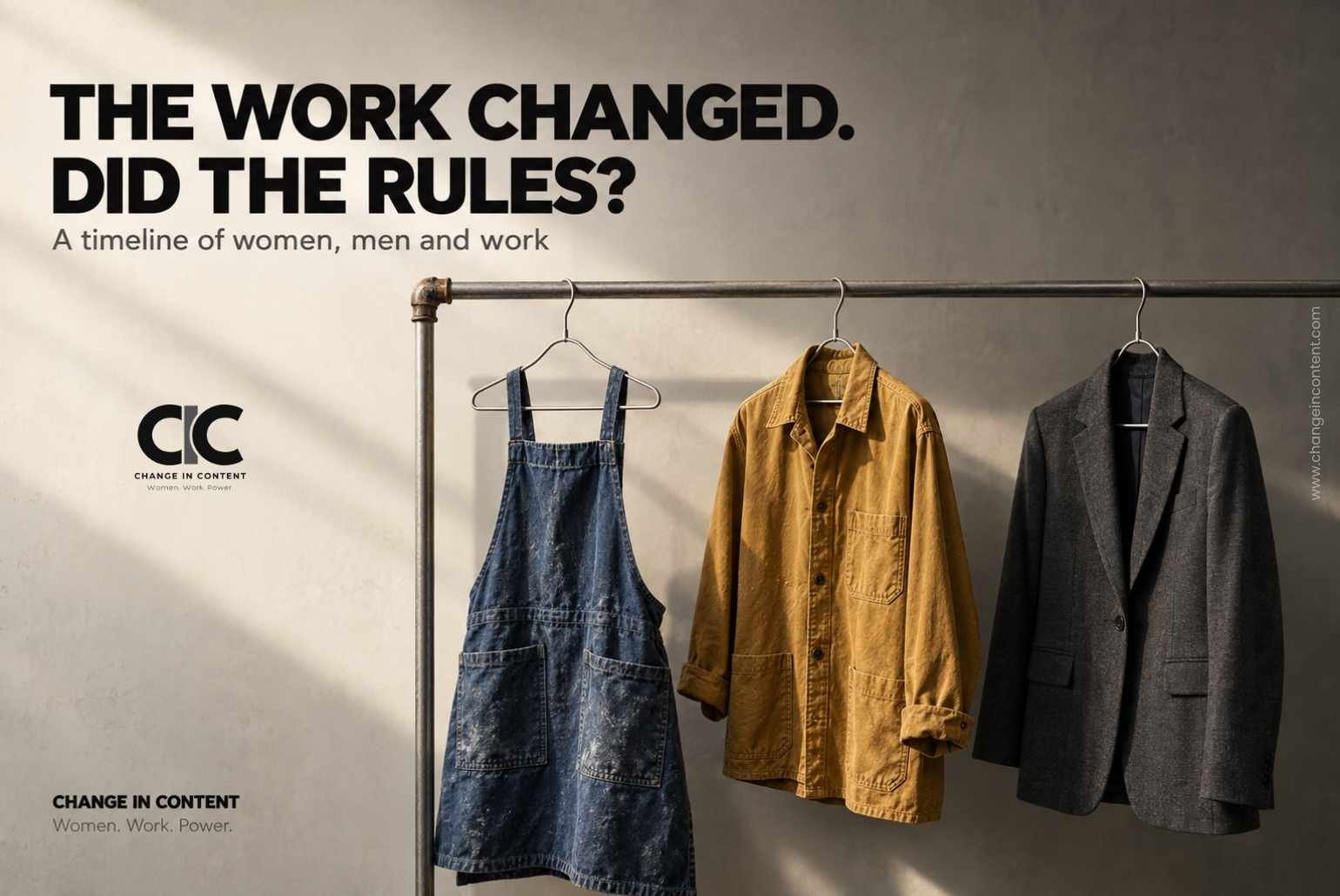
The Brief
- Women’s work did not begin when employers started hiring more women. Historical records often missed it.
- International standards gradually expanded from maternity protection to pay, opportunity, care and safety.
- Progress has included setbacks. The pandemic damaged employment for both women and men.
- The ILO’s September 2026 update puts women’s average earnings around 18% below men’s globally.
- A fairer working life requires both access to decent jobs and a more equal division of care.
Ask a family when its women began working, and the answer may start with the first teacher, nurse or office employee. Ask who farmed, stitched, cooked, sold produce or kept a small business running before her, and the history grows longer. Gender equality at work begins with that missing part of the story. The progress of women and men in the world of work depends partly on whose effort we recognise in the first place.
The latest ILO pay-gap update, published on 21 September 2026, reports that women still earn around 18% less than men on average globally. It describes a narrowing of only two percentage points over a decade.
How did we travel through a century of reforms and arrive here? The answer involves more than salaries. It runs through homes, factories, laws and the everyday question of who can afford to take a job.
This is a selective timeline of international milestones and measured outcomes, with an Indian example. Countries did not move together, and an international agreement never meant that every worker immediately gained an enforceable right.
Before 1919: The work existed. The records were incomplete.
Claudia Goldin’s historical research offers a useful starting point. As the Nobel Prize’s account of her work explains, US records could describe a married woman as a wife while overlooking her contribution to agriculture, family businesses or home production. Her findings concern a particular national history, rather than a universal account of women everywhere.
The wider question remains useful: does having no recorded occupation mean someone did no economically valuable work?
It plainly cannot tell the whole story. Nor are all these activities interchangeable. Paid employment, work in a family enterprise and unpaid care have different meanings in labour statistics. Keeping those categories clear helps us recognise the cost of unpaid work without pretending every form of work comes with a wage.
1919: Motherhood enters international labour standards
The ILO’s first year included the adoption of the Maternity Protection Convention, No. 3. Pregnancy and childbirth had a place in the international discussion of workers’ rights.
That was a significant step, with limits. Protecting a woman during maternity could not, on its own, give her equal access to every occupation or ensure that somebody else shared the care afterwards. A working life is longer than a period of leave.
1951 and 1958: Pay and opportunity become equality questions
Two further ILO milestones widened the agenda. The Equal Remuneration Convention of 1951 addressed equal pay for work of equal value. The Discrimination Convention of 1958 addressed discrimination in employment and occupation more broadly.
“Equal value” matters because unfairness can sit between occupations as well as within a job title. Evaluating work fairly requires examining its demands, rather than assuming a role is worth less because women commonly do it.
For a worker, the promise reaches from getting considered for a job to having its value assessed fairly. It does not mean everyone should receive an identical salary regardless of duties or relevant differences.
1981: Care becomes a question for men’s working lives too
The Workers with Family Responsibilities Convention explicitly concerns women and men whose care responsibilities affect employment.
This changes the picture of the worker whom a workplace is designed to accommodate. A father can have a dependent child. A son can need time to care for a parent. Treating those responsibilities as exceptional in men makes it easier to treat them as inevitable career limitations in women.
The practical question behind paternity leave policies is therefore bigger than how many days appear in a handbook. Can men use the time available without being treated as less committed? Does care actually become more shareable?
1995: A global agenda makes the promises harder to ignore
At Beijing, 189 governments agreed on a platform for advancing women’s rights. It gave governments and campaigners a common reference point against which to assess change.
30 years later, the ILO’s 2025 review supplied a sobering comparison. The global gap between women’s and men’s employment rates had narrowed from 27.1 percentage points in 1991 to 23.1 points in 2024.
Four points of improvement across more than three decades is progress. It also shows why a list of landmark declarations cannot stand in for a record of people’s opportunities.
2011 and 2019: The workplace grows beyond the office
In 2011, the ILO adopted international standards for domestic workers. A private home could be understood as somebody’s workplace, with working conditions requiring protection.
In 2019, the Violence and Harassment Convention recognised the right to a world of work free from violence and harassment. Its scope extends beyond a conventional office and includes work-related communications.
These developments help answer a question too often left out of a celebration of employment: what is the job like once someone has it? A place on the payroll says little about safety, dignity or the ability to challenge mistreatment. These concerns apply to men as well as women, although exposure and vulnerability differ.
2020: Progress proves reversible
The pandemic interrupted any comfortable story of continuous improvement. In its July 2021 assessment, the ILO estimated that employment fell by 4.2% for women and 3% for men between 2019 and 2020.
In that assessment, the losses amounted to 54 million women’s jobs and 60 million men’s. Women suffered the larger proportional decline; men lost more jobs in absolute numbers because their employment base was larger. Both facts belong in an honest account.
A crisis also forces difficult household decisions about whose hours can change and whose income takes priority. The way jobs reward availability belongs in this discussion, including the pressures examined in Claudia Goldin’s work on demanding, highly paid jobs.
2023–2025: The numbers show several kinds of progress
There is no single score that captures equality at work. These snapshots measure different things and should be read separately.
| What is being measured? | Women | Men | What it tells us |
| Global employment rate, 2024 | 46.4% | 69.5% | The share of each working-age population in employment, according to the ILO’s 2025 review. |
| Outside the global labour force because of care responsibilities, 2023 | 708 million | 40 million | People aged 15 and over, estimated by the ILO. They are outside the labour force, not necessarily unemployed jobseekers. |
Sources: ILO employment review; ILO care estimates.
Leadership has changed too. ILOSTAT’s ten-year review reports that women held 30.5% of managerial positions globally in 2025, up from 26.9% in 2015. That is a meaningful increase, while remaining well short of equal representation.
India’s Time Use Survey 2024 brings the story into the day itself. Among participants aged six and above who performed unpaid domestic services, females spent an average of 289 minutes a day on them, compared with 88 minutes for males. These are averages among participants in that activity, not every woman and man, and caregiving is recorded separately.
Someone can have a paid job and still have a very unequal working day. Employment totals alone will miss that.
September 2026: The payslip still carries the gap
The ILO’s new estimate of an approximately 18% average earnings gap does not mean every woman receives 18% less than a man doing the same job. An overall gender pay gap and unequal pay for comparable work are different measures of a wider problem.
The ILO identifies occupational segregation, unequal care responsibilities, access to employment and progression, discrimination and undervaluation among the factors involved. It also reports that some countries have improved while others have stalled or gone backwards.
That points towards several places to act. Employers can examine how jobs are valued and how progression works. Governments can invest in care and enforce protections. Households can reconsider the assumption that one person will absorb every interruption. Helping women stay in work requires attention to the conditions around the job as well as the offer letter.
Gender equality at work, and the change ahead
Women and men have gained a broader language of rights, and some measurable gaps have narrowed. We should be able to acknowledge that without describing the work as finished. Men’s higher employment rate also tells us nothing, by itself, about whether their jobs are safe, secure or fairly paid.
The next chapter should give more people a genuine choice: to earn, care, advance and rest without gender deciding which of those they must surrender. A future family history ought to describe both what its women achieved and what its men learned to share.
Editorial Note
This selective historical explainer uses ILO and ILOSTAT publications, UN Women material, the Nobel Prize’s account of Claudia Goldin’s research and India’s official Time Use Survey. It is not an exhaustive history or country-specific legal guide. Convention adoption dates are milestones, not evidence of universal ratification or implementation. Statistics retain their reference years and definitions; no interviews or personal histories have been invented. The ILO’s September 2026 release describes a decade of pay-gap change while referring to estimates released in 2018; we attribute its comparison without creating an exact observation-period series.
Sources
- ILO, 21 September 2026: The gender pay gap narrows by just two percentage points in a decade.
- Nobel Prize, 2023: History helps us understand gender differences in the labour market, explaining Goldin’s historical research.
- ILO: The fight for women’s rights in the workplace: an ILO history. The 1919 instrument is Convention No. 3; Convention No. 183 dates to 2000.
- ILO: Convention 156 and International Day of Families.
- UN Women, 2025: Women’s rights in review 30 years after Beijing.
- ILO, 6 March 2025: Achieving gender equality in employment rates would take almost two centuries. Used for the historical employment gap and 2024 rates, not as a forecast of a fixed equality date.
- ILO: Development of Convention 189 and Recommendation 201.
- ILO, 28 June 2019: ILO Convention on Violence and Harassment: Five key questions.
- ILO, July 2021: Fewer women than men will regain employment during the COVID-19 recovery. Pandemic figures are attributed to that assessment.
- ILO, 29 October 2024: Unpaid care work prevents 708 million women from participating in the labour market, estimates for 2023.
- ILOSTAT: The world of work and the 2030 Agenda: a ten-year review, reporting 2015–2025 managerial representation.
- Ministry of Statistics and Programme Implementation, 25 February 2025: Time Use Survey 2024, particularly Table 2.
