
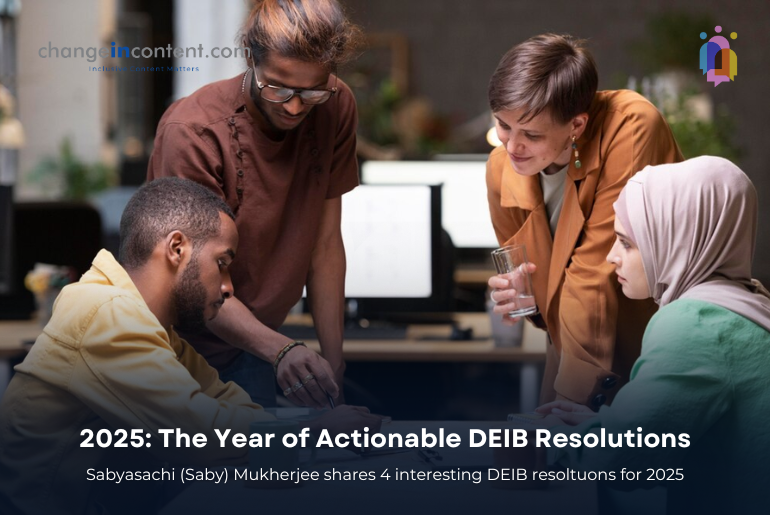
As we welcome the new year, setting DEIB Resolutions for 2025 is more crucial than ever. Sabyasachi (Saby) Mukherjee shares his four key resolutions to drive Diversity, Equity, Inclusion, and Belonging (DEIB) forward. His insights offer practical strategies to create meaningful change at both organisational and individual levels. His insights can pave the way for a more inclusive and equitable future.

DEIB resolutions for 2025: Introduction
As we look ahead to a new beginning, one thing is clear: the landscape of Diversity, Equity, Inclusion, and Belonging (DEIB) continues to evolve. Thankfully, DEIB efforts have gained momentum across industries over the past few years. Still, for true change to occur, a sustained commitment to meaningful action at both macro (Country, organisation, etc.) and micro (individual allyship) levels is required.
I wanted to discuss my four key resolutions that I believe will drive DEIB forward in 2025. Each of these actions can create a more inclusive, equitable, and safe environment for all employees.
De-aggregate data by region, function, and seniority to drive targeted change
We must go beyond reporting broad diversity statistics. Instead, we must de-aggregate data across multiple dimensions, such as region, function, and seniority level. Simply reporting a 10% diversity rate at the organisation-wide level can mask significant disparities between different teams, regions, or leadership levels. For example, diversity in one region or function may be much higher than in others, or senior leadership may have limited diversity, even if the overall workforce is more balanced.
De-aggregating data in this way allows organisations to gain deeper insights into where inequities exist within their workforce and to take targeted action. By breaking down diversity metrics at a granular level—by region, function, and seniority level—organisations can assess representation in each specific cohort and identify where improvements are needed. This approach ensures that diversity initiatives are strategically aligned with the unique challenges and opportunities in different parts of the business.
For instance, if a company finds that its marketing department has strong diversity representation, but its tech department is lacking, it can then design specific interventions for the tech function, such as targeted recruitment or mentorship programs. Similarly, if there’s a significant diversity gap at the senior leadership level, a focused strategy to increase diverse leadership representation, such as leadership development programs or sponsorship opportunities for underrepresented employees, can be implemented.
Toolkit for de-aggregating data
- Collect demographic data for each employee by region, function, and seniority level.
- Regularly track and analyse diversity metrics across all departments and leadership levels.
- Identify which cohorts (e.g., specific regions, functions, or levels of seniority) have lower representation and develop targeted strategies to address these gaps.
- Create specific action plans with clear goals for each underrepresented group to increase their representation in key areas.
- Ensure transparency by sharing de-aggregated data with leadership and employees to foster accountability.
Pilot new models before full-scale implementation
When introducing new DEIB strategies, it is crucial to pilot initiatives before scaling them across the organisation. I have seen many well-meaning diversity programs failing because they were implemented without sufficient testing or without understanding how they might work in a real-world setting. Piloting allows them to test assumptions, evaluate the impact of new strategies, and refine their approach based on actual outcomes rather than theoretical predictions.
For instance, if a company is considering implementing a new mentorship program for underrepresented employees, it makes sense to pilot the program with a small group first. By gathering feedback and measuring outcomes, such as career advancement or improved employee satisfaction, the organisation can determine what worked, what didn’t, and how to improve before rolling it out to the wider organisation. Piloting new programs also fosters a culture of learning and adaptation, ensuring that the final strategy is more effective.
DEIB resolutions for 2025: Toolkit for piloting
- Select a small group or department to pilot a new DEIB initiative.
- Establish clear goals and measurable outcomes for the pilot program.
- Gather feedback from participants and stakeholders throughout the pilot phase.
- Use data to make adjustments and optimise the program before broader implementation.
- Ensure the pilot includes a feedback loop to improve the initiative continuously.
Prioritise sensitisation workshops for people managers
One of the most effective ways to drive DEIB change is to empower people managers with the knowledge and tools they need to advocate for DEIB. People managers are the front-line catalysts for inclusion. They interact daily with employees and have the power to create a culture of belonging within their teams. Therefore, one of the top resolutions for 2025 should be providing sensitisation workshops that educate managers on unconscious bias, microaggressions, and inclusive leadership practices.
These workshops must go beyond surface-level diversity training and focus on practical, actionable strategies for managing diverse teams. It should include strategies to confront and address bias, as well as practical approaches to building inclusive teams. Nothing works better than a supportive manager and an inclusive team.
Toolkit for sensitisation workshops
- Develop training programs that focus on inclusive leadership, unconscious bias, and how to foster an inclusive team culture.
- Offer workshops regularly to ensure people managers receive ongoing education on these critical topics.
- Create safe spaces for managers to discuss challenges and share solutions related to DEIB in their teams.
- Integrate DEIB into leadership performance reviews, holding managers accountable for creating inclusive work environments.
Create safe and accessible spaces—Physically and psychologically
Creating physically and psychologically safe workplace spaces should be a non-negotiable priority. Work environments—whether in-person, remote, or hybrid—must be accessible to everyone, regardless of their physical ability, mental health, gender identity, or cultural background. Research shows that employees who feel psychologically safe at work are more likely to contribute ideas, take risks, and innovate. According to a Google study on psychological safety, teams that prioritise psychological safety outperform others in terms of team performance and satisfaction.
This resolution also includes ensuring that the physical space is fully accessible. For example, providing accessible meeting rooms, offering assistive technologies for employees with disabilities, and ensuring that team events (both virtual and in-person) are inclusive of all participants are essential steps. Equally important is ensuring that employees feel comfortable expressing themselves without fear of judgment, discrimination, or exclusion.
Organisations must not assume psychological safety and physical accessibility. Instead, organisations must actively seek feedback from employees with diverse needs to understand their challenges and experiences. Furthermore, assumptions about anyone’s identity or needs—whether it is mental health conditions, disabilities, or sexual orientation—can not be made because not all disabilities are visible, and not everyone is “out of the closet.“
Toolkit for creating safe and accessible spaces
- Regularly assess the physical workspace to ensure it is fully accessible to employees with disabilities.
- Provide tools and resources for employees to address mental health challenges (e.g., therapy benefits, mental health days).
- Ensure that virtual meetings and remote work tools are accessible, with options for closed captioning, screen readers, and other assistive technologies.
- Foster a culture of openness where employees can communicate their needs without fear of judgment.
- Include diversity and accessibility training for all employees, not just managers.
DEIB resolutions for 2025: The final thoughts
As we move into 2025, these are my four resolutions—de-aggregating data, piloting new initiatives, prioritising people manager sensitisation workshops, and creating safe and accessible spaces—to help create a more holistic, inclusive, equitable workspace. What are yours?
Disclaimer: The views expressed in this article are based on the writer’s insights, supported by data and resources available both online and offline, as applicable. Changeincontent.com is committed to promoting inclusivity across all forms of content. We broadly define inclusivity as media, policies, law, and history—encompassing all elements that influence the lives of women and gender-queer individuals. Our goal is to promote understanding and advocate for comprehensive inclusivity.

1 comment
It is not myy first time to pay a visit this web
site, i am visiting this web page dailkly and obtain pleawant data from hedre every day.