
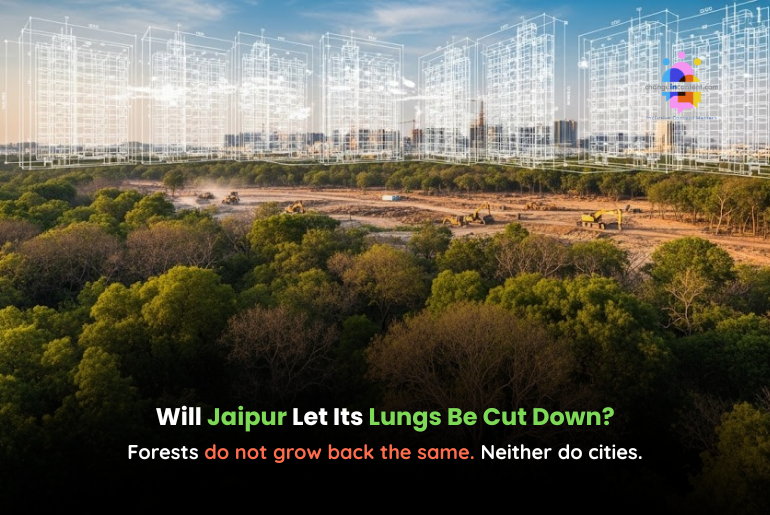
The fight to protect Dhol Ka Badh is not merely about saving trees. Instead, it is about saving Jaipur’s identity. Known as the city’s lungs, Dhol Ka Badh is a living, breathing ecosystem that quietly sustains the urban life around it. Yet, as bulldozers move in and government projects take over, the question arises: are we trading oxygen for office buildings?
According to Global Forest Watch, India had 44.4 million hectares of natural forest in 2020, covering around 15% of the country’s land. However, by 2024, 150,000 hectares were lost, resulting in 68 million tonnes of carbon dioxide emissions. From 2002 to 2024, the country lost 348,000 hectares of humid primary forest, which made up 15% of all tree cover loss. During this period, India’s humid primary forest area shrank by 5.4%.
Rajasthan, a state “not” known for its green cover, had only 37,800 hectares of natural forest in 2020, which is just 0.11% of its land. Yet even here, forests are being cleared. In 2024 alone, Rajasthan lost 3 hectares of natural forest. Now, one of its most important ecologically rich green forests, Dhol Ka Badh in Jaipur, is under threat.
Dhol Ka Badh: The lungs of Jaipur
Dhol Ka Badh is a 100-acre forest that locals often describe as Jaipur city’s lungs. It quietly cools the town by 2–5°C and supplies over 250 tonnes of oxygen each year. The forest also recharges groundwater and supports a rich diversity of life. More than 2,400 trees grow here, including several ancient Khejri trees, the state tree of Rajasthan. It also shelters over 85 bird species and countless insects, animals, shrubs, and herbs.
In 2021, a detailed survey found 2,421 trees of 30 different species in the forest. The study also documented 54 types of shrubs and herbs. Experts identified 64 bird species, both resident and migratory, that rely on this habitat.
Yet all of this may soon disappear.
2,500 trees set to fall for Government projects in Jaipur
The state government has proposed major construction projects on this very land. A Fintech Park, a PM Unity Mall, hotels, and the Rajasthan Mandapam are part of the plan. The Rajasthan State Industrial Development and Investment Corporation (RIICO) has already issued tenders. One tender, worth ₹170 crore, was issued in January 2024 for Unity Mall, with a completion target of 540 days. Construction work has already started.
The Dhol ka Badh Sangharsh Samiti, along with local residents, estimates that 2,500 trees will be cut for these projects. For the mall alone, the forest will lose about 600 to 700 trees. The “Kunj” patch, which is one of the densest parts of this urban forest, will be cleared. Residents have raised concerns over the destruction of this last remaining green space.
Voices of resistance
Locals and environmental activists have come together to protest the plan. Their demand is not to halt development but to choose a site that does not harm biodiversity. Kavita Srivastava, National President of the People’s Union for Civil Liberties (PUCL), mentioned that they made several requests to shift the project or change its layout. According to her, the authorities can build the Unity Mall without destroying the forest by using just a portion of the 15,000 square feet of land.
Activist Ashutosh Ranka also stressed that the protest is not anti-development. He highlighted that the forest lies between the city and the desert and is ecologically important. At the same time, he proposed converting the area into a biodiversity park with nature trails, eco-tours, and even a climate museum. He pointed out that 20 to 30 acres of less densely forested land nearby could be used instead for construction.
Women and forest loss: An overlooked crisis
While the debate around Dhol Ka Badh continues, there is another angle that we often ignore: How deforestation affects women. For people who live close to forests, this is not just an environmental issue. It is a daily hardship, especially for women and girls.
In rural India, women are the ones who gather firewood, collect water, cultivate crops, and gather non-timber forest products. When forests are lost, the impact falls hardest on them. With trees disappearing, women must walk longer distances to find firewood and clean water. Forest loss makes their work more exhausting and their lives more vulnerable.
Development in Dhol Ka Badh: What is at stake?
Cutting down a living forest to build cement structures is not progress. It is a loss we cannot afford. Once lost, we cannot bring back this forest. More than just a source of clean air, the forest also protects biodiversity and is a lifeline for ecosystems, traditions, and local livelihoods.
The projects proposed on the Dhol Ka Badh land might bring short-term economic gain. However, the long-term environmental and social costs will be extremely high. The city will lose its green cover. Local temperatures will rise. Groundwater will decline. Biodiversity will suffer. Moreover, women, already overburdened, will carry the weight of this so-called “development.”
The final thoughts
Forest loss in places like Jaipur shows how little space nature is given in our national development plans. These are not empty lands as they already serve a purpose. Once cleared, they don’t grow back the same. Once the trees are gone, the city will feel it in rising temperatures, water shortage, and loss of birds and animals that depend on it. However, this loss is avoidable.
India has enough degraded land that can be repurposed without cutting down forests. Moving the proposed projects to alternative sites will not halt growth; it will make it more responsible.
A sustainable economy is one that values clean air, water, and green spaces just as much as roads and malls. This means planning with care, choosing better locations, and listening to the people who are most affected. Growth is essential, but not at the cost of long-term damage.
Changeincontent Perspective
At Changeincontent, we believe that development and conservation are not enemies. Instead, they are collaborators in building a just, sustainable future. Dhol Ka Badh is a symbol of that balance tipping dangerously off scale. Cities cannot afford to ignore the cost of ecological loss, especially when women and marginalised communities pay the highest price. We are not against growth. We are against blind growth. It is time to build with conscience, not just cement.
Also Read: Man or Bear? A question that raises the serious social issue of violence against women.
Disclaimer: The views expressed in this article are based on the writer’s insights, supported by data and resources available both online and offline, as applicable. Changeincontent.com is committed to promoting inclusivity across all forms of content. We broadly define inclusivity as media, policies, law, and history. It encompasses all elements that influence the lives of women and marginalised individuals. Our goal is to promote understanding and advocate for comprehensive inclusivity.
