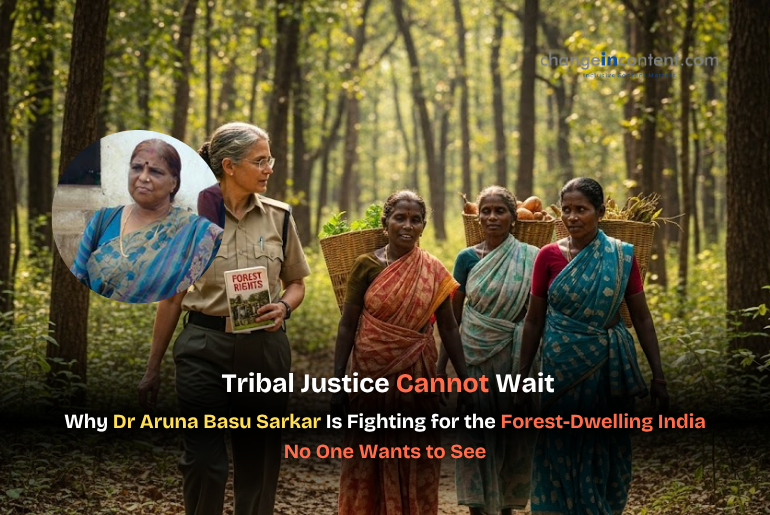
In the heartlands of Tamil Nadu, far from headlines and high offices, lives a quiet revolution. It does not roar; it resists. It does not demand centre stage; it reclaims what was taken away in silence. And at the forefront of this fight is Dr Aruna Basu Sarkar, a retired Indian Forest Service officer, founder of the Nivedita Foundation, and a fierce advocate for tribal justice.
Dr Sarkar’s journey is not a conventional one. After serving over three decades in the Indian Forest Service, she chose not to settle into retirement but to step into a battlefield long abandoned by the system. Her life’s mission? To ensure India’s forest-dwelling communities are not just written into policy, but truly empowered through it. Her work proves that DEI (Diversity, Equity, Inclusion) is not a boardroom metric; it is a grassroots struggle, and a lifelong responsibility.
The problem with paper promises
The Scheduled Tribes and Other Traditional Forest Dwellers (Recognition of Forest Rights) Act, passed in 2006 and notified in 2007, was hailed as a historic correction to centuries of injustice. But 17 years later, in Tamil Nadu, this landmark legislation remains largely theoretical. For many tribal families, the forest continues to be their home. However, the law does not recognise them. The rights guaranteed in the Act remain unseen, unread, and unacknowledged by the very departments responsible for enforcing them.
Dr Aruna Basu Sarkar saw this failure unfold up close. As an officer who rose through the ranks from District Forest Officer to Principal Chief Conservator of Forests, she observed a consistent pattern. It was all about wilful ignorance, systemic neglect, and a deep misunderstanding of what tribal rights actually mean. Most forest officials, she argues, still equate forest rights with land ownership. Moreover, they ignore the fact that these communities need not land deeds but recognition of their cultural and occupational lifelines. Some of these are collecting forest produce, grazing cattle, or following traditional forest practices.
The forest as a workplace, and a weapon
DEI often speaks of safe workplaces. But for tribal communities, the forest is their workplace, and it is increasingly hostile. The Joint Forest Management (JFM) programme, introduced in 1997 as a participatory forest conservation model, was meant to empower local communities. Instead, it became a tool for exploitation. Under the guise of ‘Tribal Village Committees,’ forest officers and contractors turned tribal labour into bonded labour. What was supposed to be inclusion became modern-day feudalism.
Dr Sarkar’s criticism of the JFM model is sharp, and backed by years of fieldwork. Between 2010 and 2018, she personally visited more than 250 tribal villages in Tamil Nadu. What she found was heartbreaking. Tribal people denied community certificates. Departments refusing to recognise basic rights. An ecosystem where rules were written in English and Tamil, but never circulated. Because awareness breeds accountability, and in these forests, ignorance is power.
From the system to the streets: Founding Nivedita Foundation
Retirement, for Dr Aruna Basu Sarkar, was not the end of service. Instead, it was the beginning of resistance. In 2018, along with a group of retired forest officials, she founded the Nivedita Foundation in Trichy. Self-funded and stubbornly committed, the Foundation took on what government departments had refused to do: empower tribal communities with access, information, and voice.
The Foundation’s work is relentless. In February 2025, it released a Tamil handbook titled Vana Urimai Angeekaram (Sattam) 2006 — Vazhikaatti Kaiyedi, co-authored by Dr Sarkar and J Elangovan. It is more than a translation; it is a tool of justice. A guide that explains the Forest Rights Act to those most affected by it, and to those meant to implement it. It is literacy as resistance.
Beyond books, the Foundation runs free medical camps in partnership with Aravind Eye Hospitals. Over 200 tribal individuals have undergone cataract surgeries. More than 500 have received eye care. Essential groceries have been distributed in chronically undernourished areas. It is DEI with sleeves rolled up; not policy, but practice.
Identity denied: The battle for certificates
One of the most urgent, yet overlooked, struggles Dr Sarkar is fighting involves community certificates. In areas like the Palani foothills of Dindigul, entire tribal populations remain unrecognised by the state. Without these certificates, they cannot access education, jobs, healthcare, housing, or dignity. Their lives remain in bureaucratic limbo.
A certificate may seem like a piece of paper. But for tribal communities, it is the difference between visibility and erasure. Between belonging and being banished from every opportunity. This denial is not administrative oversight, but structural injustice. And Dr Sarkar, despite countless letters and petitions, continues to push for redressal. Her demand is simple: recognise their identity so that they can claim their rights.
Conclusion: Why Dr Aruna Basu Sarkar’s fight for tribal justice matters
Dr Aruna Basu Sarkar is not just a retired officer or a nonprofit founder. She is a living reminder that laws mean little without enforcement, and policies mean nothing without people. Her work challenges every assumption we have about progress. Because for tribal communities, even their identity is still up for debate.
Her journey teaches us that DEI is not limited to boardrooms and brand statements. It must start where oppression does, at the margins. In the forests, in forgotten villages, in outdated government files, in languages never translated. Dr Sarkar’s story is not one of charity. It is one of accountability. Of ensuring that inclusion is not an afterthought, but the starting point.
Disclaimer: The views expressed in this article are based on the writer’s insights, supported by data and resources available both online and offline, as applicable. Changeincontent.com is committed to promoting inclusivity across all forms of content. We broadly define inclusivity as media, policies, law, and history. It encompasses all elements that influence the lives of women and marginalised individuals. Our goal is to promote understanding and advocate for comprehensive inclusivity.