
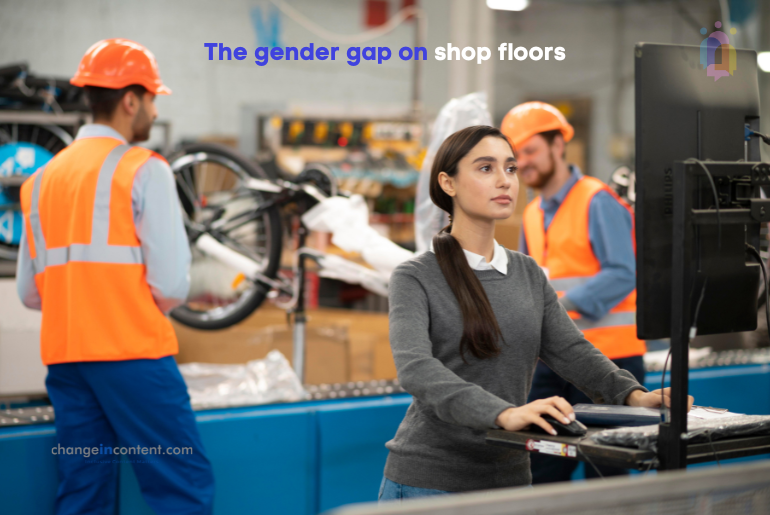
Jobs for women have certainly improved compared to the past, with companies launching initiatives to hire more women. But take a closer look, and you’ll see most organisations mainly hire women for desk jobs and HR roles. Even in the automobile industry, women are usually in design, research, or other corporate roles. The genuine concern is the gender gap on the shop floor and the persistent belief that women can’t handle project sites.
A simple postcard, a significant change on TELCO’s shop floor
Historically, women were nearly absent from shop-floor jobs. There was a time when TATA Engineering and Locomotive Company (TELCO) put out job requirement notices specifying “only male” employees. Sudha Murthy, now renowned as a writer and philanthropist, came across one of these TELCO job advertisements. She wrote a postcard to JRD Tata, the company chairman, complaining about this clear gender discrimination.
She argued that women could work just as well, if not better, than men and that without opportunities, they couldn’t prove themselves. JRD Tata responded to her postcard by changing the “male-only” policy and ordering interviews and examinations for female applicants. This change allowed Sudha Murthy to become the first female engineer in her village, Shiggaon, and eventually the first female engineer on the TELCO shop floor. We need more changes like this, breaking old habits and opening up opportunities for women, even if it starts with a simple postcard.
Gender gap on shop floors: Why women are missing from the shop floor
Women in the Indian workforce have been slow to increase, especially in the manufacturing sector. Companies are hesitant to hire women for shop-floor jobs due to safety concerns, doubts about their ability to handle challenging physical work, and worries about maternity leave costs. Additionally, there is a significant gender wage gap. In 2019-20, for every INR 100 earned by a male industrial worker, a female worker earned just INR 87.06.
The Avatar Report on gender gap on shop floors
According to an Avtar report, only 3-12% of engineering jobs are held by women, compared to 27-40% in services. Less than 5% of the people working on the shop floors in the automobile industry are women. It means that women make up a tiny fraction of the workforce involved in the hands-on, operational side of the industry.
CEDA Analysis
An analysis by the Center for Economic Data Analysis (CEDA) at Ashoka University reveals that only 1.6 million women, or about 20% of the total women workforce, work in factories. Of these, 0.68 million (43%) are employed in factories in Tamil Nadu. Women factory workers are predominantly found in the southern states of Tamil Nadu, Kerala, and Karnataka. Additionally, Manipur in the northeast also supports women in manufacturing. However, outside these regions, particularly in the northern states, there are fewer opportunities for women in manufacturing.
Gender gap on shop floors: The real challenges
Even though more girls are choosing to study science and engineering, the number of women actually working in these fields is not growing at the same rate. In other words, many women who earn degrees in science and engineering are not finding jobs in these areas. They are also facing barriers that keep them from entering the workforce.
Internships and summer jobs often reveal gender stereotypes at work. Men usually get to work with problem-solving tasks that build their analytical and technical skills. Women, however, often find themselves assigned to roles like sorting papers, copying documents, or coordinating tasks that seem more about keeping them busy than actually developing their abilities. This old-fashioned view does more than just downplaying women’s capabilities. It also suggests that their skills are better suited for less demanding, less visible work.
How Indian companies are embracing women in shop floors
With women making up 50% of the population, it’s clear that their potential in the workforce is immense. Ignoring this due to outdated beliefs means missing out on a vast talent pool. However, companies like Tata Steel, L&T, MG Motor India, and Welspun India are actively working to tap into this potential by hiring more women. This change isn’t just about improving gender diversity; it’s about embracing the future of the workforce.
For example, Daimler India Commercial Vehicles, through its global ‘DiveIN’ (Diversity and Inclusive) initiative, has successfully employed over 20% of its factory workers as women. Additionally, Tata Motors, with its ‘Kaushalya’ scheme, focuses on skill development for women. The program hires women who have completed their 12th grade, trains them on the shop floor, and provides them with a stipend.
Men have traditionally dominated the cement sector in India. However, things are starting to change. The Cement Manufacturers Association (CMA) has launched an initiative called ‘Women Of Cement’. The initiative encourages companies to include more women in leadership roles within the industry.
Gender gap on shop floors: The final thoughts
In industries with more automation, like FMCG and pharmaceuticals, more women are working on the shop floors. However, in industries where the work is less automated and often more physical, there are still very few women. It shows that while some progress has been made, there is still a long way to go in industries that rely on manual labour. To truly bring in change, companies must offer women equal opportunities across all areas of work, not just in roles that are traditionally seen as suitable for them.
Disclaimer: The views expressed in this article are based on the writer’s insights, supported by data and resources available both online and offline, as applicable. Changeincontent.com is committed to promoting inclusivity across all forms of content, which we define broadly to include media, policies, law, and history—encompassing all elements that influence the lives of women and gender-queer individuals. Our goal is to promote understanding and advocate for comprehensive inclusivity.
