
The film industry has always glorified the toxic treatment of women. It fills the screen with sexual comments, tasteless jokes, crude gestures, and, of course, the inevitable stalking as an expression of love. But what is happening offscreen is even more alarming. Sexual harassment has sadly become part of the job for many women in the industry. The nearly 300-page Hema Committee report, led by a former Kerala High Court judge and established by the state government in 2017, exposes the exploitation. The detailed report highlights the deep-rooted misogyny in Kerala’s film industry.
The report focuses on rampant issues like sexual abuse, casting couch practices, and the dominance of powerful men in the industry. It also brings attention to the everyday acts of discrimination and disrespect that women face regularly. These acts have long simmered in silence but are finally being revealed.
The study warns, “Do not trust what you see, even salt looks like sugar.“
Understanding the Hema Committee report on Malayalam Cinema
The Hema Committee is led by former Kerala High Court judge K. Hema, with actor T. Sarada and retired Principal Secretary K.B. Valsalakumari. The committee was set up in the aftermath of the shocking sexual assault of actress Bhavana Menon. Menon is renowned for her roles in over 80 films across southern India. She is also a recipient of numerous prestigious awards. Menon was attacked by a group of men while travelling from Thrissur to Kochi in February 2017.
Although Indian law protects the identities of sexual assault survivors, most people believe that Menon was the victim. In 2022, she chose to reveal her identity publicly through Instagram and an interview with the BBC.
The assault against Bhavana Menon grabbed headlines when Dileep, a major star in the Malayalam film industry and Menon’s co-star in several films, was named as a key suspect and charged with criminal conspiracy. Despite his denial of the charges, Dileep faced arrest. He spent three months in custody before being granted bail. The case remains a high-profile issue in court.
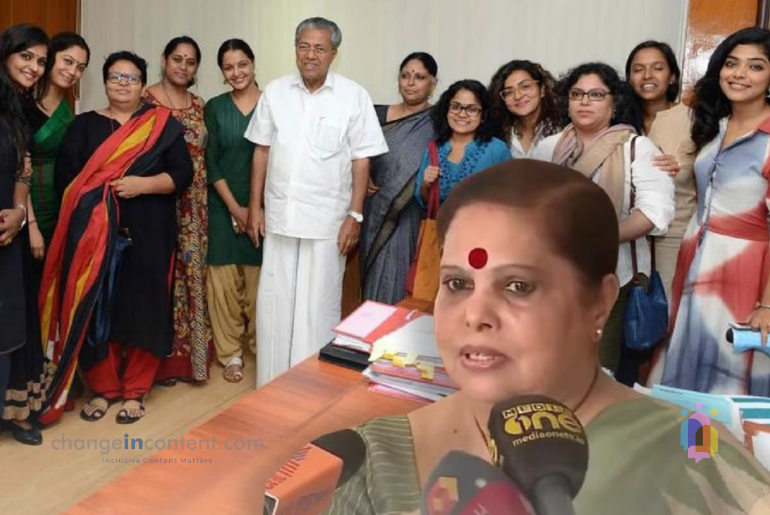
Following the assault, the Women in Cinema Collective (WCC), comprising some of Menon’s colleagues, petitioned the government. They demanded urgent action on the case and sought to address the troubling reality faced by women in the film industry.
The Justice Hema Committee report, completed in 2019, gathered anonymous testimonies from at least 80 women. These women range from well-known actresses to junior artists. The sad truth is that despite the report’s completion in 2019, its release faced significant delays due to legal challenges. After five years, when authorities finally made it public on August 19, 2024, the government redacted 63 pages from the original 295-page document.
Sexual exploitation & harassment of women in film industry
On top of dealing with inherent sexism in the entertainment industry, the most prominent challenge women face in this field is sexual harassment. They endure inappropriate advances, from groping and unwanted touches. Furthermore, the issues involve explicit propositions from senior actors or directors. Daily, they face taunts about their bodies and deal with constant, unwelcome innuendo. Perhaps the worst of all is being offered jobs with the implication that they must “return the favour” at some point.
The report’s detailed section on sexual harassment starts by describing how women entering the film industry face demands to make “adjustments” and “compromises.” These women often encounter pressure to be available for “sex on demand.”
Actresses who appear in intimate or explicit scenes get labelled as promiscuous. Witnesses have shared video clips, audio recordings, and WhatsApp screenshots. These show that even well-known figures in Malayalam cinema are involved in these predatory actions.
The report also reveals how the industry maintains an “enabling atmosphere”. This atmosphere makes it easier for exploitation and abuse to continue unchecked. “Many in the industry are made to believe that all women in the industry get into the industry or are retained only because they have sex with men in the industry,” the report observed.
When people in the industry believe that women only get roles or keep them by having sexual relationships with men, it creates an atmosphere where such exploitation becomes normalised.
Mafia-like lobby’s criminal and misogynistic influence
The report reveals that a ‘mafia’ consisting of around 10-15 prominent producers, directors, actors, and production controllers controls the film industry’s operations. Moreover, they decide which actresses get roles. The industry also suffers from the influence of criminals and misogynists.
The report states that the lobby actively targeted women who joined the Women in Cinema Collective in 2017. They worked behind the scenes to deny these women roles or to get them removed from projects using false pretexts.
Because of this lobby, “No man nor woman dare to utter any word which may offend anyone belonging to the power group, because such a person will be wiped off the industry by the powerful lobby“.
The report outlines various harassment tactics faced by women professionals. It notes that if the ‘mafia’ disapproves of an actress, they subject her to mental harassment. They do so by repeatedly filming intimate scenes. For instance, one director forced an actress to redo lip-locking scenes 17 times. Surprisingly, the scenes never appeared in the final cut of the film.
Hema Committee report on Malayalam Cinema: Unsafe work conditions and denial of basic human rights
The report highlights the lack of basic facilities for women at shooting locations. Examples are the lack of toilets and changing rooms. As a result, women often avoid drinking water, which harms their health. The report also reveals that shoots can be unsafe, particularly at outdoor locations. It describes chilling night-time knocks on doors, which are not polite but forceful. Women often feel that the door might collapse under the force and that men might force their way into the room.
The Association of Malayalam Movie Artists do not accept junior artists. Moreover, the Film Employees Federation of Kerala also does not recognise them as technicians. As individual agents hire these artists, they remain highly vulnerable to exploitation and abuse. The report also notes irregular wage payments, lack of travel allowances, and instances where junior artists are denied food and water on set.
The casting couch remains a troubling reality
“The Malayalam film industry is in the grip of a powerful all-male ‘mafia’. It is plagued by the ‘casting couch’ syndrome and systemic exploitation of women. Those who refuse to oblige or dare to speak out risk career obliteration,” the report observed.
“Women in cinema frequently feel unsafe going to work alone. Numerous testimonies reveal that sexual demands are commonly tied to employment opportunities. That makes it vastly different from other professions. In fields like teaching, medicine, or engineering, women do not have to undergo such conditions. For these jobs, demonstrating one’s skills and passing an interview is usually enough to secure employment. However, in the film industry, the casting couch remains a troubling reality,” the report further said.
The Hema Committee report also describes cinema as a male-dominated industry and tags it as an exclusive “Boys’ Club.” Men often spend long hours discussing movie scripts or future projects, frequently over drinks. These discussions sometimes stray from the topic of films and include vulgar jokes and sexual innuendos.
Despite more women stepping into leadership roles over the past decade, the entertainment industry still often feels like a “boys’ club” with a lot of locker room talk. Much of this talk happens intentionally for women to hear. It focuses on their bodies and appearances and makes them feel uncomfortable. Hearing their roles reduced to mere eye candy can make women feel insignificant, as if they are wasting their time and effort. Consequently, many women either quit their jobs or were forcefully pushed out.
The final thoughts
If the Hema Committee has exposed the dark realities of the Malayalam film industry, we must ask: what might still be hidden in the other language industries? Without forming similar committees across all film industries, the extent of these problems may remain unknown. It’s crucial that the pressure on industry professionals continues and that the conversation doesn’t fade away like the #MeToo movement did in Western cinema. The commission intended to provide women in the industry with a platform to speak out, and the anonymity offered likely encouraged many to come forward and share their experiences.
But now, the responsibility falls on the government and those in positions of power. We can only hope they take the necessary action. As a community, we must also ensure that we do not shy away from expressing our outrage and disgust at these revelations. If we reduce this issue to mere small talk or as just another piece of gossip, women will continue to face abuse in their workplaces.
Disclaimer: The views expressed in this article are based on the writer’s insights, supported by data and resources available both online and offline, as applicable. Changeincontent.com is committed to promoting inclusivity across all forms of content, which we broadly define as media, policies, law, and history—encompassing all elements that influence the lives of women and gender-queer individuals. Our goal is to promote understanding and advocate for comprehensive inclusivity.
