
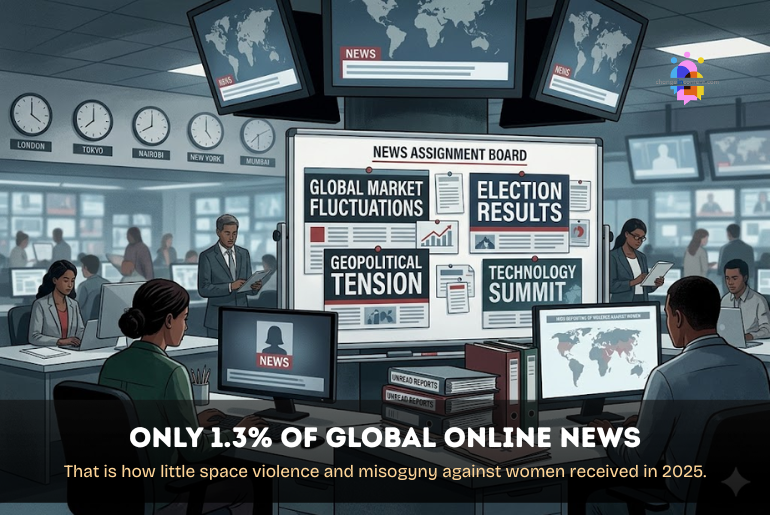
If news is supposed to tell us what matters, then the current state of the media coverage of violence and misogyny against women tells us something deeply uncomfortable about global priorities. Now, reports from the Global Misogyny News Coverage Tracker say coverage of violence against women remains ‘pitiful’ low, even as cases of misogynistic abuse persist, and such incidents continue to demand public attention. That is not a neutral editorial outcome. It is a structural blind spot.
The problem becomes harder to dismiss when placed in context. We already know from the Global Media Monitoring Project that women remain dramatically underrepresented in the news overall. They appear in only 26% of stories as subjects or sources. Now, the new misogyny tracker suggests that even when the issue is specifically violence, abuse, and structural harm against women and girls, the coverage remains strikingly thin and often badly framed.
Media coverage of violence and misogyny against women remains alarmingly low.
The Global Misogyny News Coverage Tracker: The Missing Misogyny-related Coverage in an Era of Endemic Violence against Women is the 7th report in the award-winning Missing Perspectives series. It is the first edition of what will now run as an annual review of how news media cover misogynistic harassment and violence against women and girls.
Part of the Missing Perspectives series, the report draws on multiple research methods, including analysis of 1.14 billion news stories worldwide. It finds a consistent gap in both the volume and depth of such coverage.
Why the decline matters even more now
Between 2017 and 2025, reporting on misogyny-related issues accounted for just 1.6% of total online news output, dropping to 1.3% in 2025. It remains low despite the scale of real-world violence and several high-profile cases, such as the Epstein files, during the same period. At the same time, references to “gender ideology”, a term used by anti-gender equality groups, rose sharply between 2020 and 2025, increasing 42 times in news coverage.
Even among the top 50 English-language global news providers, coverage stays concentrated within a small group, with just 5 outlets accounting for over half of the headlines on violence against women. The BBC, the Guardian, Substack, Indiatimes and Yahoo News account for over half of all article titles that explicitly mention violence and structural barriers women face.
Even when the media coverage of violence and misogyny against women appears, men still dominate the story.
Newsrooms remain male-dominated, especially in high-profile areas such as politics, foreign affairs, and economics. Editors who decide what counts as a story are still largely men, and in many countries with diverse populations, they are predominantly white men.
Between 2017 and 2025, news coverage quoted about 1.5 men for every one woman. For stories on misogyny, 3.9 men were quoted for every one woman. Although 2021 briefly saw near parity in quoted voices, that did not hold.
By 2025, the gap increased again, with 1.6 men quoted for every one woman, even in coverage focused on misogynistic harassment and violence.
Most GBV reports leave out victim support and key details
A large share of coverage still leaves women out of the story. The Global Media Monitoring Project finds that nearly half of the articles do not include a female perspective. At the same time, 45% of pieces that quote contributors do not quote a woman at all.
In reporting on gender-based violence, women appear more often as eyewitnesses. Conversely, men are more likely to be quoted as experts or authority figures. In gender-based violence stories, 24% of men’s voices appear as experts compared with 17% of women’s. It shows that authority still skews male even in reporting on misogynistic harm.
Only 32% of the articles include quotes from victims or survivors, while about one in four give space to the alleged or convicted perpetrator. In many cases, the perpetrator remains absent even from the headline. Only 41% of articles mention their name or gender. It leaves responsibility unclear and shifts focus away from those affected.
Support for readers facing similar situations also remains limited. Just 14% of articles provide any information or resources for victims or survivors. Coverage reports the incident but often stops there, without offering guidance or acknowledging what victims might need beyond the story itself.
The Changeincontent perspective
The most revealing part of this story is not merely that coverage is low. Instead, the revelation is that the low coverage persists even in an era when violence against women, online misogyny, and gender-based abuse are both globally widespread and digitally amplified.
Newsrooms still appear more comfortable reporting isolated scandals than sustained structural violence. That creates a public record where harm looks episodic instead of systemic, and where misogyny remains easier to consume as shock than to understand as power.
It should also be a lesson for organisations and corporates that still believe media neutrality exists by default. Editorial bias does not always appear as open hostility. It often appears as omission, under-prioritisation, and narrative framing. What gets a headline, whose voice leads, and whether structural inequality is named are all forms of institutional choice.
That is why representation in decision-making roles matters as much in newsrooms as it does anywhere else. A newsroom that keeps women at the margins of coverage will keep treating violence against women as marginal news.
The final thoughts: Tell the full story and centre survivors in coverage
Coverage can do more than just report what happened. It can include women as real voices in the story, as survivors, experts, and those who understand the issue closely. It can also be more direct about who is responsible rather than using vague language that avoids naming perpetrators.
Who gets quoted, whose words lead the story, and what details make it into the headline all shape how people understand the issue. Including helpline numbers, legal rights, and verified resources should become a basic part of such coverage, not an afterthought. Training journalists to report on gender-based violence with care and accuracy can also reduce harm.
Newsrooms that invest in diverse teams tend to tell these stories differently. More women in decision-making roles can shift what gets covered and how it gets framed. None of this requires new tools or big promises, just consistent choices about what to prioritise and whose voices to include.
Disclaimer: The views expressed in this article are based on the writer’s insights, supported by data and resources available both online and offline, as applicable. Changeincontent.com is committed to promoting inclusivity across all forms of content. We broadly define inclusivity in terms of media, policies, law, and history. It encompasses all elements that influence the lives of women and marginalised individuals. Our goal is to promote understanding and advocate for comprehensive inclusivity.
