
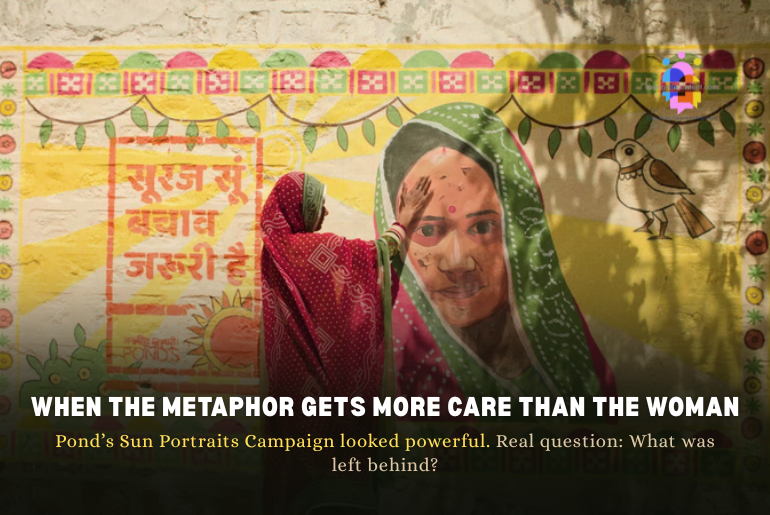
Some campaigns are so visually striking that criticism arrives late. The first reaction is admiration. The frame looks powerful, the symbolism feels intelligent, and the storytelling seems to say exactly the right thing. That is what happened with the Pond’s Sun Portraits Campaign.
Set in one of India’s hottest districts, it transformed the homes of women in Phalodi into slowly fading UV-sensitive portraits meant to demonstrate the effects of prolonged sun exposure. It was elegant, memorable, and built for attention.
But the problem with highly aesthetic campaigns is that they often make extraction look like empathy. The moment you stop looking at the craft and start looking at the exchange, the questions multiply.
- What did the women actually receive?
- What support continued after the portraits faded?
- What protections were built into using their homes, their identities, and their daily reality for a branded intervention?
These are not side questions. They are the real test of whether the campaign was awareness with accountability or awareness without consequence.
What the Pond’s Sun Portraits campaign actually did on the ground
Pond’s “Sun Portraits” campaign, created by advertising agency Ogilvy India, takes place in Phalodi. That is a district in Rajasthan where summer temperatures often cross 50°C. The campaign focuses on women who spend close to 8 hours a day working in direct sunlight. To bring this to life, the team worked with artists trained in Phad, a traditional painting style from the region. They painted life-size portraits of these women on the walls of their homes.
[penci_video url=”https://www.youtube.com/watch?v=D91TXT_mzFA” align=”center” width=”770″ /]
These portraits used UV-sensitive paint. As days passed and the walls stayed exposed to sunlight, the images began to fade, discolour, and break down. The idea was that the women could see these changes happen in real time. The brand aimed to build awareness around sun damage by showing its effects in a way that felt immediate and personal, not just something explained in an ad.
At the end of the campaign, the brand distributed free Pond’s sunscreen sachets to the women. But the reaction has been mixed. Online, people are asking what the women actually got out of this. Some are pointing to the gap between the idea and the impact, raising concerns around benefits, consent, and what support, if any, continues after the campaign.
Pond’s Sun Portraits campaign: What did the women actually receive?
The campaign got attention, but what did the women receive other than a single sunscreen sachet?
A daily-use product cannot be a one-time gesture.
Even if the idea was to promote sun protection, handing out a single small pack is a poor initiative. Sunscreen is not a one-time use product. It needs to be used daily, reapplied, and chosen based on skin type. Oily, dry, and combination skin all need different care. The skincare industry itself pushes this idea, so a single product for everyone does not really hold up.
There is also the question of cost and access. Once the sachet is over, can these women afford to keep buying sunscreen regularly? Is it even stocked in nearby shops, or does it require travel to bigger towns? Without thinking about affordability and supply, awareness alone does not go very far.
The continuity gap
There is also a gap in continuity. Did the campaign plan for repeat distribution? Did it include any follow-up or education on how and when to use sunscreen properly? Without that, the effort risks becoming a one-time interaction. The women become part of the campaign story, but not part of a longer support system.
The Pond’s Sun Portraits campaign also raises questions about Consent, Safety, and Risk.
The advertising team painted portraits on the walls of the women’s homes. That brings up more questions.
- Were the women paid fairly for using their homes and identities in a public campaign?
- Did they fully understand how their images would be used and shared?
Once these portraits are visible, they are no longer private. They become part of a public space.
That comes with risk. Murals can be vandalised, altered, or misused. There is also the question of who takes responsibility if something goes wrong.
A recent case in Gwalior showed murals of women in yoga poses being defaced with vulgar markings. Incidents like this are not rare, and they show how public representations of women often attract misogynistic attention.
There is also the everyday aspect. These walls are part of the women’s homes. Any damage, fading, or unwanted attention directly affects their living space. Without clear safeguards, compensation, and follow-up, the burden of risk stays with the women.
What could have made a real difference
The campaign could have done more on the ground. Medical camps staffed by dermatologists would have helped women better understand their skin conditions after years of sun exposure. Regular skin checks, early detection of damage, and basic treatment advice could make a real difference for women who spend 8 hours a day outdoors.
Caps, cotton scarves, or UV-protective masks designed for daily work would help reduce direct exposure. Even shaded rest areas or access to clean water and cooling spaces during peak heat hours would make daily work safer. These are small changes, but they fit into the rural women’s actual routines.
Real protection needs distribution, education, and follow-up
Groups like ASHA workers already know these communities and can track follow-ups. Periodic camps, awareness sessions, and product distribution through these networks would make the effort more consistent. Instead of a one-time campaign, it could turn into something that supports women over time.
If the goal is awareness, it has to come with access, continuity, and care. A product that needs daily use cannot be introduced as a one-time gesture. A story about sun damage cannot stop at showing effects without offering ways to deal with them. And when women’s homes and lives become part of a campaign, their safety, consent, and long-term benefit cannot be treated as secondary.
This uneasy gap between message and material support also echoes what we explored in our piece on the Band Baja Bitiya Goel TMT campaign, where the real question was not whether a campaign looked progressive, but whether it changed anything for the women whose reality it borrowed.
The Changeincontent perspective
The most serious problem with the Pond’s Sun Portraits Campaign is not that it used a metaphor. Advertising does that all the time. The problem is that the metaphor seems to have been far more developed than the material intervention.
If the campaign’s central claim is that these women face severe daily sun exposure, then the response cannot stop at visibility. It has to include continuity. Regular sunscreen access, shade interventions, dermatology camps, protective gear, education in local language, and some durable path to follow-up would have made the campaign feel less extractive and more accountable.
That is also a larger lesson for brands and agencies.
Communities are not raw material for aesthetic storytelling. Once a campaign enters someone’s home, body, labour, and environment, it assumes obligations that extend far beyond the language of awards and social engagement metrics.
The bar should not be whether the work is beautifully executed. The bar should be whether the people whose lives carry the story are safer, healthier, and better supported after the campaign is over.
The closing thoughts
Campaigns like this show how much creative brands can go with ideas, and how little that can mean without follow-through. Real impact does not come from a moment. It comes from what continues after the cameras are gone. Access to affordable products, regular health support, and basic safety measures would have made the campaign useful in everyday life rather than merely symbolic.
If brands want to work with real communities, the responsibility cannot end with storytelling. It has to include what people can actually use, afford, and rely on. Otherwise, the campaign becomes something that takes from their reality, without adding much to it.
It is not about whether brands should take up social themes. It is about how far they are willing to go once they do. Because people are no longer just looking at the idea, they are looking at what remains after the campaign ends and who actually benefits from it.
Disclaimer: The views expressed in this article are based on the writer’s insights, supported by data and resources available both online and offline, as applicable. Changeincontent.com is committed to promoting inclusivity across all forms of content. We broadly define inclusivity in terms of media, policies, law, and history. It encompasses all elements that influence the lives of women and marginalised individuals. Our goal is to promote understanding and advocate for comprehensive inclusivity.
