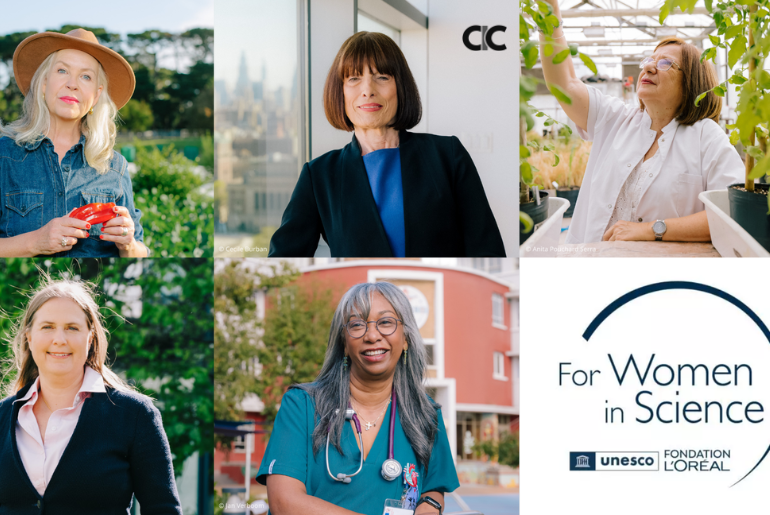
The 2026 L’Oréal–UNESCO For Women in Science International Awards will honour five leading women scientists for their contributions to life and environmental sciences, marking 28 years of the global programme.
UNESCO will recognise and award the laureates on 11 June 2026 at UNESCO Headquarters in Paris. According to UNESCO, this year’s selection highlights scientific work addressing major global health and environmental challenges. That includes tissue engineering, genomic research, agricultural innovation, child heart care and the link between nutrition and mental health.
The 2026 laureates were selected from a record 504 nominations representing 89 countries. They now join a global community of more than 5,000 women researchers who have been supported by the programme since its launch.
2026 L’Oréal–UNESCO For Women in Science International Awards: The Laureates
The laureates for the 2026 L’Oréal–UNESCO For Women in Science International Awards are:
- Professor Liesl Zühlke from South Africa, recognised for her work on cardiac and cardiovascular systems, particularly in improving care for children with heart conditions such as rheumatic heart disease.
- Professor Felice Jacka from Australia, recognised for establishing the field of nutritional psychiatry and advancing understanding of the relationship between diet, mental health and brain health.
- Professor Sarah A. Teichmann from the United Kingdom, recognised for her interdisciplinary work in genome science, computational biology and single-cell technologies.
- Professor Raquel Lia Chan from Argentina is recognised for her work in agricultural biotechnology. That includes research contributing to the development of drought-tolerant crop varieties.
- Professor Gordana Vunjak-Novakovic from the United States, recognised for pioneering work in bioengineering, tissue engineering and regenerative medicine.
The awards come at a time when gender representation in science remains a global concern. UNESCO notes that women still account for only 1 in 3 researchers worldwide. That makes recognition programmes such as the L’Oréal–UNESCO For Women in Science International Awards important not only for visibility, but also for building role models across generations.
The India Story
For India, we should not read the absence of an Indian laureate in this year’s international list with pessimism. Instead, it is a useful reminder of the long pipeline needed to support girls from school science learning to higher education, research laboratories and global scientific leadership. Change in Content has earlier examined gaps in India’s school education system, and those gaps matter deeply when discussing the future of women in science.
The milestone also connects with India’s wider conversation on women in STEM. While more women are entering technical education and qualifying for elite institutions, the challenge is to ensure that learning pathways lead to research opportunities, core technology roles, leadership and international recognition.
Change in Content has previously reported on the gender gap in STEM and women’s underrepresentation in core tech roles. We also reported on the need to support women in IITs and scientific learning environments.
The 2026 L’Oréal–UNESCO For Women in Science International Awards are ultimately a global reminder that science needs more women at every stage. Recognition matters because it makes achievement visible. But the larger task is to build systems where girls can imagine scientific careers early, women researchers can access funding and laboratories, and excellence is not treated as exceptional when it comes from women.
As the programme marks 28 years of impact, the message is clear: women are not only participating in science. They are shaping its future.
Editorial Note and Disclaimer
This news article stems from UNESCO’s official press release on the 2026 L’Oréal–UNESCO For Women in Science International Awards. The Change in Content team has edited it for the DEI Insights section. The India-related observation is an editorial contextual note, not a criticism of the awards or the selection process.
Source
UNESCO press release: Marking 28 years of impact, the 2026 L’Oréal–UNESCO For Women in Science International Awards honour five pioneering researchers.