
The Short Read
- Workplace fashion rules are not about policing what women wear. They are about understanding how clothes shape confidence, perception, and personal style at work.
- Dressing well can influence how people perceive capability, polish, and trust, though personal comfort and body positivity remain central.
- The article explores simple ways to stand out at work through colour, proportion, accessories, Indian workwear, make-up, and styling choices.
- The author argues that dressing up at work often reflects the privilege of time and taste, but both can be acquired.
- The article offers practical styling ideas for women navigating modern office fashion.
Workplace fashion rules: Where it all began for me
It started with a chance remark from a friend. She said that the women who dare to dress up at work have a better chance at promotion than those who pay no attention to their attire. I also feel there is something more to it. Women who dress up, apply make-up, or wear a saree to work come from a certain privilege. The privilege of time and taste. Both can be acquired.
It goes without saying that feeling confident in your attire positively affects how you are perceived. Research on workplace appearance and interviews has long suggested that clothing can influence perceptions of capability, confidence, and suitability. A Robert Half survey also found that 80% of executives believed clothing choices affect an employee’s chances of earning a promotion.
How to start getting better dressed at work?
I believe in body positivity. There are no fixed rules for which attire you should pick. If you are confident in a pantsuit, go for it. However, keep in mind that with e-commerce and quick commerce, there is always a chance of looking exactly like your colleague. There is a huge possibility that the algorithm looks at you in the same manner as your colleague, who is of the same age and income bracket.
The workplace fashion rules
After years of conversations with friends and my experience in the corporate world, I realise that certain rules often take the centre stage when it comes to workplace fashion.
Look different
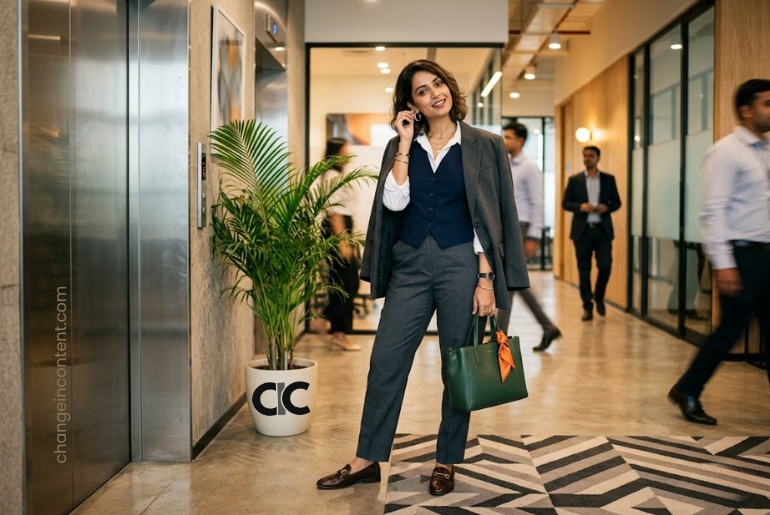
Even if you wear a simple white blouse and black trousers to work, dress them up by adding a masculine or sporty element to your regular outfit. For example, pair a waistcoat with a blouse, or a fitted top with an oversized blazer. This creates an interesting contrast.
It gives workwear a bit more of a focal point, which makes dressing more individualistic. If you are in the media industry, please know that long shorts are in. Wear them with a formal shirt. Pairing them with minimal leather loafers adds instant polish.
Understand colours
If you are short, wearing a single colour or different shades within the same colour family creates a seamless, vertical column. It instantly adds the illusion of extra height. At work, navy blue, black, grey, and beige are all good. However, these colours can be slightly dull. In that case, invest in a good bag. It could even be yellow or red for a pop of colour.
During winter, pair a black top with black trousers, then layer an unbuttoned, contrasting blazer or a long coat over it. My go-to is a long, knee-length, flowing linen blazer in Mumbai, which I picked up from Cottonworld. I am also a little embarrassed to talk about a red blazer that I purchased from Ralph Lauren. It never fails to turn heads.
Be mindful of your body shape.
I have struggled with my body shape all my life. I am a slim, pear-shaped, petite woman. Another thing that I do is wear a lighter top with darker, high-waisted bottoms. I also wear two nose rings and multiple earrings. The trick is to draw attention towards your face.
This draws visual interest to your face and shoulders while extending the leg line seamlessly downward. As a short woman, I avoid horizontal breaks. Pairing a bright red top with a bright blue skirt of equal length literally cuts my height visually by 50%.
Absolutely a no-no: big, bold patterns. No oversized dresses for me. If a dress is a size larger, I use belts to add shape and structure to loose dresses, and I carry structured bags to keep my look sharp.
The desi corpcore panic
Do not wear heavily embroidered salwar kurtas or your wedding saree with a matching blouse to work. You will look like you are celebrating an HR-driven festival day.
Wear smart blouses in muted shades with a saree. I prefer short-sleeved blouses. Nothing with a tie or a very deep back.
For salwar kurtas, stick to khadi, Chanderi, kalamkari, or cotton. No chikankari. It removes seriousness. You can pair a white kurta with fitted pants and a formal longline jacket, so nobody questions your quarterly deliverables.
The proportion anxiety
If my blazer is oversized and my pants are also loose, will the CEO think I am hiding a breakdown? Balance it.
Pair that chunky knit sweater with a pleated midi skirt so you look “intentionally styled” rather than “swallowed alive by fabric”.
The high-low crisis
I am suffocating in this stiff corporate wear, but if I wear white denim, will I spill my turmeric latte immediately? Yes, probably.
But dress it up with a monochromatic silk blouse anyway, or throw a biker jacket over wide-leg trousers so you look edgy, not unemployed.
The accessory paranoia
My loose dress feels like a nightgown. Find a belt before someone asks if I am wearing pyjamas to the office.
Shove your entire disorganised life into a structured, minimal bag to fake an organised mind, and step into minimal leather loafers, because if these slingbacks trip me up in front of the board, I will simply pass away.
Finally, the make-up
My motto is to copy the best in the business. Hillary Clinton’s signature make-up style is a masterclass in the 10-minute power look designed for the modern businesswoman.
Her routine focuses on enhancing her natural features for a polished public image, featuring a highly hydrated base rather than heavy, dry powders. She famously shifts between bold, commanding lip colours, like custom plums or her go-to rose-coral crayons, and softer glosses that keep her lips looking fresh and hydrated.
Her eyes are defined with a subtle, smudged eyeliner that emphasises them on camera without appearing overly harsh. Overall, her classic approach to beauty balances a commanding presence with approachable warmth.
Closing thoughts on the workplace fashion rules
Stop treating workplace fashion rules as a manual for becoming acceptable. Women already deal with enough invisible performance codes at work. The better way to look at fashion is through confidence, choice, presence, and personality.
- Clothes cannot replace competence.
- A blazer cannot do your job.
- A red bag cannot write your quarterly report.
- A saree cannot build your career.
But style can help a woman feel more visible in a room where she has often been taught to shrink. It can help her claim presence before she speaks. It can make work feel less like survival and more like self-expression.
This piece is not a fashion sermon. It is a playful reminder that women at work are allowed to be competent and interesting, polished and chaotic, ambitious and stylish, practical and dramatic.
The best workplace fashion rule may be this: dress in a way that lets you walk into the room like you intend to be remembered.
Editorial Note and Disclaimer
This article is part of Changeincontent’s Mosaic section, where we publish personality-led, opinion-driven, and culturally observant pieces on women, work, identity, and everyday workplace behaviour. This piece has been lightly edited for grammar, punctuation, readability, and SEO structure while preserving the author’s original voice, humour, arrangement, and personal style.
This article is an opinion-led and personal-style essay by Neurotic Nayika. The views expressed are the author’s own and are intended to be read as a fun, reflective, and practical take on workplace dressing. The article does not prescribe fixed fashion rules for all women or suggest that appearance should be valued over competence, performance, comfort, or individuality.
Sources
Robert Half survey on clothing choices and promotion chances
Research on applicant clothing and hiring perception
Allure report on Hillary Clinton’s lipstick and public image make-up references
