
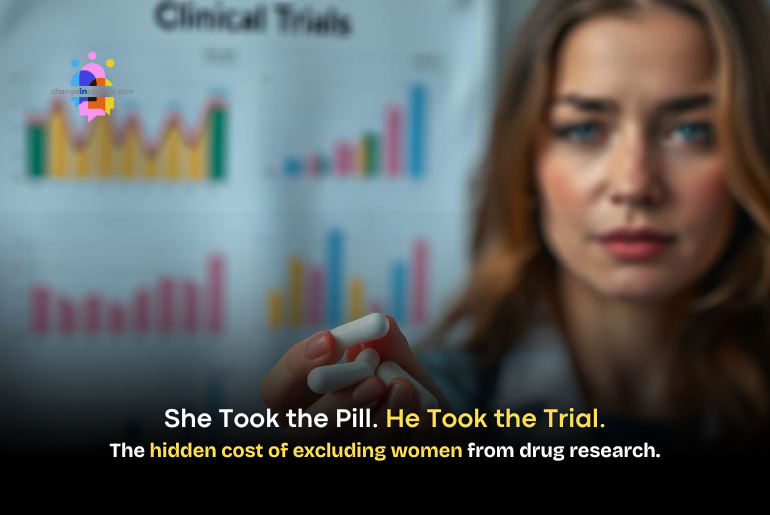
The underrepresentation of women in drug trials is a dangerous flaw in our healthcare system. While men have historically been the default subjects in clinical studies, women have paid the price through incorrect dosages, misdiagnoses, and adverse reactions. The issue is more than statistical; it is systemic, and it impacts women’s safety every single day.
Men and women are equal, but not biologically the same. Unfortunately, the medical and healthcare systems continue to ignore this difference. Women are disproportionately affected by this oversight, and in many instances, they’re the only ones who suffer.
How the underrepresentation of women in drug trials risks lives
Previously at ChangeinContent, we covered the issue of medical gaslighting, where women’s health concerns are ignored or downplayed by healthcare professionals. According to the 2022 SHE Media survey, over 72% of women reported that their symptoms were dismissed or not taken seriously.
This year, researchers from the University of Windsor launched a study on medical gaslighting. The researchers received such an overwhelming number of painful personal accounts from women that they had to pause between responses, each one describing how medical providers overlooked serious health problems.
This happens because women are not a priority in the way medicine is taught, researched, and practised. Without enough studies on women’s health, treatment plans often rely on incomplete data. When the data does not show how women’s bodies respond, their treatment becomes less safe and less effective.
Sex bias in drug trials leads to overmedication in women
A primary concern in women’s healthcare is the manner in which drug trials are conducted. Research from UC Berkeley and the University of Chicago shows that drug dosages are usually based on studies done on men. It puts women at higher risk for side effects.
The study reviewed thousands of articles from medical journals. It found that 86 FDA-approved drugs, including antidepressants, heart medication, seizure drugs, and painkillers, were tested mostly on men. Yet the exact dosages were later given to women. As a result, women had higher drug levels in their blood, and their bodies took more time to clear the drugs. In over 90% of cases, women suffered worse side effects. These included nausea, depression, seizures, hallucinations, cognitive problems, and heart-related symptoms.
Professor Irving Zucker from UC Berkeley, one of the study’s authors, pointed out that the system continues to use a one-size-fits-all approach. In his words, women get the “short end of the stick” when medicine fails to recognise basic biological differences.
Over-reliance on male-centric data results in adverse reactions among women
After a drug called thalidomide caused congenital disabilities in the 1960s, the U.S. FDA banned women of childbearing age from early-stage clinical trials in 1977. Even after this policy changed in 1993, many pharmaceutical companies still avoid including women in trials. Today, fewer than 30% of participants in early-stage trials are women. Companies and researchers often claim that hormone changes make studies more difficult. Others say they want to avoid risks tied to pregnancy. These reasons have led to a system that continues to treat men as the default test subjects.
Even when drug dosages are adjusted for weight, women report more severe side effects than men. It shows that the issue is not just about body size. It is about how the body processes and reacts to the medication. Science clearly shows that women and men differ in hormone cycles, metabolism, immune responses, and body composition. These factors affect how drugs work.
A review of 86 commonly used drugs found that 76 showed apparent differences in how men and women responded. But most dosage recommendations still do not take sex differences into account. As a result, women often face twice the risk of adverse drug reactions compared to men.
Common reactions include nausea, mood changes, dizziness, and bleeding. In more serious cases, women experience seizures or cardiac problems. These effects make daily life difficult and can also discourage women from continuing necessary treatments.
Is ‘One-Size-Fits-All’ science built to fail women?
Clinical trials typically exclude pregnant or breastfeeding women. As a result, drug labels often say, “Safety in pregnancy not established.” Without proper research, doctors cannot offer reliable advice to pregnant women. Many end up choosing between taking an untested drug and skipping treatment.
Let’s also talk about the COVID-19 pandemic. Research showed that men and women had different infection rates, responses to drugs, and death rates. Still, only 4% of clinical trials related to COVID-19 made efforts to recruit women. Pregnant and breastfeeding women were almost entirely left out.
The idea that men’s health data can apply to everyone has never been supported by science. Yet it remains deeply embedded in medical research and practice. As a result, women pay the price through more side effects, delayed diagnoses, and ineffective treatments.
Women’s health has long been treated as a niche topic or reduced to reproductive issues alone. But the women’s unique biology affects everything from mental health treatment to heart disease diagnosis. When the system ignores this, it puts their lives at risk.
The real side effect of bias: What the underrepresentation of women in drug trials teaches us
We continue to push the conversation at ChangeinContent because the neglect of women in healthcare remains unaddressed. Too many women have spent years living with undiagnosed conditions because the professionals dismissed their concerns early on. Meaningful change requires attention at every stage, from how drugs are developed to how they are prescribed.
Medical schools, research institutions, and pharmaceutical companies must begin by including more women in clinical trials. At the same time, doctors need better training to identify how symptoms and treatment responses differ between men and women. Healthcare should work for everyone, not just for those who fit the default.
At ChangeinContent, we believe that healthcare systems cannot continue to function on biased data. The underrepresentation of women in drug trials is not a flaw in the system; it is the system. And that system must change. Women’s biology is not a variable to be controlled, but is central to science. Unless the research reflects this, medicine will continue to fail half the population.
Also Read: Medical gaslighting: Alive and well, but exclusively for women.
Disclaimer: The views expressed in this article are based on the writer’s insights, supported by data and resources available both online and offline, as applicable. Changeincontent.com is committed to promoting inclusivity across all forms of content. We broadly define inclusivity as media, policies, law, and history. It encompasses all elements that influence the lives of women and marginalised individuals. Our goal is to promote understanding and advocate for comprehensive inclusivity.
