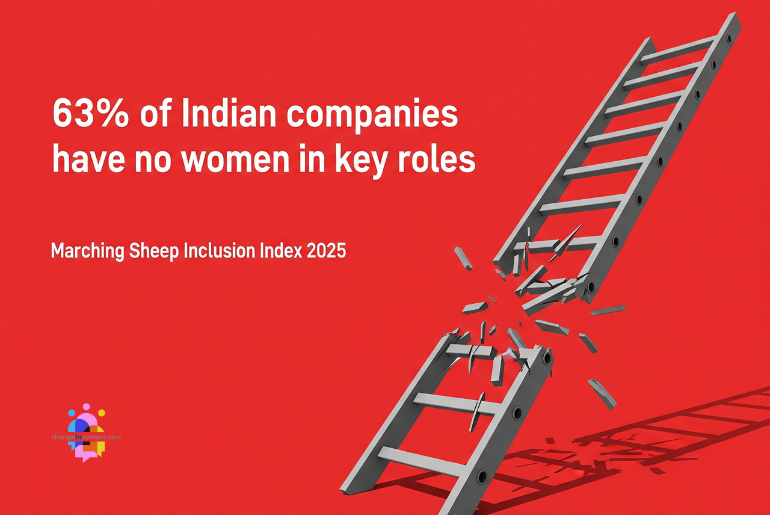
The Marching Sheep Inclusion Index 2025 has sparked a meaningful conversation. It is a conversation that compels us to look beyond boardroom tokenism and examine the structural gaps in our workforce. Gender diversity may be on paper, but what happens in practice is a different story. This article uses the Marching Sheep Inclusion Index as a lens to expose the urgent need for systemic reform.
The real meaning behind the Marching Sheep Inclusion Index
A new study by HR advisory firm Marching Sheep reveals that companies with a higher proportion of women in their workforce tend to perform better financially. According to the Marching Sheep Inclusion Index 2025, companies with greater gender diversity reported 50% higher net profits than those with less diversity.
The study analysed data from 840 listed companies across 30 sectors, including manufacturing, steel, BFSI, pharmaceuticals, FMCG, infrastructure, and IT.
Eight out of ten industries studied showed a positive relationship between the presence of women in the workforce and improved post-tax profit (PAT). However, alongside this progress, the report also highlights some long-standing issues regarding gender representation in leadership.
63% without women KMPs: The number that should shake us
While more women are getting hired into companies, they are not being promoted into top roles. Over 63% of the companies in the study had no women in Key Managerial Positions (KMPs). Overall, women made up only 22% of the workforce, despite the latest Periodic Urban Labour Force Survey indicating that the number should be closer to 28%. One of the main reasons for the gap lies in how companies approach gender diversity.
Beyond boardrooms: Where are the women in leadership?
Most companies have improved gender diversity at the board level mainly because the law requires it. Under the Companies Act, all listed companies, as well as public companies with a paid-up share capital of ₹100 crore or more, or an annual turnover of ₹300 crore or more, must appoint at least one woman director. Most firms appoint just one woman to meet the rule, without making further efforts to build gender diversity in leadership.
Moreover, beyond this legal obligation, they rarely take extra steps to support women’s growth in other key areas of the organisation. Middle management, which plays a crucial role in developing leadership skills and preparing future leaders, is often overlooked. Because companies don’t focus on creating gender balance in these roles, men continue to dominate this level, and the leadership pipeline remains uneven.
The Hourglass Effect: Women’s growth is not linear
The report employs the term “hourglass effect” to describe the phenomenon affecting women’s careers. Many women get hired at the entry level. Some make it to the top, especially if a board needs to tick a diversity box. But in the middle level, the number of women drops sharply. Without strong representation in mid-level roles, women don’t get the same chances to grow, take on responsibility, or move to KMPs.
The shrinking of middle-income jobs has created an “hourglass effect” in the job market as well. There’s growth at the top and bottom, but the middle is missing. For women, this means that most are confined to low-paying roles, with limited opportunities for advancement. It has led to concerns over potential ‘labour market polarisation’, resulting in income inequalities among women in general.
Inclusion must be more than a compliance checkbox
Sonica Aron, Founder and Managing Partner of Marching Sheep, said companies need to focus less on just hiring women and more on giving them real decision-making power. “We don’t just need more women in the room; we need them at the table, influencing decisions and shaping strategy,” she said.
In other words, it’s not enough to just have women present. Inclusion means providing people with the same opportunities, responsibilities, and recognition as everyone else. With a focus on sustainable change, the Marching Sheep Inclusion Index 2025 report urges company leaders and policymakers to treat inclusion as a core responsibility.
“The business case is closed. The call to action is urgent; listen deeply, act decisively, and reimagine leadership to reflect the world we actually live in,” Sonica Aron added.
The Marching Sheep Inclusion Index reveals what we keep ignoring
The Marching Sheep Inclusion Index 2025 reveals that companies with better gender diversity tend to exhibit improved financial performance, particularly in key sectors such as steel, pharmaceuticals, banking, financial services, and information technology (BFSI and IT).
However, meaningful inclusion can’t stop at entry-level hiring or one board appointment. Build pathways that enable women to transition from interns to team leads to decision-makers. Create roles that aren’t just supportive but strategic. We must match a diverse workforce with equally diverse leadership.
Changeincontent perspective
At ChangeInContent, we believe numbers like “63% of companies without women in key roles” are not just statistics—they are warning signs. These figures expose a chronic failure of systems that claim progress while sidelining the very people they promise to uplift. Inclusion is not about headcount; it is about power, participation, and parity.
Also Read: Disparity in entry-level jobs: Why Indian women are left behind from the first step?
Disclaimer: The views expressed in this article are based on the writer’s insights, supported by data and resources available both online and offline, as applicable. Changeincontent.com is committed to promoting inclusivity across all forms of content. We broadly define inclusivity as media, policies, law, and history. It encompasses all elements that influence the lives of women and marginalised individuals. Our goal is to promote understanding and advocate for comprehensive inclusivity.