
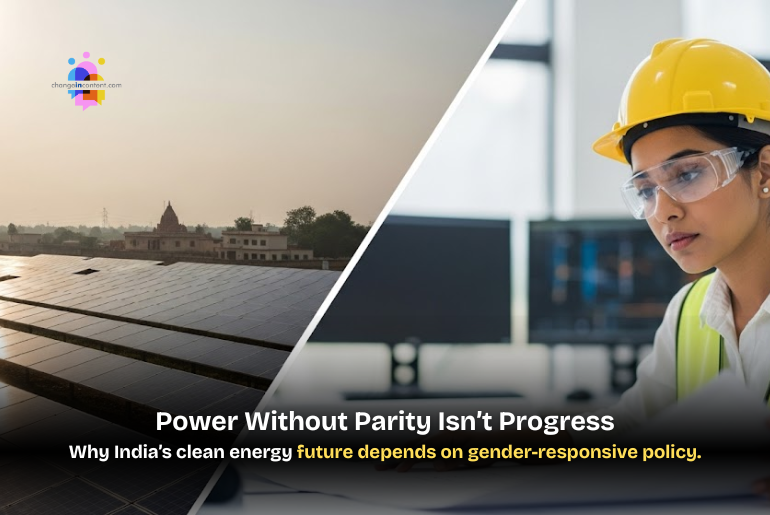
The IESA report makes it clear: gender equity in India’s clean energy future will not happen by accident. With 60% of women in the industry calling for Gender Responsive Policies in Energy Sector, the message is loud and unmissable. Without structural reform, India risks building its 500 GW clean energy dream on an unequal foundation.
At the Women in Energy Forum during the India Energy Storage Week 2025, a new report by the India Energy Storage Alliance (IESA) states that 60% of women in India’s energy sector are asking for gender-responsive policies to help achieve the country’s target of 500 GW of clean energy capacity by 2030. The study covered 26 states, including key cities such as Delhi, Mumbai, Bengaluru, Chennai, and Kolkata. It highlighted the urgent need for gender-based policy and regulatory frameworks to increase women’s participation in the energy sector.
Gender responsive policies in energy sector in India: The representation gap
Despite the rapid growth of renewable energy and storage technologies, women remain severely underrepresented in India’s energy workforce. They make up only 11% of the energy distribution workforce and hold less than 1% of leadership roles. Globally, women account for approximately 32% of the energy workforce, showing how far India still has to go. On average, there are 76% fewer women than men working in the energy sector.
The International Energy Agency (IEA) says women in the global energy sector earn nearly 15% less than men with the same skills. Fewer than 15% of senior managers in the industry are women. Only about 11% of energy startup founders are women, compared to around 18% in other sectors.
The underrepresentation of women in the energy sector creates a gender equity issue and impacts the economy. A McKinsey Global Institute study found that if women in India were given equal opportunities to work alongside men, the country’s economy could grow by an additional 27% or add $3 trillion to the nation’s economy in 2025.
Barriers holding women back
The IESA report outlines a set of challenges that continue to limit women’s participation in the sector. About 26% of respondents said they experience unconscious bias, lack of visibility, and structural barriers that delay career progression. Many called for inclusive hiring practices, leadership development programs, and institutional support that can create a supportive environment for women to grow and lead.
Notably, 14% of the women surveyed stressed that they should not remain confined to being beneficiaries of clean energy initiatives. They want to be active owners, managers, and decision-makers in India’s clean energy transition. In other words, women are asking to move from token inclusion to genuine participation and leadership.
When policies are “gender blind,” they treat everyone as if they have the same needs, opportunities, and challenges. In reality, women and men often have different levels of access to resources, decision-making roles, and job opportunities in the energy sector. Without a gender perspective, policies may unintentionally cause inequalities to continue instead of reducing them.
Government programs and industry efforts
The Indian government has rolled out several flagship programs that could open new opportunities for women in the energy sector. Initiatives such as the PM Surya Ghar, PM KUSUM, and the National Green Hydrogen Mission aim to scale up renewable energy generation and adoption. These schemes have the potential to create new jobs, training opportunities, and entrepreneurial roles for women.
However, as the IESA report points out, these benefits will only reach their full potential if gender-responsive frameworks back them. It includes designing policies that actively address barriers faced by women, offering targeted skill development, and building pathways for career progression in clean energy industries.
Gender responsive policies in energy sector: Strategies for change
To ensure meaningful change, the report recommends embedding gender-responsive policies at every stage of the clean energy value chain. It includes expanding skill-building programs, mentoring networks, and diversity-driven innovation.
The Women in Energy Forum itself demonstrated the impact of such strategies. The event brought together voices from across the energy value chain, sharing success stories and practical examples of gender inclusion in action. Vedanta Group and the CES CARE team presented how gender-inclusive initiatives have led to meaningful change on the ground, from mining sites to energy operations to circular economy practices.
In his address, IESA President Debmalya Sen highlighted that women are not simply participants in the energy transition but leaders shaping it. “There can be no meaningful progress without harnessing the full potential of women,” he said. “Their ideas, leadership, and actions are lighting the path to a better energy future for everyone.“
The forum ended with the Women in Energy Felicitation Ceremony, held under the theme “Honouring Your Inspiring Contributions in Advancing Inclusion in Energy.” It celebrated women leaders making real change in the sector. By sharing their achievements, the event encouraged more women to take on leadership roles and work toward greater equality in the industry.
The final thoughts
India’s goal for 500 GW of clean energy will need more women at the decision-making table. The IESA report shows that women are ready to lead, but policies and workplaces must make space for them with equal pay, fair hiring, and unbiased paths to leadership. Without them, the progress of women in India’s energy sector will be slower and less inclusive.
Changeincontent Perspective
At Changeincontent, we believe energy transition without inclusion is an incomplete mission. The IESA report is a call to rewire policies so they work for everyone, not just the majority. If women are to lead in the clean energy movement, the sector must dismantle its invisible barriers. These barriers range from biased hiring to unequal pay. At the same time, the industry must power a future where gender equity is as non-negotiable as sustainability itself.
Read more: 7 key ESG metrics to monitor in 2025.
Disclaimer: The views expressed in this article are based on the writer’s insights, supported by data and resources available both online and offline, as applicable. Changeincontent.com is committed to promoting inclusivity across all forms of content. We broadly define inclusivity as media, policies, law, and history. It encompasses all elements that influence the lives of women and marginalised individuals. Our goal is to promote understanding and advocate for comprehensive inclusivity.
