
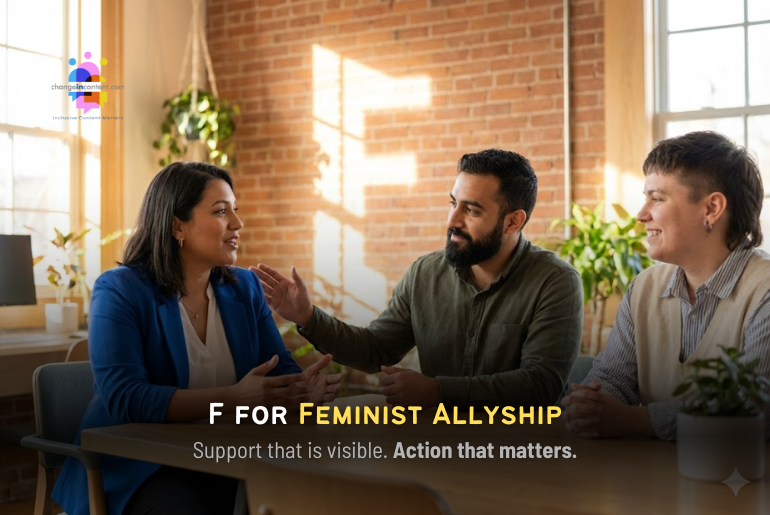
As we move forward in our A–Z Year-End Glossary, we arrive at a word that refuses to stay theoretical. Feminist Allyship is not academic, abstract, or distant. It is deeply practical. It shows up in the small moments. These moments decide whether women feel supported or silenced, included or overlooked, respected or minimised. Feminist allyship demands participation, not applause, and that is why it matters.
If previous chapters explained how ambition, bias, conditioning, and unequal labour shape women’s lives, this chapter is about what we can do in response. It is where awareness becomes responsibility.
Feminist Allyship: What does it really mean?
Feminist allyship means choosing to stand with women, and acting like it. Not just believing in fairness, but proving it through everyday behaviour. You listen without defensiveness. You learn without dismissing lived experience. You speak up when something is wrong. You use your privilege to make sure others get the space, credit, and safety they deserve.
And feminist allyship never benefits only women. When workplaces treat equality as everyone’s responsibility, men gain the freedom to show vulnerability, ask for help, share caregiving, and work without the pressure to perform invulnerability.
How to practise Feminist Allyship at work
Feminist allyship is not limited to men. Women can support other women, too. Anyone can help create a fairer and more respectful workplace. Here is how you can do that.
1. Make sure women’s ideas get heard
Research shows that women are 33% more likely to be interrupted than men. They are also 20% less likely to receive credit for their contributions. On top of that, women are four times more likely to be questioned, corrected, or dismissed during discussions. Because of this treatment, many women hesitate before speaking, and they become 2.5 times less likely to share their thoughts.
When someone interrupts a woman colleague, intervene and state that you would like to hear her complete her point. If someone repeats a woman colleague’s idea, acknowledge its original source by noting that she introduced it earlier. You can also ensure she receives equal opportunities, such as presenting in meetings, leading projects, or accessing training programs.
2. Recognise and celebrate women’s achievements
Women’s achievements often receive less visibility at work, and many women hesitate to claim credit for their own success. One recent economic study found that men receive nearly equal credit whether they publish research alone or with mixed-gender teams. Women, however, receive almost no credit when they coauthor work with men. This pattern exists across many fields and highlights how easily women’s contributions can vanish.
You can help shift this by actively recognising women colleagues’ achievements. Look for moments to highlight their work, especially during meetings or performance discussions. Form a group with your female colleagues and agree to celebrate one another’s successes regularly. This shared effort allows women to uplift each other in ways that feel natural and supportive.
3. Be a mentor, especially if you are a woman in a senior role
Women often move through their careers without the guidance and support they deserve. In the 2025 ANSR Women in Tech Report, 58% of women said they do not have access to strong mentorship at work. Another study, titled Women as Mentors: Does She or Doesn’t She?, surveyed 318 businesswomen across 19 countries and 30 industries and found that 63% had never had a mentor.
Consider mentoring a female colleague or sponsoring her for a leadership position. If you are a woman in a senior position, you are in a privileged position. You can guide younger women, share lessons from your own journey, and help them navigate challenges such as negotiations, promotions, and workplace bias.
If you are not in a senior role, you can still mentor. You can help new employees adjust, offer insights, and encourage them to pursue opportunities with confidence. Mentorship does not depend on job titles. It grows from support, listening, and consistent encouragement.
4. Use inclusive language
Using inclusive language ensures that everyone, women and men alike, feels respected, valued, and part of the team. For instance, addressing a team as “you guys” might unintentionally signal that the workplace is male-centred. So, instead of saying “you guys”, you can say “you all,” “team,” “folks,” or “colleagues.” These simple substitutions remove gender assumptions and make communication more inclusive.
5. Challenge the double standard in leadership
Women often face a likeability penalty. Assertive men are seen as confident, while assertive women are labelled “bossy” or “bitchy.” This double standard can block women from leading effectively.
You can help by speaking up when you notice unfair judgments. Ask questions like, “Would you describe a man the same way?” or highlight her actions: “Her approach was clear and effective.” Reflect on your own reactions and focus on results rather than style.
By challenging these biases, you support women in leadership and help create a workplace where competence is valued over gendered expectations.
The closing thoughts on Feminist Allyship
Feminist allyship is about action, not just words. It asks all of us, men and women, to stand up for fairness, amplify women’s voices, and challenge bias whenever we see it. Small actions, acknowledging ideas, celebrating achievements, mentoring, using inclusive language, and challenging biases, combine to create meaningful change. Every effort matters, and every voice contributes to building a fairer, safer, and more inclusive environment.
We will be back with the next letter in our year-end glossary, continuing our exploration of ways to support women and drive meaningful change in the workplace.
Changeincontent perspective
Feminist Allyship is the bridge between intention and impact. It is how workplaces move from statements to culture, from policy to practice. At Changeincontent, we believe allyship is not a favour, but a responsibility that comes with power, privilege, and presence. Every time someone steps up to amplify a woman’s voice, challenge a stereotype, or shift a conversation, they move the workplace closer to fairness. And fairness, ultimately, is everyone’s job.
Disclaimer: The views expressed in this article are based on the writer’s insights, supported by data and resources available both online and offline, as applicable. Changeincontent.com is committed to promoting inclusivity across all forms of content. We broadly define inclusivity as media, policies, law, and history. It encompasses all elements that influence the lives of women and marginalised individuals. Our goal is to promote understanding and advocate for comprehensive inclusivity.
