
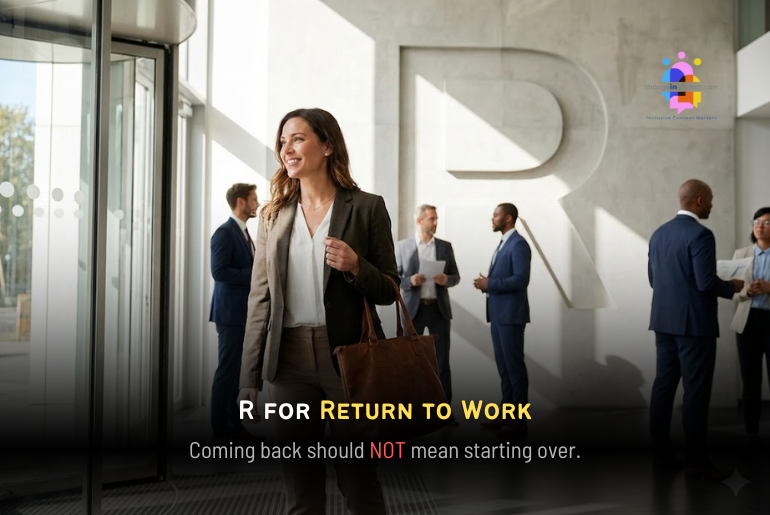
As we reach R in our A–Z Glossary on Women and Work, the focus shifts to Return to Work, a phase many women experience, yet few workplaces truly understand. Career breaks are common in women’s lives, often driven by caregiving, health, or major life transitions. What remains underdiscussed is what happens when women return, how they are perceived, and how systems respond to their return.
Millions of women step away from paid work every year. Many also want to return, rebuild, and continue their careers. The challenge is rarely a lack of ambition. It is the absence of structures that recognise non-linear careers as normal rather than flawed.
What do we mean by Return to Work?
Return to Work refers to the process of women re-entering employment after career breaks. These breaks usually arise from caregiving responsibilities, health needs, or major life changes, rather than from a lack of ambition or interest in work.
According to LinkedIn’s Economic Graph analysis, women worldwide list 43% more career breaks than men. Nearly 44% step away from the workforce due to childcare demands. Another 24% leave to care for elderly parents or other family members. Approximately 9% take breaks due to personal health needs.
In India, World Bank 2021 data shows that nearly 31% of women exit the workforce, especially from the formal sector. Many re-enter informal, unstable, or unpaid work instead. After childbirth, the drop ratio becomes higher. Approximately 73% of women stop working after becoming mothers. Only 27% remain employed or return to work.
Why does Return to Work matter?
Return to Work matters because many women want to rebuild their careers. Their decision to step away is rarely permanent. Approximately 60% of women report preferring to balance family life and professional growth, and they view career pauses as temporary adjustments rather than permanent exits. Globally, research shows that 93% of highly educated stay-at-home mothers eventually want to re-enter the workforce.
The genuine hurdle lies in how workplaces receive them.
What do women face when they try to return?
Bias often appears at the hiring stage itself. The Udaiti Foundation’s Women in India Inc (WIIn) initiative reports that women with the same qualifications and experience as men are still 24 percentage points less likely to be hired after taking a career break. The assumption that a break reduces capability continues to influence hiring decisions.
Even when women rejoin, they do not always return to roles that match their skills or experience. Many experience wage penalties and role downgrades. In India, women still earn about 34% less than men in similar roles, with career interruptions linked to motherhood being a significant factor. The 2024 Aon Voice of Women study finds that nearly 75% of women experience career setbacks of up to two years after maternity leave, while about 40% face pay cuts or downgraded positions when they return.
A large number of women leave again after re-entering because the environment around them does not support sustained participation. Long commutes, childcare challenges, lack of flexibility, family expectations, and workplace bias make continuity difficult. This is a common challenge in metropolitan cities, tier-two locations, and smaller towns, even though the pressures take different forms in each context.
How can workplaces support Return to Work better?
Barriers and challenges women face when returning to work continue because many organisations still treat career breaks as a weakness rather than a normal part of working life. Hiring systems prioritise linear careers. Work cultures expect uninterrupted availability. Policies and leadership approaches often do not recognise caregiving responsibilities as legitimate and ongoing realities. As a result, women pay a professional price for responsibilities that society routinely expects them to handle.
Meaningful support requires intention rather than symbolic gestures, such as:
Fair hiring practices
Support begins at hiring. Employers should assess skills and experience rather than penalising women for career gaps. Structured returnship or re-entry programmes, clear evaluation criteria, and supportive onboarding can help women re-enter with confidence instead of starting from a disadvantaged position.
Stable and growth-oriented opportunities
Returning to work should not mean accepting lower roles or stagnant careers. Women need clarity on responsibilities, fair role alignment, and transparent growth pathways. Access to training, mentorship, and gradual upskilling support helps them rebuild continuity without being treated as “new” professionals despite years of experience.
Support systems that enable continuity
Women do not only need help getting back. They need work environments that allow them to stay. Flexible working models, reasonable workload expectations, and practical childcare support can reduce pressure. Sensitivity toward caregiving responsibilities helps prevent repeated exits, especially in the months following a return.
Equitable pay and role alignment
Compensation and roles must reflect capability, not career breaks. Women should return to positions that match their skills and previous experience, with pay parity and transparency. Correcting wage penalties and avoiding role downgrades are essential if organisations truly value inclusion, rather than treating return to work as a favour.
The closing thoughts
Return to Work is ultimately a question of whether workplaces acknowledge real career patterns or continue to reward only uninterrupted work lives. Women are willing to return and capable of contributing at full capacity, but they need systems that recognise experience, respect career pauses, and enable continuity. When organisations address bias, role dilution, and pay penalties, the return becomes a fair transition rather than a compromise.
Women are ready to return. The real progress lies in whether workplaces are ready to receive them properly.
Changeincontent perspective
Return to work should not feel like starting from scratch. When women re-enter the workforce, they bring experience, resilience, and perspectives shaped by real-life experiences, not gaps in competence. Yet too often, systems treat career breaks as liabilities instead of lived expertise. If workplaces want to retain women, they must stop rewarding only uninterrupted careers and start recognising reality. Women are ready to return. The real question is whether organisations are ready to meet them with fairness.
Disclaimer: The views expressed in this article are based on the writer’s insights, supported by data and resources available both online and offline, as applicable. Changeincontent.com is committed to promoting inclusivity across all forms of content. We broadly define inclusivity as media, policies, law, and history. It encompasses all elements that influence the lives of women and marginalised individuals. Our goal is to promote understanding and advocate for comprehensive inclusivity.
