
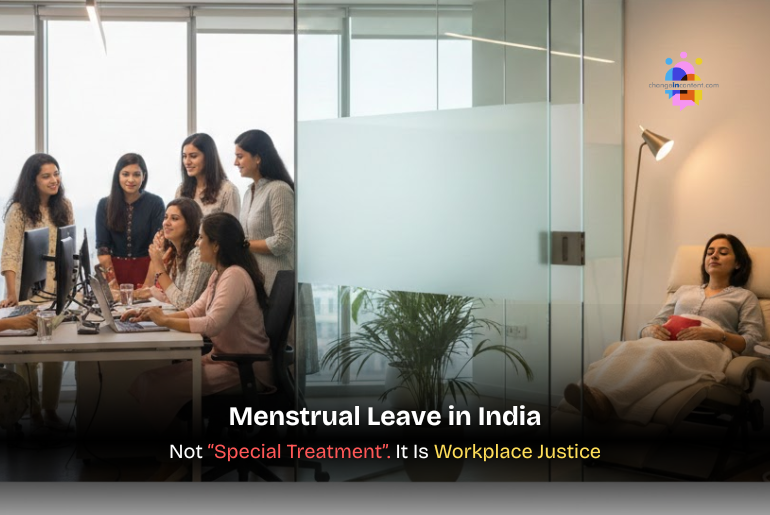
Menstrual Leave in India is usually framed as a culture-war headline: progressive versus regressive, empowerment versus stigma. That framing is lazy. It turns a workplace health reality into a morality debate, and it allows employers to keep doing what they already do best: pretend menstruation does not exist, while quietly rewarding people who show up unwell and work through discomfort.
If the goal is dignity at work, the conversation has to shift. Menstrual leave is not about “women being weak”. It concerns whether institutions have the maturity to design policies for real-world bodies, rather than corporate imagination. When a large part of the workforce experiences cyclical symptoms that meaningfully affect focus, energy, and pain tolerance, the absence of a policy is not neutrality. It is a choice.
Menstrual leave as workplace justice, not a stigma debate
At its core, Menstrual Leave is a workplace design question. Do we build systems that acknowledge employee health, or do we force employees to privately absorb the cost of discomfort so organisations can publicly perform “equality”?
India already recognises health-related leave in multiple forms. We accept sick leave, medical leave, recovery leave, and, in some corporate settings, wellness days. Menstrual leave fits the same logic: a short, periodic accommodation that protects productivity by protecting the person.
The uncomfortable truth is that many workplaces do not experience productivity losses when employees take leave. They experience reduced productivity because employees remain at work while unwell and cannot function at full capacity. It is the hidden economy of presenteeism, and it often costs more than straightforward absence.
The real productivity problem is ‘Presenteeism’
A person dealing with severe cramps, heavy bleeding, migraine, nausea, or exhaustion does not become “high-performing” because they are physically present. They become invisible labour: doing half the work at twice the emotional cost, while trying not to look “unprofessional”.
That is why it is not right to reduce the menstrual leave debate to a token benefit. When we ignore health, organisations pay anyway, just in a more extractive form: slower output, lower-quality decisions, errors that need rework, burnout, and sometimes longer-term health complications. The “discipline” narrative is simply a prettier name for institutional indifference.
India’s patchwork reality: Policies exist, but only in islands
India lacks a unified national framework for menstrual leave. We have fragmentation: a few government orders, a few state-level moves, a few institution-specific policies, and many organisations waiting to see whether public opinion turns first.
Bihar is often cited as an early mover. A state government order dated 2 January 1992 granted women employees two days of menstrual leave per month.
More recently, the question has re-entered public debate through courts and policy commentary. It also includes the Supreme Court’s concern that a mandated national policy could, unless carefully designed, trigger discriminatory hiring behaviour.
States have also continued to experiment. Karnataka’s cabinet-approved approach (one paid day per month, up to 12 days annually) shows how quickly this can become mainstream when a state chooses to treat menstruation as a workplace reality rather than a taboo.
The operational fear: “Everyone will take leave together”
This is the most frequently raised objection, and it is rarely taken seriously.
The idea that all menstruating employees will take leave on the same day rests on three weak assumptions: that cycles are synchronised, that symptoms are uniformly severe, and that the policy would force people to take leave rather than allow choice. Real workplaces handle predictable demand spikes and unpredictable absences all the time, from project deadlines to flu season to family emergencies.
The solution is not to reject menstrual leave. The solution is to design it properly.
Simple principles
A workable model has a few simple principles:
- Autonomy: Leave should be optional and self-declared. No proofs, no interrogation.
- Predictable caps: A defined monthly allowance prevents ambiguity and misuse without compromising the policy’s non-surveillance character.
- Team planning without privacy invasion: Organisations can manage staffing through capacity buffers and cross-training, rather than by asking employees to disclose intimate details.
- Flex-first options: For many roles, partial-day work, remote work, adjusted hours, or a lighter workload may be more useful than full-day leave.
If an organisation cannot handle 1 day of health accommodation a month without “collapsing”, the organisation is not fragile because of menstruation. It is fragile due to poor design.
What menstrual leave should not become
Menstrual leave becomes harmful when it turns into:
- A hiring penalty (quietly avoiding menstruating employees)
- A stigma badge (“she is always on leave”)
- A surveillance tool (medical certificates, tracking, managerial policing)
The fear of discrimination is not imaginary. That is why policy must be paired with anti-discrimination enforcement and clear accountability on managers. It is also why menstrual leave must sit inside a broader framework of workplace justice: flexible work, health support, and dignity-first management.
Our perspective: Equality is not identical treatment
India’s workplace equality conversation often gets stuck on one flawed idea: “If we treat everyone the same, we are fair.” That is not fairness. That is avoidance.
Menstrual leave is not a demand for special status. It is a demand for reality-based systems. A workplace that can accommodate human bodies is not “soft”. It is modern. A workplace that compels people to suffer in silence is not “meritocratic”. It is simply old.
It is not about biology alone. It is about power: who gets to define professionalism, whose discomfort is acceptable, and who pays the price of keeping organisations running.
Conclusion: Menstrual leave must be a policy of dignity, not debate theatre
Menstrual leave is a litmus test for how India thinks about work. If we keep treating pain as an individual problem, we will keep producing workplaces built for only one kind of body and one kind of life.
The point is not to glorify menstruation or to dramatise it. The point is to stop punishing people for having bodies. Workplace justice means health is accounted for, not hidden.
And yes, this is precisely where ChangeInContent will continue to push: fewer performative debates, more institutional responsibility. Because a fundamental change in content begins with a change in how we design work itself.
Also Read: Menstrual Leaves in India: How states and companies are redefining workplace equality.
Disclaimer: The views expressed in this article are based on the writer’s insights, supported by data and resources available both online and offline, as applicable. Changeincontent.com is committed to promoting inclusivity across all forms of content. We broadly define inclusivity as media, policies, law, and history. It encompasses all elements that influence the lives of women and marginalised individuals. Our goal is to promote understanding and advocate for comprehensive inclusivity.
