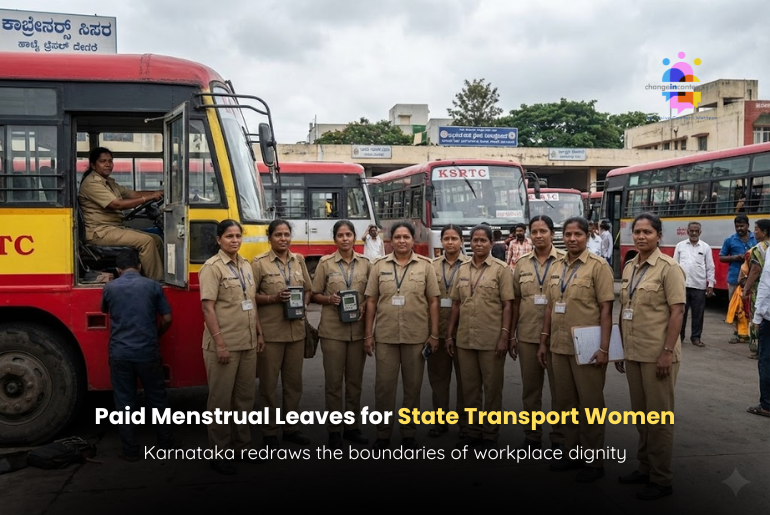
For decades, women in India’s public transport system have kept cities moving while quietly managing physical strain, long shifts, and social expectations that rarely account for their bodies. Drivers, conductors, depot staff, and field workers (many of them women) work through exhaustion and discomfort because absence is often seen as a sign of indiscipline rather than a necessity. There was no provision of menstrual leaves for state transport women.
From January 2026, that equation shifts in Karnataka.
With the approval of one paid menstrual leave per month for women employees in state-run transport corporations, the state has taken a policy decision that directly addresses a long-ignored workplace reality. The move places menstrual health within the framework of labour rights, not personal inconvenience. And in doing so, it brings menstrual leave into a sector where the cost of silence has always been high.
Menstrual leaves for state transport women: What the policy says
The Karnataka government’s directive applies to women employees aged 18 to 52 working across its state transport corporations, including the Karnataka State Road Transport Corporation, BMTC, NWKRTC, and KKRTC.
From January 1, 2026, eligible women will be entitled to one paid day of menstrual leave per month. The leave does not require a medical certificate, cannot be accumulated or carried forward, and must be taken within the same calendar month. Administratively, it will be processed through existing casual leave systems, with separate attendance entries to ensure transparency.
In practical terms, this amounts to a maximum of twelve paid days annually. It is an acknowledgement that menstrual discomfort is predictable, recurring, and legitimate, especially in physically demanding roles.
Why this matters in the state transport sector
Discussions of menstrual leave often remain abstract, centred on corporate offices or white-collar settings. Karnataka’s decision forces a necessary shift in that narrative.
State transport work is physically taxing. Long hours behind the wheel, standing for extended periods, irregular meal times, exposure to heat, and limited access to clean restrooms intensify menstrual discomfort. For many women, working through pain has been the only option, leading to fatigue, reduced concentration, and unreported absenteeism masked as “sick leave.”
By formalising menstrual leave, the policy does not reduce productivity. Instead, that makes it more honest. Women no longer have to choose between showing up in pain or risking disciplinary action. Instead, the state acknowledges that health and efficiency are not opposing ideas.
The context: How Karnataka got here
Karnataka’s move did not emerge overnight. In October 2025, the state cabinet approved paid menstrual leave for women working in private establishments under labour laws such as the Factories Act and Shops and Establishments Act. This decision followed sustained advocacy from women’s groups, labour organisations, and public health experts who highlighted how menstrual stigma directly impacts workforce participation and well-being.
The policy was later extended to government employees and, despite initial legal challenges from industry bodies citing operational concerns, public sector entities were permitted to implement it. The extension to transport corporations marks a critical phase in this rollout. It brings menstrual leave to one of the most operationally complex and male-dominated public sectors.
Menstrual leaves for state transport women and the legal balancing act
The policy’s journey through scrutiny also reveals something important about how social reform unfolds in India.
Concerns raised before the Karnataka High Court focused on ambiguity, potential misuse, and operational disruption. In response, the government clarified the scope, ensured administrative safeguards, and limited applicability to defined categories. The court’s eventual approval of public transport corporations reflects a balance between institutional efficiency and public welfare.
This matters because it sets a precedent: menstrual leave can be implemented without dismantling systems, provided policies are clearly framed and responsibly executed.
What women workers are saying
For women on the ground, the response has been largely one of relief.
Transport workers say that a formal provision validates the experiences they have long endured in silence. Many point out that menstrual discomfort does not disappear simply because we need to cover a bus route. Having a recognised option allows them to manage health without guilt or fear of judgement.
Unions have also acknowledged that such policies can reduce unplanned absenteeism and improve morale. When you address discomfort openly, workers are more likely to return focused and engaged, rather than pushing through pain that affects safety and service quality.
The bigger picture: Beyond Karnataka
While Karnataka is currently leading this conversation in India’s public transport sector, the implications extend far beyond state borders.
Globally, countries such as Japan and Spain have formal menstrual leave frameworks, whereas India’s approach has remained fragmented. It is often limited to isolated pilots or symbolic gestures. Karnataka’s policy shifts the discussion from “should menstrual leave exist?” to “how can it be implemented responsibly?”
For a workforce where women make up an estimated 20–25% of state transport employees, this move recognises that inclusion is not about numbers alone. It is about designing systems that acknowledge bodily realities rather than forcing conformity to outdated norms of endurance.
Conclusion: A policy that reframes work and care
Menstrual leave for women in state transport is outside the scope of concessions. It is a correction.
By approving one paid day of menstrual leave each month, Karnataka has reframed how public workplaces understand care, labour, and dignity. The policy does not romanticise biology, nor does it treat menstruation as a weakness. Instead, it recognises that a functional workforce allows its workers to recover, regulate, and return with agency.
As other states watch closely, the real question is no longer whether menstrual leave is feasible. It is whether public institutions are willing to design workspaces that reflect the realities of the people who keep them running.
Disclaimer: The views expressed in this article are based on the writer’s insights, supported by data and resources available both online and offline, as applicable. Changeincontent.com is committed to promoting inclusivity across all forms of content. We broadly define inclusivity as media, policies, law, and history. It encompasses all elements that influence the lives of women and marginalised individuals. Our goal is to promote understanding and advocate for comprehensive inclusivity.