
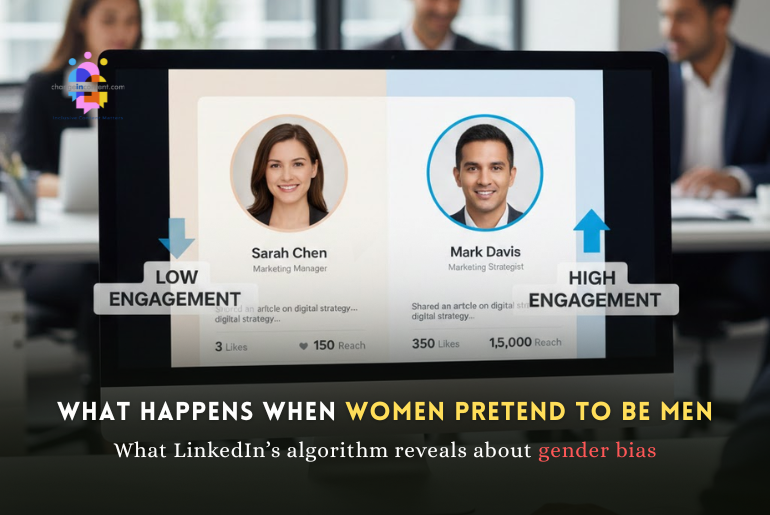
Gender bias on LinkedIn and other social media platforms shows how visibility, authority, and opportunity are still shaped by gender, even in spaces that claim neutrality.
From food orders to feeds: How gender bias travels across platforms
A few months ago, a social media trend began with something seemingly trivial. Women started placing food delivery orders using male names. TikToker Emily Joy Lemus (@emilyjoylemus) first tested this by placing the same Chipotle order at different locations, once with a male name and once with a female name. Orders under male names carried 10-30 grams more food.
Following the viral success of her video, many women shared similar stories. They reported receiving larger portions and encountering fewer issues when they used a man’s name. Some even noticed they received less food when ordering the same meal as a man sitting right next to them.
Gender bias in everyday life is not new. What made this moment different was where the experiment travelled next.
Gender bias on LinkedIn: The emergence of something concerning
On LinkedIn, women began running a similar test. This time, with careers, visibility, and professional credibility on the line. By changing names, pronouns, profile photos, or even tone, many saw their reach multiply almost instantly. Many of them experienced a significant increase in likes, views, and reach. Together, these stories demonstrate how gender continues to shape access, visibility, and opportunity.
The LinkedIn Gender Test: When masculine profiles get more reach
According to reporting by The Washington Post, gender-swapping experiments on LinkedIn showed that when women changed their profiles to appear male, their reach increased almost fourfold. Some switched their pronouns. Others adjusted their language to sound more masculine or the “bro-style” writing we see online. Soon after, their posts reached a much larger audience.
The experiment began with Megan Cornish, a mental health professional and LinkedIn Top Voice. Cornish changed her gender marker to “male” and revised parts of her profile to use more traditionally masculine language. She did not change her work experience, qualifications, or expertise. The only change came from asking ChatGPT to rewrite her bio in masculine-coded language.
Within days, her impressions increased. Cornish later wrote about the experience in a Substack post titled “LinkedIn Likes Me Better as a Man.”
After this, LinkedIn was filled with screenshots and side-by-side comparisons. Women started testing their own profiles. Many reported higher reach almost immediately.
Simone Bonnett, a social media, content, and brand strategist based in Oxford, also joined this gender swap experiment. After changing her pronouns to “he/him” and her name to “Simon E,” her profile views rose by 1,600%. Her impressions increased by 1,300%.
The speed of this change led many to question how visibility functions online.
If AI is neutral, why do women get less visibility online?
In response to these concerns, LinkedIn stated that its systems rely on hundreds of AI signals to determine what people see. The company also stated that it does not use personal details such as age, race, or gender to determine the visibility of profiles, posts, or content in the feed.
Gender bias on LinkedIn and the illusion of algorithmic neutrality
If we look more closely, the answer to the bias may lie within this explanation. LinkedIn relies on AI systems to sort and push content. These systems decide what to show based on the type of content, the user’s professional identity, and their listed skills.
What happens if the data used to train these systems already carries bias?
Can AI be fair when women build only a small part of it?
AI systems learn from existing patterns. If those patterns come from workplaces and platforms where men already dominate, the system learns to repeat the same behaviour.
Women remain underrepresented in the very field that is building these tools. Data on nearly 1.6 million AI professionals worldwide indicate a substantial gender gap. Women make up only 22% of global AI talent. At senior levels, women hold less than 14% of top leadership roles in AI. A study by Girls Who Code found that only 11% of AI role models are women.
When fewer women build AI systems, those systems reflect a narrow, biased view of success, authority, and expertise. Over time, platforms may appear neutral while quietly rewarding profiles, language, and behaviour that look more masculine. The result is not an intentional decision to favour men, but a system that mirrors old workplace gaps in a new digital form.
Read our take on Women in AI: Underrepresentation, bias, and barriers.
Gender bias on LinkedIn: The closing thoughts
Women should not need to pretend to be men to get noticed because their work already holds value on its own. When women feel the need to change their names, tone, or identity to gain attention, it shows that the system rewards gender more than effort or ability. It creates an unfair situation in which women must adjust to existing norms rather than receive recognition for their actual work.
True fairness will arrive only when visibility no longer depends on gender. That means platforms and workplaces must respond to ideas, skills, and contributions in the same way, regardless of who presents them.
Changeincontent perspective
At Changeincontent, we do not see this as a “social media glitch” or an isolated experiment. What unfolded on LinkedIn mirrors what women experience across workplaces, hiring systems, leadership pipelines, and now—algorithms.
Platforms often claim neutrality because bias is no longer explicit. But invisibility is not neutral. When women must masculinise their identities to be heard, the system is not broken. Instead, it is behaving exactly as it was trained to.
Gender Bias on LinkedIn is not about intent. It is about outcomes. And outcomes shape careers.
Disclaimer: The views expressed in this article are based on the writer’s insights, supported by data and resources available both online and offline, as applicable. Changeincontent.com is committed to promoting inclusivity across all forms of content. We broadly define inclusivity as media, policies, law, and history. It encompasses all elements that influence the lives of women and marginalised individuals. Our goal is to promote understanding and advocate for comprehensive inclusivity.
